 Brandon Fletcher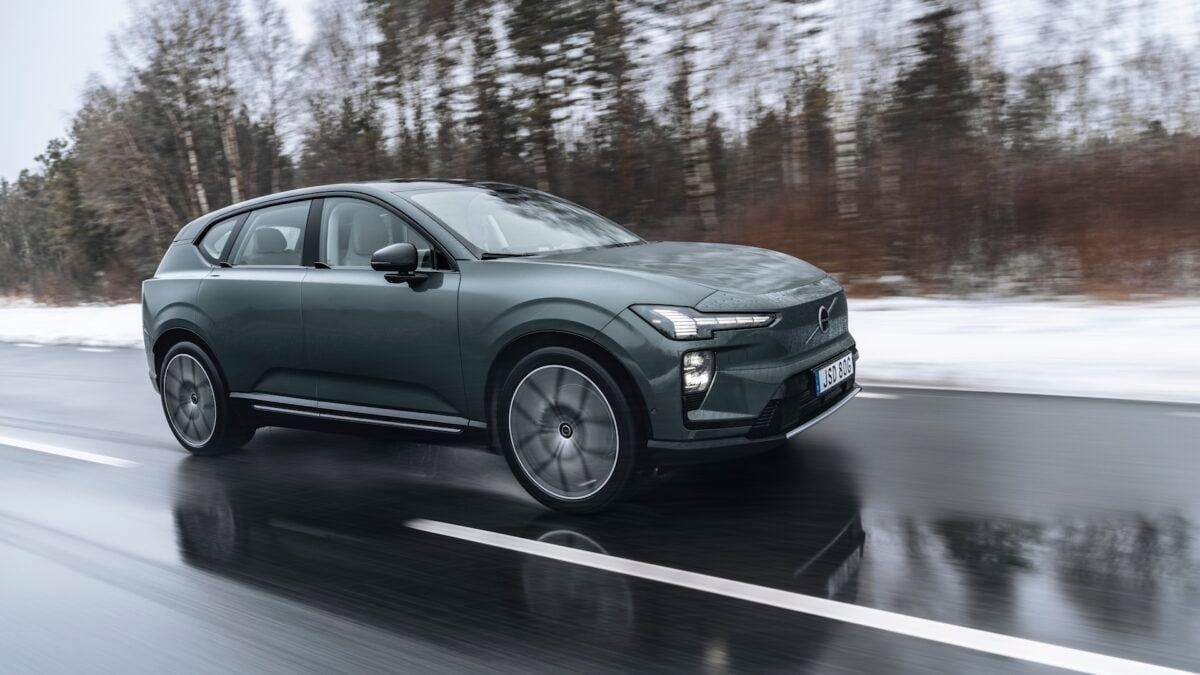

Although the adoption rates of electric vehicles (EVs) in Sweden may not match those of its neighboring country, Norway, which leads globally, Sweden’s growth is notable. The Swedish EV fleet reached a significant milestone of 15% last year, especially considering the harsh winter climate that demands extensive use of energy-draining vehicle heating for much of the year. Volvo, aiming to solidify its position as a leading EV manufacturer, faces challenges not only from the country’s climate extremes but also from inconsistent rural charging networks.
With a history of 50 years in electric vehicle technology and a presence in the U.S. market since 2021, Volvo is no stranger to this field. Despite this, previous models have not been recognized for their exceptional range, which is a crucial concern for prospective EV buyers anxious about the potential to run out of charge due to inadequate infrastructure.
Volvo is optimistic that its new Volvo EX60 will change this narrative by aiming for a remarkable range of up to 400 miles on a single charge, along with rapid DC fast charging capabilities. To achieve this goal, Volvo’s engineering team has opted not to simply add a larger battery, but rather utilize advanced software solutions to optimize the existing charge, thereby enhancing efficiency.
In a strategic move for 2024, Volvo Cars has partnered with Breathe Battery Technologies, a London-based company founded in 2019. Breathe specializes in using software to maximize charging efficiency and performance while also monitoring battery health for both automotive and consumer electronic applications.
Dr. Yan Zhao, the CTO and Co-Founder of Breathe Battery Technologies, emphasized the company’s mission in a recent interview with Gizmodo, stating, “Our company’s mission is to do more with the power you have.” This philosophy resonated with Akhil Krishnan, the Head of Program Management for the EX60 at Volvo Cars, during a winter drive from the car’s reveal in Stockholm to Volvo’s headquarters in Gothenburg, covering approximately 170 miles in challenging weather conditions. He successfully completed the journey, aided by Breathe’s innovative software designed to optimize battery performance without compromising essential vehicle functions like heating and cooling.
“We wanted to ensure that the charging stops for the EX60 would mirror the experience of refueling a traditional vehicle,” Krishnan explained. This includes achieving charge times that are comparable to conventional refueling durations. The goal is to allow the EX60 to add an impressive 170 miles of range in just 19 minutes.
Battery conditioning has become a standard practice for modern EV owners. Since the introduction of the first Chevrolet Volt and Nissan Leaf in the early 2010s, drivers have been encouraged to use smartphone applications to precondition their vehicles while charging and prior to driving. This strategy helps mitigate the impact of extreme temperatures on battery performance and allows users to maintain comfort through heating or cooling systems, similar to their experiences with internal combustion engine vehicles.
The EX60 is set to be Volvo’s longest-range electric vehicle with a target range of up to 400 miles on one version, which is anticipated to launch in the U.S. later this year. Its release will coincide with the arrival of the similarly sized and likely comparably priced BMW iX3 and Mercedes-Benz GLC electric SUVs, both of which aim for the same range benchmarks. Essentially, these vehicles are positioned as long-distance EVs, with the 400-mile range quickly becoming the new standard, surpassing the previous 300-mile goal. Enhancing battery longevity in varying climates is a primary objective for Volvo, who believes that simply increasing battery size does not provide a sufficient solution.
“For us, simply adding a larger battery is not the answer,” Krishnan asserted. Cold temperatures can not only reduce range but can also complicate fully charging the battery to 100%. Therefore, a large, costly battery may not be as beneficial as developing a more efficient overall system.
Krishnan acknowledges that Volvo’s current EVs utilize an app for preconditioning similar to those available for over a decade, yet labels it as “primitive.” He insists that the advancements made in collaboration with Breathe for the EX60 represent a much more practical evolution. Breathe’s preconditioning leverages built-in artificial intelligence that enhances safety and driver assistance features, as well as integrating Google Maps and Google Gemini technology native to Volvo vehicles. This system assesses both ambient and battery temperatures along a route to determine the most efficient way to optimize battery cells and extend the range of battery packs ranging from 80 kWh to 112 kWh, depending on the model.
“With Google Maps, the vehicle understands your destination and the prevailing temperature,” he explained. “This wealth of information allows the vehicle to alleviate long trip planning anxiety by ensuring optimal performance.”
The collaboration between Breathe and Volvo aims to have a sufficient number of EX60s on the road across various regions, enabling the algorithm to accurately predict weather and road conditions. This predictive capability is essential for conditioning vehicles before they reach different environments. Zhao emphasizes this approach is crucial for enhancing EV adoption in areas where public charging infrastructure does not meet the demand from the number of vehicles needing to recharge simultaneously.
Although Volvo Cars is an investor and shareholder in Breathe Battery Technologies, the specifics regarding the investment amount or share percentage remain undisclosed. Furthermore, the EX60 was designed to incorporate Breathe’s software from its inception, though Breathe did not influence the car’s development process.
Both Zhao and Krishnan concur that the capabilities of Breathe necessitate certain engineering adaptations on Volvo’s part or for any future automotive collaborators. The EX60 is the first Volvo EV engineered from the ground up on an 800-volt architecture, enabling seamless operation of integrated technology and supporting rapid charging time estimates. While some of Volvo’s latest EVs, such as the EX90, are adopting this 800-volt architecture for 2026, Breathe’s technology will remain exclusive to the EX60 for the foreseeable future.
Although Volvo is widely recognized as a safety-focused automaker, the company has been striving to redefine itself as a software-driven manufacturer throughout this decade. Despite facing various challenges along the way, Volvo believes it has reached a pivotal milestone with the EX60 electric SUV, which it considers a transformative event not only for its future but for its trajectory as an EV producer.
In keeping with Volvo’s minimalist Scandinavian design philosophy, the partnership with Breathe has enabled the automaker to meet its objectives without unnecessary extravagance.
“Our company’s mission is to do more with the power you have,” Zhao reiterated, highlighting the ethos that drives both organizations towards a more sustainable future in electric mobility.


 Daniel Mercer
 Ethan Carter