 David Bridges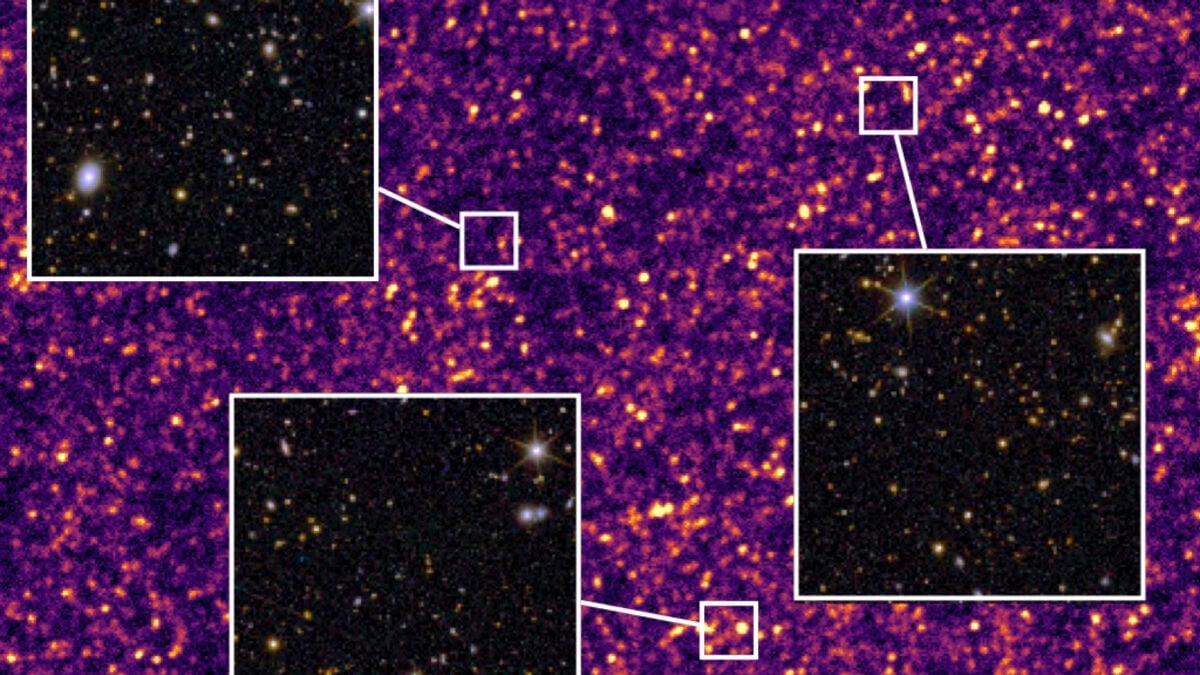

Key Insights
- Research Focus: A team of 175 astronomers used Euclid’s data to analyze the universe’s heat emissions.
- Temperature Trends: The study indicates that star formation has peaked and galaxies are cooling down.
- Future Implications: The findings suggest that the universe will continue to get colder over billions of years.
- Research Significance: The extensive dataset from Euclid allows for more accurate measurements of galactic dust temperatures.
Earlier this year, Euclid—a European telescope tasked to create the largest 3D map of the universe—sent back troves of cosmic data from deep space. Astronomers have since been hard at work picking through the stars, with one team arriving at a surprising conclusion about the fate of the universe.
By studying both Euclid’s optical measurements and far-infrared data from the now-concluded Herschel mission, a team of 175 astronomers constructed the most detailed heat map of the universe. The temperature map strongly suggests that star formation in our universe has already passed its peak rates and that galaxies have begun to cool down. In short, our universe is “already past its prime,” the researchers noted in a statement.
“The Universe will just get colder and deader from now on,” added Douglas Scott, study author and a cosmologist at the University of British Columbia in Canada, in the statement. The paper describing the results has been submitted for publication to Astronomy & Astrophysics and is currently available as a preprint on arXiv.
What Did Researchers Discover About Cosmic Dust?
For the analysis, the researchers studied heat emission data from 2.6 million galaxies captured by Euclid. Specifically, they used a stacking method to trace the evolution of stardust and relevant heat signals for the past 10 billion light-years of the universe’s history. Then, they made the appropriate adjustments to account for elements such as redshift, or shifts in the wavelengths of a galaxy as it moves away from us.
Average dust temperatures had not changed that much from around 35 Kelvin, or -396 degrees Fahrenheit (-238 degrees Celsius), in the universe’s early days, according to the study. In 10 billion years, dust temperatures fell a mere 10 Kelvin, so about 1.8 degrees Fahrenheit.
This is significant because the temperature of galactic dust is strongly linked to the rate of star formation, the researchers noted in the release. Simply put, hotter galaxies form more stars, whereas cooler galaxies form fewer stars. The small yet clear downward trends in galactic dust loads and temperatures imply that our universe is gradually becoming populated with the latter, meaning that “we’re past the epoch of maximum star formation,” Scott explained.
What Does This Mean for the Universe’s Future?
All that said, if anything is to be felt on Earth as a result of this gradual cooling, it won’t happen for at least tens of billions of years. Still, the new findings are impressive in that the astronomers leveraged a huge dataset to draw insightful conclusions about galaxies, which are considered the building blocks of the cosmos.
“In the past, researchers wouldn’t have a large enough sample or might be missing key populations of cold or hot galaxies,” said Ryley Hill, an astrophysicist at the University of British Columbia who led the research, in the statement. “Since Euclid is so comprehensive, you can really measure dust temperatures in a way you can’t argue with.”
If the universe is indeed slowing down in terms of star formation, it opens up a whole new set of questions for researchers to explore. What does this imply about dark energy or dark matter? And because this is the first batch of Euclid data, will the next rounds reveal something completely different? Will current cosmological models continue to successfully defend their reliability?
None of these questions will be easy to answer. So it seems that, even if the universe’s star formation is past its prime, humanity’s research has a long way to go.


 Daniel Mercer
 Ethan Carter