 David Bridges

As Meta continues to integrate its advanced AI models into various sectors, and X unveils its latest Grok 3 AI model, a recent report from Pew Research emerges at a pivotal moment. This report assesses the potential implications of AI on the workforce, shedding light on how these advancements may reshape our professional landscape.
Pew Research conducted a comprehensive survey involving 5,395 U.S. adults, aiming to gauge public sentiment regarding the anticipated effects of AI and the degree of engagement with AI tools in everyday tasks. The findings from this survey are crucial as they highlight the current attitudes towards AI technology and its role in our daily work routines.
The survey results reveal a prevailing sense of apprehension among workers, with the majority expressing concern about the potential ramifications of AI in the workplace. Rather than viewing AI tools as opportunities for enhancing productivity, many see them as threats to job security, emphasizing the need for a thoughtful approach to AI integration in business practices.
The data indicates that a significant 52% of respondents harbor concerns regarding the long-term impacts of AI in the workplace. Additionally, 32% of participants fear that AI could result in diminished job opportunities in the future. These statistics underscore the widespread uncertainty surrounding AI’s role and the importance of addressing these concerns through transparent communication and education.
This skepticism is understandable, as large corporations actively seek ways to leverage AI technologies to optimize operations and reduce reliance on human labor. Furthermore, even governmental agencies are exploring AI solutions to improve efficiency and streamline processes, which exacerbates fears of job displacement among the workforce.
It appears increasingly likely that certain job roles may indeed be replaced or diminished due to the rise of AI systems. However, current generative AI technologies are not yet capable of fully replacing human expertise and knowledge. While AI can assist in various tasks, the need for human insight and decision-making remains critical in many areas.
AI tools can serve as valuable complements to human expertise, enhancing overall efficiency. However, to truly maximize the benefits of these technologies, users must possess a solid understanding of their outputs, including potential flaws and inaccuracies. By recognizing these limitations, individuals can refine and improve AI-generated results, transforming them into reliable tools rather than relying on them without question.
Despite these challenges, businesses are likely to continue pursuing AI integration for potential cost savings. This trend is also reflected in survey responses regarding future job opportunities. Organizations must balance the pursuit of efficiency with the need to maintain a skilled workforce, ensuring that the human element remains integral to operations.
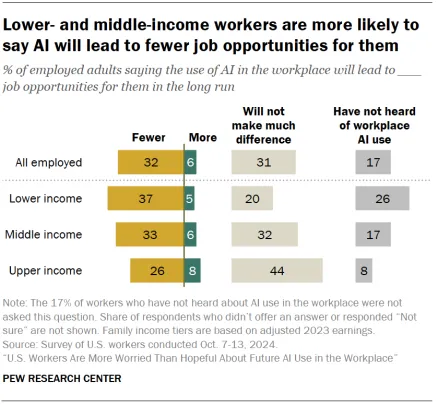
The survey reveals that only 6% of respondents believe that the adoption of AI in the workplace will result in increased job opportunities in the long term. In contrast, 32% anticipate fewer opportunities, while 31% feel that the impact will be negligible. Such findings highlight the pervasive uncertainty about the future job landscape shaped by AI technologies.
Low-income workers express the greatest concern regarding AI’s impact, as businesses increasingly turn to AI solutions for automating basic tasks. This shift can lead to more job displacement among lower-skilled positions, further exacerbating existing economic inequalities.
As anticipated, younger demographics are leading the charge in utilizing AI tools in their workplaces. This trend indicates a generational shift in how technology is integrated into professional settings, with younger workers being more adept at leveraging these advancements for their tasks.
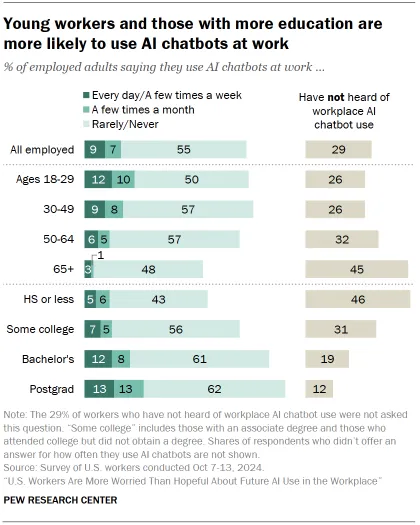
Individuals aged 18 to 29 are the most frequent users of AI chatbots at work, while those with higher education levels also show a greater propensity to engage with AI technologies in their processes. This trend emphasizes the role of education in facilitating the adoption of AI in various job sectors.
The emerging trends are noteworthy as they indicate a significant shift in workforce dynamics. It will be fascinating to observe how AI shapes the future of work, particularly as younger, AI-native audiences enter the workforce and whether the implementation of AI chatbots enhances productivity or diminishes essential knowledge and skills.
A critical concern persists: while tools like ChatGPT can provide answers, they cannot replace genuine understanding and expertise. This reality may result in more individuals achieving correct outcomes without comprehending the underlying principles or ways to refine their processes. As a result, the value of real experience and knowledge may increase in future job markets.
Regardless, the ongoing evolution of the AI landscape presents intriguing insights into how these shifts will affect various industries and professions. Businesses and individuals alike must adapt to the changing environment and find ways to leverage AI technology effectively.
For a deeper understanding, you can explore Pew Research’s comprehensive report on AI in the workplace here.


 Cameron Steel
 Tessa Everly