 David Bridges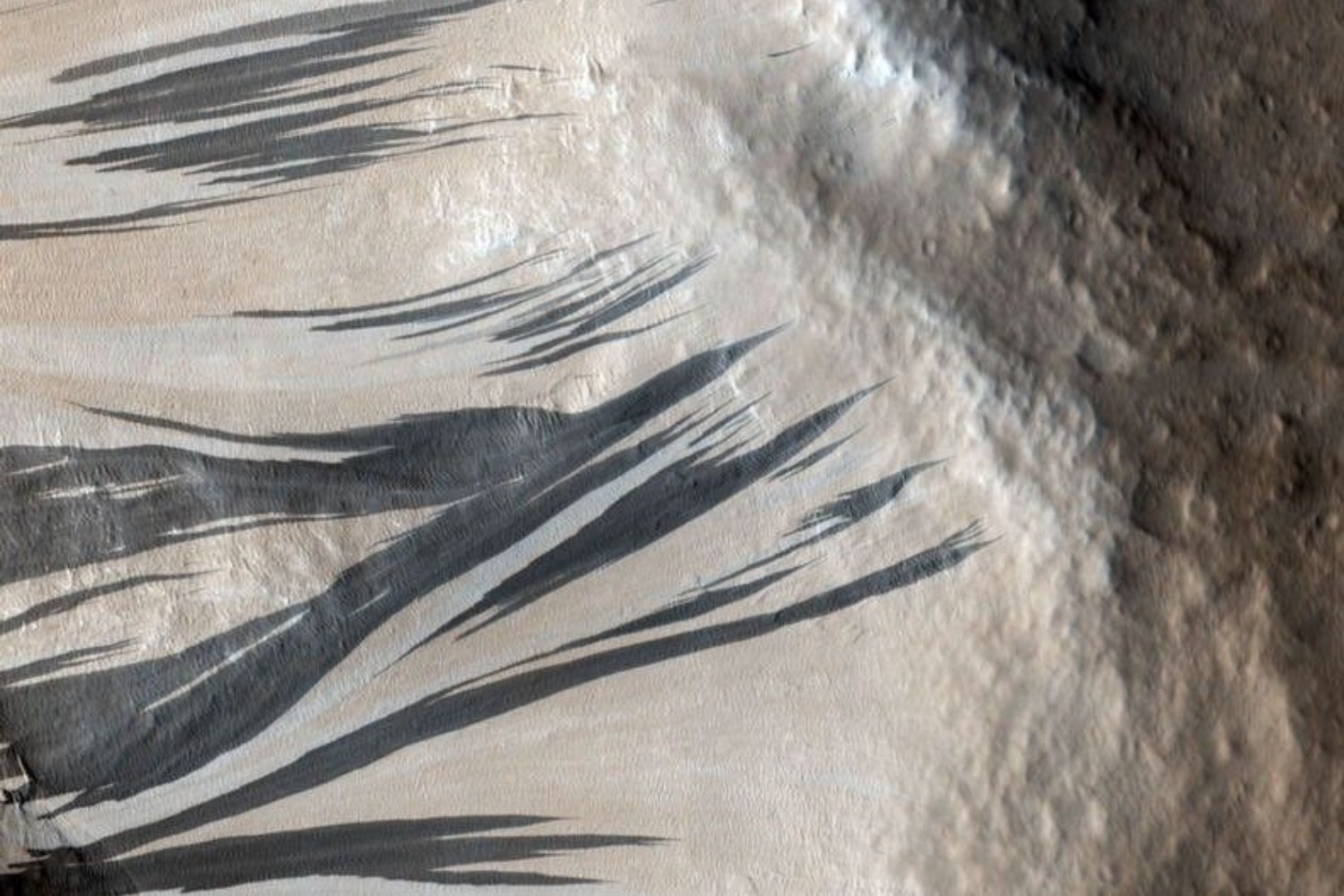
NASA’s Groundbreaking Viking Mission: The First Successful Mars Landing
In 1976, NASA’s Viking mission achieved a historic milestone by successfully landing the first spacecraft on Mars. As the mission progressed, it began transmitting a wealth of data, including stunning images of Mars’ surface back to Earth. Among these images, scientists observed intriguing long, dark streaks adorning the walls of craters and the sides of cliffs. These mysterious geographical features have sparked ongoing debates among researchers, with some hypothesizing that they may indicate the flow of water on Mars. However, a recent study has emerged that challenges this long-held belief, suggesting an alternative explanation for these enigmatic formations.

Revolutionary AI Insights Reveal the Origin of Martian Streaks
A team of planetary scientists from Brown University and the University of Bern has leveraged the power of artificial intelligence to analyze the Martian streaks, concluding that they are likely the result of wind and dirt movement rather than water flow. The implications of their findings are significant, particularly for the future of Mars exploration and humanity’s ongoing quest for potentially habitable environments and extraterrestrial life beyond our planet.
Understanding the Nature of Slope Streaks and Recurring Slope Lineae on Mars
On Mars, some of these slope streaks are notably long-lasting, while others—known as recurring slope lineae (RSL)—exhibit a more transient nature, appearing in the same locations during the planet’s hottest seasons. Despite Mars’ overall dry and frigid climate, with temperatures plunging to as low as -225 degrees Fahrenheit (or -153 degrees Celsius), it is conceivable that small amounts of water could originate from potential ice deposits, underground sources, or even humidity. This water might mix with salts, creating conditions conducive to liquid movement down slopes. Since water is a fundamental component for life as we know it on Earth, these streaks could signify potentially habitable areas on the Red Planet. However, a faction of researchers remains skeptical, proposing that these features could instead be formed through dry processes.
Utilizing Advanced Algorithms to Analyze Martian Geology
To clarify the origins of these slope streaks, the researchers developed a sophisticated algorithm trained on a dataset of confirmed sightings of slope streaks, as detailed in a recent study published in Nature Communications. This innovative algorithm was employed to meticulously scan over 86,000 high-resolution satellite images, allowing the team to construct a comprehensive map detailing the distribution of Martian slope streaks.
Exploring Correlations: Mapping Martian Conditions and Slope Streak Development
“After creating this global map, we were able to compare it against various databases and catalogs, including factors like temperature, wind speed, hydration, rock slide activity, and numerous other environmental elements,” stated Valentin Bickel, co-author of the study and a fellow at the University of Bern Center for Space and Habitability, in a statement from Brown University. “This enabled us to search for correlations across hundreds of thousands of instances, granting us deeper insights into the conditions that lead to the formation of these features.”
New Findings: The Dry Processes Behind Slope Streaks and RSLs
The findings of this study reveal that there is no significant correlation between slope streaks and RSLs and features that would suggest the presence of liquid water or even frost. Instead, the researchers determined that these Martian features predominantly form in regions characterized by high wind speeds and significant dust deposition. In essence, the development of these streaks appears to be linked to dry processes, where layers of dust suddenly slide down slopes due to external forces.
Implications of Research: Rethinking Extraterrestrial Life and Mars Exploration
Rather than perceiving these findings as another setback in the pursuit of extraterrestrial life, the planetary scientists underscore the importance of their research for future explorations of Mars. Had their research supported the idea that slope streaks were formed by water, it might have led NASA to avoid those regions temporarily. This is due to concerns that spacecraft and rovers may carry terrestrial life, such as microbes, which could contaminate Martian environments and disrupt efforts to discover indigenous Martian life.
Harnessing Big Data for Future Mars Missions: A Game-Changer
“The strength of this big data approach is that it allows us to eliminate certain hypotheses from orbit before we deploy spacecraft for on-ground exploration,” explained Adomas Valantinas, the other co-author of the study and a planetary scientist at Brown University specializing in Martian geology. This research acts as a crucial reminder that the scientific journey to uncover secrets of the universe does not always hinge upon the discovery of water or signs of life.



 Daniel Mercer
 Ethan Carter