 David Bridges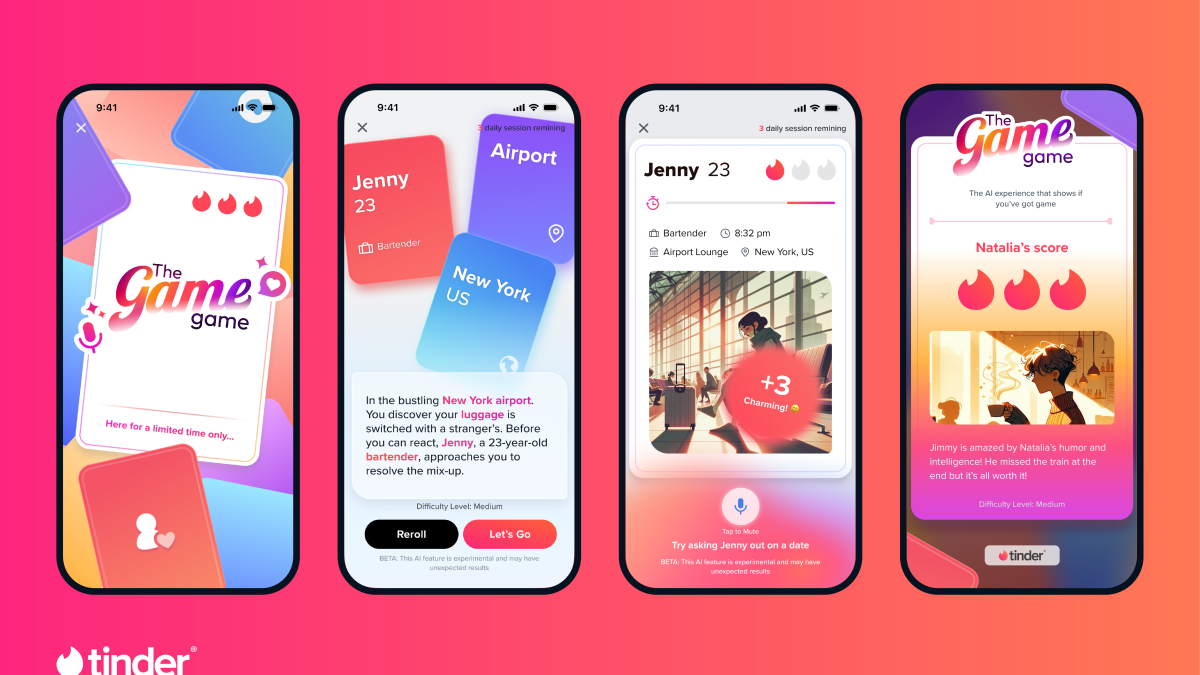
Can an AI voice bot truly assist you in securing a date? This is the innovative concept behind Tinder’s latest endeavor, partnering with OpenAI to create an engaging game experience aimed at enhancing your conversational skills.

On Tuesday, Tinder unveiled The Game Game, an interactive platform designed to refine your conversation abilities by engaging with an AI voice, powered by OpenAI’s GPT-4o model. The Game Game presents you with a “stack of cards,” each featuring a distinct AI persona and a unique “meet cute” scenario, such as the humorous situation of mistakenly grabbing someone else’s luggage at the airport. Your challenge is to successfully obtain a date or a phone number within a specified time frame, while earning points represented by three Tinder flame icons based on your performance.
Do flirty chatbots generate good IRL dates?
The time constraint is not merely a gamification tactic; it serves a greater purpose. Devyn Simone, Tinder’s resident relationship expert, explained at the launch event, “We built the time limit on purpose because this is just a warm-up. This is just a game. It is not designed to replace human conversations. Instead, it’s actually designed to encourage real conversations with real people in real life.” Additionally, players are limited to five games per day to ensure they remain focused on Tinder’s primary goal: connecting with real individuals, not bots.
Tinder is not alone in integrating AI features into its platform. Hinge has recently introduced an AI prompt editor, while Grindr tests an AI wingman to assist users. Moreover, applications like Rizz and WingAI act as AI agents that engage in dating activities on behalf of the user. However, unlike other text-based AI features found in dating apps, Tinder’s innovative game introduces a higher level of realism to the practice of dating skills through the advanced capabilities of OpenAI’s Advanced Voice Mode.
Within this game, players are incentivized to express flirty and engaging phrases that would typically sustain a conversation. “The AI rewards curiosity and warmth, listening, and asking follow-up questions,” Simone remarked during the event. “It’s not about being slick or having the best line; it’s about being human.” Furthermore, The Game Game is constructed using frameworks from social psychology, which influence scoring and offer valuable tips and recommendations for users to improve their conversational prowess.
Mashable After Dark
Despite the game’s educational aspects, it’s intended to be light-hearted and fun. “The Game Game is intentionally over the top—a low-stakes, playful experience that feels more like improv than a guide to perfect flirting,” stated a Tinder representative in a follow-up email. “It’s about helping people feel comfortable expressing themselves, not following a formula for success.”
This means the objective is to hone your skills in a no-pressure environment, ultimately boosting your confidence for real-life interactions.
My Experience Playing Tinder’s Engaging Game Game
So, what is it like to immerse yourself in The Game Game? At the launch event, I had the opportunity to give it a try. My “meet cute” involved encountering a lawyer AI persona in a bustling mall. We conversed about his shopping choices (legal books, naturally, since he was a lawyer), while I fabricated a story about purchasing an anniversary gift for my parents.
As I struggled to keep the conversation flowing, the game alerted me that I needed to ask more questions. “So, what kind of law do you practice?” I blurted out, and learned he specialized in corporate law. As I listened to his standard response about his passion for corporate law, I couldn’t help but feel as though I was navigating a genuine dating scenario, complete with forced interest and awkward small talk—made even more surreal by the fact that I was speaking to a robot.
Our time together expired before I could secure a date—perhaps I should have feigned greater interest in corporate law? Or maybe we simply weren’t compatible from the start. Regardless, I can now say I’ve experienced the peculiar situation of being romantically rejected by an AI. For context, this particular session was set at the highest difficulty level, so my pride remains relatively unscathed.
Did my flirting abilities improve? With a time constraint and a clear objective, I certainly made a concerted effort to maintain the conversation, suggesting that practice may indeed lead to enhancement after several sessions. However, throughout the gameplay, I found myself pondering how a human might react differently in the same conversation, which made the entire experience feel somewhat unrealistic.
Ultimately, that’s the essence of the game. It’s designed to be a fun exercise, encouraging you to step out into the real world and interact with actual people instead of just AI.
var facebookPixelLoaded = false;
window.addEventListener(‘load’, function(){
document.addEventListener(‘scroll’, facebookPixelScript);
document.addEventListener(‘mousemove’, facebookPixelScript);
})
function facebookPixelScript() {
if (!facebookPixelLoaded) {
facebookPixelLoaded = true;
document.removeEventListener(‘scroll’, facebookPixelScript);
document.removeEventListener(‘mousemove’, facebookPixelScript);
!function(f,b,e,v,n,t,s){if(f.fbq)return;n=f.fbq=function(){n.callMethod?
n.callMethod.apply(n,arguments):n.queue.push(arguments)};if(!f._fbq)f._fbq=n;
n.push=n;n.loaded=!0;n.version=’2.0′;n.queue=[];t=b.createElement(e);t.async=!0;
t.src=v;s=b.getElementsByTagName(e)[0];s.parentNode.insertBefore(t,s)}(window,
document,’script’,’//connect.facebook.net/en_US/fbevents.js’);
fbq(‘init’, ‘1453039084979896’);
fbq(‘track’, “PageView”);
}
}


 Daniel Mercer
 Brandon Fletcher