 David Bridges

It feels like it’s gone by way too fast, but 2025 is almost over, which means that you probably should be mapping out your 2026 marketing plan, in order to ensure that you’re maximizing your opportunities.
But how can you plan ahead with so much change on the horizon? AI, for example, is changing entire industries, yet, at the same time, it’s not having the expected level of impact on others. AR glasses are now closer than ever, with the launch of Meta’s Display wearables, while VR is also evolving fast.
Will these have major impacts on your marketing plan for 2026?
To assist in your planning, here are 36 predictions for social media marketing in 2026, looking at each platform’s key areas of focus.
And historically, my predictions have been pretty accurate (you can check my predictions for 2023, 2024 and 2025 for reference).
Here’s what I expect to see coming from the big social apps.
Key Insights
- Planning Ahead: 2026 marketing strategies should consider rapid changes in technology, especially AI and AR.
- Social Media Trends: Predictions provide insight into platform-specific focuses, essential for effective outreach.
- Facebook’s Role: Facebook remains a vital platform with over 3 billion users for marketing campaigns.
- Algorithm Changes: Potential court rulings on algorithm use could influence content visibility and engagement.
<span><span><span>Facebook</span></span></span>
Despite losing its luster, and its position as the cool app, Facebook remains the most used social platform in the world, at over 3 billion active users. The platform is part of how many people live and connect, and as such, it’s also a key consideration for marketing outreach, and getting your promotions in front of the right people.
And with its evolving AI ad tools, that’s getting easier to do.
Here are some of the things that I expect to see from Facebook in 2026.
Non-algorithm trial
This may seem like a minor story, and another consideration that Meta will be able to sidestep. But earlier this month, a Dutch court ruled that Meta must provide a more accessible, permanent option for users to opt out of its algorithmic news feed, switching them to a purely chronological timeline instead.
Which Meta wants to avoid, because usage of its apps invariably declines if it’s not using the algorithm to highlight relevant content to each user. Facebook also now gains a heap of benefit from Reels, which are recommended to users and highlighted in feeds, and without the capacity to showcase such, that will have big impacts on audience engagement.
But if this is upheld (Meta’s going to appeal the ruling), it could give us the first large-scale test of what happens if algorithmic amplification is removed, and the impact that has not only on usage, but also on polarization, angst and disagreement prompted by social media exposure.
Algorithms aim to highlight whatever generates engagement, and the best way to get a response from social media users is to evoke fear, anger or joy. As such, algorithms effectively incentivize publishers and creators to post content that sparks this type of response, which undoubtedly has a big effect on our broader consumption of information.
And when you also consider that Facebook is a key news source for many users, those incentives no doubt drive publishing decisions to a significant degree, driving more hate and division for the sake of performance.
What happens if that incentive is removed?
I don’t think that this is a solution, as such, to the many ills of the modern news cycle, but I do think that it’s worthy of an experiment, and if the Dutch court decision holds, we may well get just that.
And you can bet that many regions will also be watching on to see whether the removal of algorithms has an impact on news consumption behaviors, and their broader impacts as a result.
This is an element to keep tabs on, because I suspect that many are looking for answers as to why our informational system is so broken, and even if the decision is appealed, more regions may still consider similar pushes.
Integration with Horizon Worlds/focus on avatars
Meta really wants to make the metaverse a thing.
Yes, the metaverse is still a longer-term goal for Zuck and Co. He may have gotten his feelings hurt when people criticized his Eiffel Tower image, and Meta may have opted to tone down the metaverse talk due to negative reception, and shifted its focus onto AI instead.
But the VR-enabled metaverse is still on Meta’s longer-term radar, and as such, you can expect to see more metaverse-related integrations in its apps moving forward.
But rather than going all-in with flashy product demos that don’t reflect reality, Meta’s going to quietly add in more features that will eventually feed into its expanded digital experience.
On this front, you can expect to see the steady integration of features that tie into its Horizon Worlds VR social environment, including more ways to use your Facebook and Instagram avatars in its apps.
Expect, also, to get more ways to “visit” metaverse experiences from these apps, like interactive video and games, with Meta looking to enable VR creators to showcase their worlds in all-new ways.
Meta’s also looking to make VR creation more accessible, with conversational AI prompts now enabling anybody to generate a VR environment by simply speaking it into existence.
And as the next generation of users ages up, and out of the Roblox/Minecraft/Fortnite open world ecosystems, where they’ve conducted much of their developmental social activity, these types of interactive experiences will be a logical progression into more engaging, immersive social experiences.
It may not be the immediate future, but expect Meta to keep planting seeds that will encourage users to interact with metaverse-related elements.
Footage captured through glasses will get boost
Meta’s camera-equipped, and now AI-enabled smart glasses have become a big hit for the company, and with its new Display glasses now also in circulation, Meta will be looking to boost adoption, as a means to drive more opportunities for an expansion of its connective products.

Indeed, Mark Zuckerberg has expressed his ambition to see digital glasses supersede phones as our key connective device, with ever-advancing models facilitating all-new experiences and making Meta a bigger part of our everyday experience.
And if Meta can get more people using its glasses, that will help to embed its tools as the best option, amid rising competition in the space. As such, I expect to see Meta put more emphasis on content created through its AI glasses, as a means to get more people interested in buying their own.
The more useful the glasses are, the more people will buy them, and with a growing range of video content being captured through these devices, Meta now has an expanding library of content to showcase such.
Expect to see Stories captures through glasses appear with a different colored ring, and expect to see new glasses watermarks on video thumbnails too, as Meta seeks more ways to essentially advertise its devices through this material.
It’s a key opportunity for Meta to shift more units, and the more people that buy in, the stronger its hold will be on the wearables market.
Product search in Meta AI
Meta recently announced that it’s going to be using your Meta AI queries in its ad targeting system, which will give it a heap more insight to pull from in targeting its ads.
That’ll also present significant opportunities for specific product promotions, based on product-related queries, and as such, I expect to see Meta looking to prompt more shopping-related activity within its AI tools.
It’s already moving in this direction, with the addition of AI chatbots that can be used on external sites, with the information from those conversations then coming back to Meta to use for more specific ad targeting.
Basically, the more product queries Meta can drive, the more targeted its ads become, and it’ll no doubt be seeking more ways to prompt people to ask its AI tools for more product info.
On a related front, Meta’s also looking to integrate ads directly into its AI answers as another ad display option.
A lot of the value here does depend on Meta AI usage, but Meta says that its AI chatbot is the most used in the world, and the more it can get people using it, the more info it will have to further hone in its ad systems.
Friend highlights
Every year or so, Facebook seems to make an effort to get people sharing more personal updates in the app, and “get back to its roots” as a social engagement platform.
That hasn’t been overly effective in recent times, as people have changed their engagement behaviors online, but expect Meta to keep trying to push this angle, and seeking more ways to get people to engage with friends and family, as a means to maintain the value of the app.
My guess at Facebook’s next experiment on this front will be a friend highlights panel in-stream, which will showcase which of your connections, or extended connections, have shared new updates recently.
Facebook already shows you when people in your search history have posted new updates, and this is essentially the same thing, but with a dedicated breakout panel that will appear as you scroll, prompting you to check out the latest updates from people you know.
The concern for Facebook is that as more people come to the platform for Reels, that actually reduces its unique value proposition, and as such, it wants to reiterate that Facebook is the place where you connect with the most important people in your life, which is why it remains important.
Showcasing friend updates, in between the influx of Reels, could be another way to do this.
AI profiles
Earlier this year, reports suggested that Meta was exploring the possibility of integrating millions of AI-powered profiles into its apps, which would then interact and engage as if they were actual people.
This feels like a risky proposition, as the backlash could be significant if Meta gets it wrong. But it would also make a lot of Facebook users feel better, by giving them that dopamine hit of recognition, through likes and comments, on their posts.
So will Facebook actually do it?
I suspect that Meta is already trialing this to some degree, and that AI profiles will become more prominent over time, and will contribute to boosting engagement behaviors in the app.
Whether they become overwhelming, and overwhelmingly obvious, is another consideration, but I do think that Meta’s keen to explore the capacity of its AI-powered personas, and whether they can effectively pass as real people and drive more activity.
Instagram recently became Meta’s third 3 billion user app (after Facebook and WhatsApp), and has continued to establish its place as a key connective platform for many, many users.
And despite IG taking most of its “inspiration” from competing platforms, that has actually proven to be a successful strategy, helping to ensure that it remains relevant, even when faced with competition.
Yet, at the same time, IG hasn’t been radically innovative, and has really only evolved based on broader trends.
Will that change in 2026?
Managing the AI wave
While Meta’s super keen to push ahead with its AI tools, and enable users to generate their own AI content, that also comes with problems, in terms of fake depictions, misrepresentation, abuse of IP and more.
That’s actually been a key early selling point of OpenAI’s new Sora app, giving users the capacity to insert themselves into Hollywood movies and TV shows, though publishers and rights holders are already pushing back, and seeking to enforce restrictions on the use of such depictions in AI generations.
Instagram will also face many of the same concerns, as users look to republish and reshare AI content there, while IG will also have to improve its labeling and transparency measures, to counter the growing wave of AI content.
We’re already seen Meta implement more measures to tackle “celeb-bait” scams, where depictions of famous people are used to promote products without their consent. AI generation will only exacerbate this, while the more that IG moves away from human-generated content, the more, I suspect, people will lose interest.
As such, I expect to see stronger enforcement of AI labeling, and more action to address the use of AI depictions.
Open to Reels
You may like Instagram as it is, opening to the main feed, with Stories on top, showing you the latest image posts from profiles that you follow.
But that doesn’t align with how people now use the app.
Reels now make up 50% of all time spent in the app, and with Reels playing such a big part in Instagram engagement, it makes sense for IG to at least consider opening to Reels as the main focus.
Which it’s already testing with selected users in India.
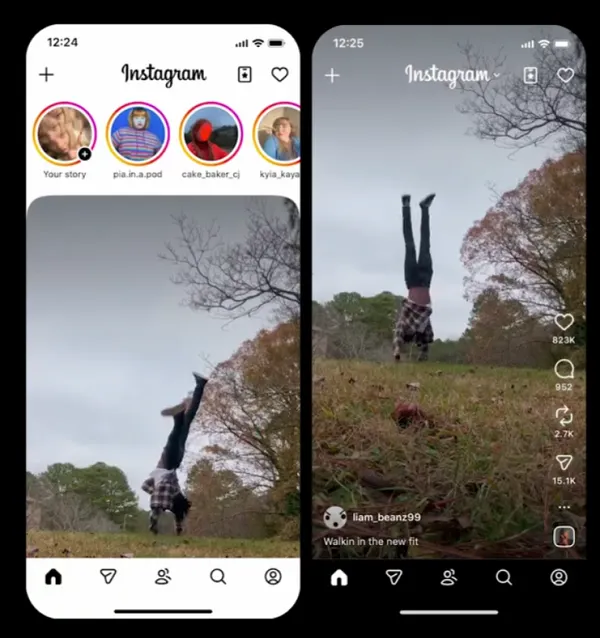
That’s going to become a broader test, and again, given that Reels do drive so much more engagement, I suspect that this will yield good results, and that Instagram will look to give more people the option to open to a Reels feed, more akin to TikTok.
It’s a pretty safe bet, given the stats, but yes, I do expect that the traditional IG feed will be further relegated in 2026.
If you’re a fan of OG IG, it may have only a short time left.
Charging for Edits
Instagram’s new video editing app Edits has been a big hit, providing an alternative to TikTok’s CapCut as a simple, valuable mobile video editor.
But ever since launch, Instagram has warned that, like CapCut, it may eventually have to charge users to access the full feature set in the app. That particularly relates to AI features, and as Edits gets more AI editing and creation tools, I suspect that Meta will switch to a paid model for the platform around the middle of next year.
It’s a smart process, building a valuable platform, establishing a solid user base, then introducing a subscription model. And given its utility, many people will pay, providing Meta with another revenue stream, and giving it more reason to continue investing in additional editing tools for the platform.
Creators pay to boost reach
Creators are another key consideration for Meta’s future, which relates not only to posting original content in the app, but also in terms of influence and driving new experiences.
Because as Meta has repeatedly shown, its internal developers and engineers are not great at coming up with interesting, original and creative options.
Snapchat has been much better at this front, rolling out tools that align with platform usage (which is why Snapchat+ is so popular), while TikTok has also shown more understanding with its updates and features.
Adding cool, original features has never been Meta’s strong suit, so it’s relying on its creators to come up with more engaging options to help keep people coming back to its apps. That’s true for Instagram now, and for the metaverse in the future, and as such, you can expect Instagram to keep rolling out new options to help creators make money and build their presence in its apps.
Part of that will likely be a simplified post boosting options to increase the reach of posts that are gaining traction organically.
X recently added similar, offering creators additional reach at variable pricing thresholds.
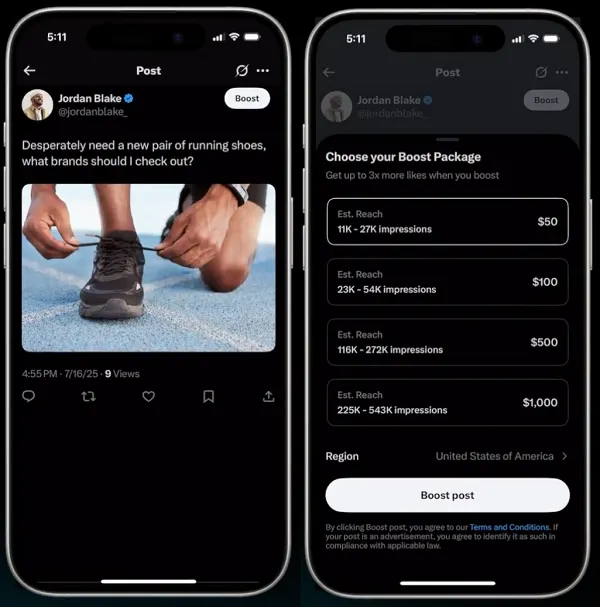
Instagram will likely add the same, making it as easy as possible for creators to get more traction for their content, while also driving more incremental ad revenue for the app.
Of course, that isn’t a heap different from the current Boost option that’s available on posts. But like X, I expect to see IG add simplified boost packages, which will make it easier to amplify your posts in a few clicks.
Threads
After establishing itself as a real player in the social media ecosphere, Threads gets its own breakout section in this year’s predictions, with the platform now on track to become the leading real-time social network, beating out X for total users.
It’s not there just yet, but Threads now has 400 million actives (versus X’s 600 million), and some reports suggest that Threads is already overtaking X for daily active users.
So what comes next for Meta’s “friendlier” version of Twitter? Well, for one…
Threads becomes bigger than X
Given the trend data, this is pretty easy to project, but yes, Threads will exceed X in active users sometime next year.
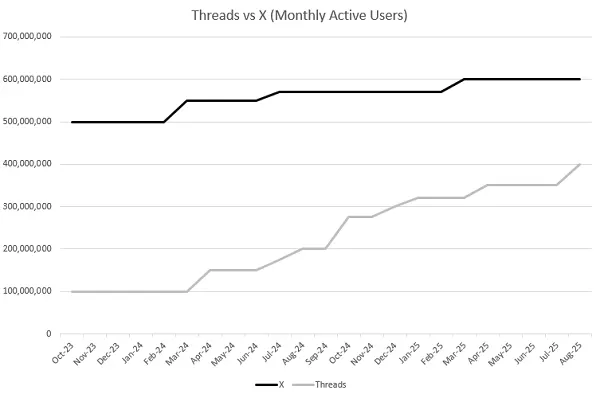
As you can see in this chart, Threads is rapidly gaining on X in monthly actives, and is clearly on a path to becoming the leader in the real-time social race.
So when will Threads overtake X?
Well, going on the last year of growth data, Threads is adding around 50 million more users every four months, which would suggest that around this time next year, Threads will overtake X in total usage. Though at the same time, growth momentum also tends to increase as more people come to an app, while X’s usage is also declining, based on the available usage data.
As such, it’s hard to pinpoint exactly when the scales will tip towards Threads as the definitive real-time news and information app. And really, the proof will come during major events. Many people still turn to X to stay up to date with the latest news and information, but when they start turning to Threads instead, the shift will be evident.
And it feels like that’s already starting to happen, at least to some degree, around major breaking stories and events.
By this time next year, I don’t think there’ll be any doubt.
Separating from IG
Threads also needs to enact further separation from Instagram, and the connection of interest graphs between the two platforms.
Because the profiles that people follow on Threads will often bear little resemblance to what they follow on IG, and as such, using this as a proxy, and showing users recommendations based on their IG activity, feels like a step backwards for Threads, which is rapidly developing its own identity.
Meta has already stopped showing follow recommendations to new users based on their IG activity. It now needs to separate the two entirely, in order to give Threads its own personality and feel.
Trend highlights in feed
Trending topics is another key to Threads’ growth, and it’s looking for more ways to show people more relevant discussions, through search recommendations, communities, and more.
Expect Threads to make this a bigger focus, with a more structured Search tab, highlighting breaking news in real-time (more like X), as well as relevant trend highlights in-stream, showing the top trending topics related to your interests.
Again, people still revert to X when breaking news is happening, as it tends to be better at showing the latest updates in real time, while many influential users also still post to X first out of habit. Threads needs to break that paradigm, and it can do it by ensuring that real-time discussions are better highlighted to users in-stream.
Algorithmic improvement
Which also leads into the final point, in improving the Threads algorithm to ensure more relevant, real-time content is displayed in user feeds.
Meta has repeatedly touted the development of its AI systems, and the capacity of its AI tools to uncover increasingly relevant, valuable insights for users. It needs to put that to work in Threads, ensuring that increasingly engaging suggestions and highlights are shown to people, based on what other Threads users are discussing, not what’s trending on IG.
Threads has already improved a lot on this front, but the more in-tune it can make its algorithm, the more likely that people will feel informed and empowered by the app.
X
Despite massive staff cuts, the loss of its CEO, reduced advertiser interest and declining usage and engagement, X continues to see steady usage, with (reportedly) over 600 million people coming to the app every month.
Though that is debatable. X is not obligated to provide regular usage updates (as it’s no longer publicly listed), and the only official usage data that it does report shows that usage is declining, not growing.
X had 570 million users in July last year, and it now claims that’s risen to 600 million. But the data we can access would point to the actual number being lower, not higher.
Mathematical anomalies aside, X still remains a key platform for many millions of users, and despite seemingly losing its shine, and declining in broader popularity, it may still be a relevant consideration for reaching your target audience.
The pressure is on
Make no mistake, X is under pressure to perform, and get its ad business back on track.
X owner Elon Musk has warned, at various times, that the platform is “barely breaking even,” even after culling 80% of its staff, and if it can’t improve its ad revenue intake, it may not be a viable business moving forward.
The equation here has changed somewhat in recent months, because Elon’s AI project, xAI, acquired X back in March, which means that the billions in funding that xAI has raised (and is raising) can also be shared with X, which is the key data input source for Musk’s AI models.
But really, both projects will suffer if X continues to decline.
If X can’t make money from ads, then it’ll need to take more money from xAI’s funding, and with several major AI datacenter projects underway, xAI needs that money to continue its operations.
And if fewer people post to X, that will also reduce xAIs real-time data pool. So X’s failures will also impact Elon’s AI push, if it can’t turn things around.
Though there have been some positive signs on this front.
X has generated more revenue in 2025 than it did last year, after several big advertisers came back to the app following the U.S. presidential election. Though X’s revenue intake has fluctuated throughout the year, with Musk’s own political activity and stances seemingly still having some impact on external considerations. But the data does suggest that X might still be able to stage a recovery in its ad business, which it’s working to do through improved AI targeting tools.
But right now, X’s future remains precarious, even with the world’s richest man at the helm. X needs to make money in its own right, and if it can’t, that’ll lead to a range of flow-on impacts. Which are unlikely to end X in 2026, but they will prompt more questions about X Corp’s broader viability.
Community Notes concerns
Another concern with X’s declining usage is the relative decline in contributions to Community Notes, its crowd-sourced “solution” to content moderation.
Conceptually, Community Notes makes a lot of sense, in empowering users to decide what deserves to be “noted” and what doesn’t, effectively putting moderation into the hands of the user community, sort of like Reddit does with its up and downvote system.
That’s been an effective approach for Reddit, through a simple, direct feedback process that then displays posts accordingly, based on user response. But the in-built mechanisms to eliminate political bias within Community Notes (which are likely a necessary measure, to be clear) have rendered them largely useless for some of the worst kinds of misinformation, enabling many false and misleading reports to proliferate in the app.
So it hasn’t ended up being the solution that X had hoped, and if X’s overall usage numbers keep declining, that, inevitably, will also mean fewer Community Notes contributors, and in particular, fewer contributors from opposing political perspectives.
Essentially, Community Notes only works if you have enough people making and assessing notes in the app. The more feedback you have, the better the system will be, but the reverse is also true, and with X’s usage sliding, that’s clearly going to pose a problem for moderation.
Which will result in more bias, more false information going unchecked, and X will eventually just become Truth Social 2.0, if it hasn’t already.
This is a compounding issue, relative to overall usage, and eventually, that’s going to weigh down X’s engagement, while also impacting the data that xAI processes for Grok outputs.
It’s a harmful circle, which doesn’t bode well for X.
X Money
Hey, remember how part of Elon Musk’s grand plan for X “the everything app” was enabling payment transfers in-stream?
That was actually a foundational element of his plan for X, stemming from his time working on PayPal, and in 2023, Elon said that it would “blow my mind” if payments were not available on X by the end of 2024.
But they’re not available yet, and they’re seemingly not on the horizon either, as X continues to grapple with relevant licensing in U.S. states.
So does that mean that X Money is no longer on the cards?
I suspect that we will actually see some version of this become available in the app next year, with Elon pushing to get payments active, in some form, even if it can’t fully enable all transaction types in all regions.
But the bigger question is, will people use it?
Will people really want to transfer money on X, and rely on the app for financial services, or to buy products in-stream?
There’s not a lot of precedent to suggest that this will be a popular option even if it is made available, but given the significance of payments and financial service elements within Musk’s plan, I do think X will try it out, either way.
Which will also give businesses the opportunity to potentially sell products direct in the app. This logically follows if payments are enabled, and that could be another consideration for your X approach.
Monetizing adult content
Overall, I do think that X is going to be facing a tough time in 2026, and that it’s going to be looking for any way that it can to eek out more money from its various offerings and services.
One avenue that it could explore is enabling adult content creators to sell subscriptions in the app, getting into OnlyFans-style territory, which Twitter did actually investigate once before, but opted not to activate, due to concerns that it couldn’t adequately police harmful sexual content.
But X already hosts a lot of this type of material in the app, and I suspect that Elon would be less concerned about such.
Maybe, X’s own version of OnlyFans could be a winner, while it would also tie into X’s AI companion bots that can engage in NSFW activities (and could maybe also be monetized under this approach).
<span><span><span>LinkedIn</span></span></span>
LinkedIn has seen a big surge in attention following the demise of Twitter (and the decline of X), which has pushed more business-related online discussion towards the app.
And like all platforms, LinkedIn is now seeing a lot more engagement with video content, opening up more opportunities to engage its professional audience with relevant promotions aligned to their specific needs.
Here’s what’s likely on the horizon for the Professional Social Network.
Mapping career paths
A unique benefit of LinkedIn’s unmatched pool of professional insights is that LinkedIn is the only platform in existence that can provide a realistic, informed overview of your likely career path, based on personal history, education, experience, interests, etc.
For years, LinkedIn has been trying to harness this, with simulations of likely career trajectories, “Career Finder” pathways for university graduates, and more. But none of these have ever caught on, either due to non-correlating career trajectories or data usage concerns.
But with AI, LinkedIn may finally be able to provide more accurate guidance for your ultimate career path, based on insights gleaned from the 1.2 billion profiles in the app.
It’s difficult to build a system that can parse this amount of data, and exclude false anomalies and misrepresentations. But AI tools provide LinkedIn with more capacity to do this, and next year, I would expect to see more guidance tools that highlight relevant career opportunities, as well as LinkedIn Learning courses you can take, open positions and more.
AI will effectively supercharge LinkedIn’s capacity on this front, and once it gets the system right, this could be a hugely valuable resource for career building.
Video feed
As noted, like all social media platforms, video has become a key engagement driver on LinkedIn. Video watch time is up 36% year-over-year in the app, while video posts are also now shared 20x more than any other content type.
As such, you can expect LinkedIn to make video a bigger focus in 2026, through broader expansion of its dedicated, full-screen video feed (accessible via the lower function options), and a bigger focus on live-stream events.
LinkedIn has already rolled out its dedicated video feed in some regions, making it easier to flip through video updates in the app.
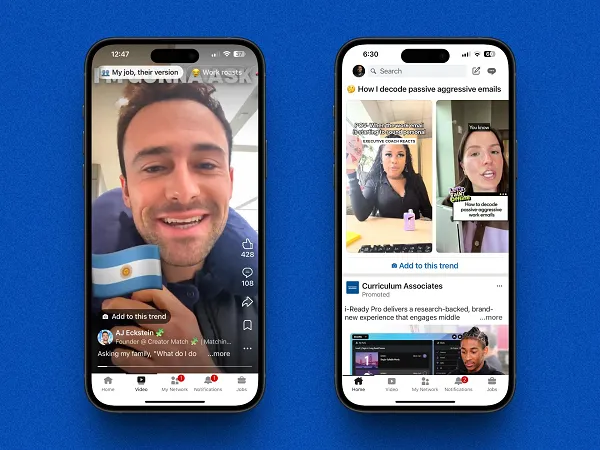
That’ll soon come to all markets, while I also expect LinkedIn to put more emphasis on live video events, highlighting the power of LinkedIn to connect users to professional insights.
This is a key opportunity for the app, showcasing major industry gatherings and conventions within dedicated feeds in the app, and helping to connect users from around the world into these important conversations.
The more LinkedIn can lean into this, the more valuable its video feed will become, and I expect to see it partnering with some well-known events for these presentations.
LinkedIn Learning quick sessions
LinkedIn Learning has also become a valuable addition, providing an easy way for members to improve their skills, particularly in rapidly evolving areas like AI.
As such, I expect LinkedIn to better highlight more of its educational content, through quick, 3-minute education updates that people can undertake in-stream.
This would be like the TikTok-ificiation of educational material, giving users a means to stay up to date without any major time commitment. If you can teach people one skill per day, surely that’s more valuable than having them play an in-stream puzzle game, while it would also serve as an entry point to more LinkedIn Learning opportunities.
And again, with elements like AI developing so fast, there’s big demand for education. Quick lessons on smaller elements could be a good way to engage more members, and improve their skills, without feeling like an imposition.
In-stream chatbot
Given that LinkedIn is owned by Microsoft, and Microsoft has invested billions into AI, it makes sense that LinkedIn’s been looking to add AI into every element of the app.
Though surprisingly, LinkedIn hasn’t yet added a persistent in-stream chatbot in the main app, which is something I expect it to rectify in the new year.
LinkedIn’s “Inbot” could be your personal assistant in improving your LinkedIn presence, and ensuring that you cover off on all the tasks that you need to each day, in order to maximize your opportunities.
It seems like a fairly obvious integration, and really, it would only be an expansion of LinkedIn’s existing chatbot tools, which are already available in separate sections of the app.
It’s possible that adding a chatbot to operate at this scale could be prohibitive, but I suspect that LinkedIn will be looking to add an assistive tool like this in the near future.
Trend insights
With more people posting to LinkedIn, the platform is also looking to help creators build a presence, and is even now letting some of them monetize their LinkedIn content through in-stream ads.
Another element of this is trend insights, and giving creators the tools they need to tap into what people are discussing in the app, and I expect that LinkedIn will be looking to provide more data on such in the new year.
By showcasing relevant, keyword-based trends, identified by AI, that could encourage more creators to post on more of these topics, and spark further discussion in the app.
LinkedIn has been rolling out improvements to its creator analytics tools throughout the year, and I suspect that broader trend data could be the next big addition on this front.
Snapchat
The little app that could, Snapchat famously spurned Facebook’s takeover offers in its early days in order to forge its own path, and it has since played a significant role in the evolution of social media, through the introduction of Stories and advanced AR tools.
But Snapchat’s opportunities could be shrinking, particularly on the revenue side. Snap’s user growth is slowing (especially in key markets), while its costs continue to rise, and if it wants to continue battling it out with the tech giants, that could, eventually, force a change in approach.
And this comes as Snap stands on the precipice of its next big shift, with the launch its own AR glasses expected to happen next year.
That could be a make or break launch for the company, or at least, the business as we currently know it.
Here’s what’s on the horizon for Snapchat:
AR development
Snap’s biggest move, and biggest risk, is AR glasses, with its AR Specs set to get a public launch sometime in 2026.

Snap’s seemingly trying to get ahead of Meta and Apple, both of whom are eying a 2027 launch date for their own AR glasses, with Snap’s Specs set to bring an initial feature set of AR experiences to users, in its own chunky device.
The problem for Snap, however, is that its AR glasses are reportedly nowhere close to Meta or Apple in terms of overall functionality, while Meta’s latest AI glasses, including its just released Display model, which features a heads-up display in the lens, and its revolutionary wrist control device, seem way more advanced, functional and practical than Snap’s current Specs model.
Essentially, what I’m saying here is there’s a good chance that Snap’s Specs are already dead in the water, even before their actual release.
I don’t see there being a significant market for Snapchat’s less enabled, less fashionable device, while I also don’t see Snap’s Specs even outshining the current Meta glasses for functionality.
As such, I suspect that Snapchat will either abandon the project ahead of its release, saving it billions of dollars in development, manufacturing, etc. Or it won’t, and it will conversely lose billions of dollars in development, manufacture, etc.
And given that Snap’s current growth and revenue challenges, that could be a back-breaker for the app.
Snap is still hugely popular with younger audiences, and it’s no doubt hoping that these users will be receptive to its AR device, which will help to drive broader adoption and interest. But I just don’t see it, though I do think that Snap could have huge potential as a developer of AR experiences for other apps, partnering with Apple or Meta (or both) to assist with their coming AR products.
That’s likely a more viable path to Snap, and I don’t see AR Specs playing any significant beneficial role within the broader scheme.
Lens creation through AI
Snapchat’s also been working to simplify its AR creation tools, in order to make it easier for anybody to build their own AR experience.
Which has always been a limiting factor, in that you need a level of technical expertise to create standout AR effects. But the evolution of generative AI could change that, enabling anybody to create an AR experience by speaking it into existence.
<


 Tessa Everly
 Troy Sanders