 David Bridges

Key Highlights
- Revenue Impact: Meta reportedly generates approximately 10% of its total annual revenue from scam advertising, amounting to around $16 billion.
- Ad Volume: An internal document states that Meta shows users an estimated 15 billion scam ads daily across its platforms.
- User Experience: Many complaints about scam ads seem to be ignored, indicating a potential lack of response from Meta.
- Global Issue: Victims worldwide lost at least a trillion dollars to scams last year, with significant impacts observed in South America and Africa.
Yeah, this seems bad.
According to a new report from Reuters, Meta has estimated that around 10% of its overall annual revenue, equating to around $16 billion, comes from scam advertising, and/or promotions for banned goods.
The revelation was laid out in internal company documents, which Reuters’ journalists were able to access, presenting the scope of scam ad activity in Meta’s apps, and the benefit that the company derives from such.
As reported by Reuters:
“On average, one December 2024 document notes, the company shows its platforms’ users an estimated 15 billion ‘higher risk’ scam advertisements – those that show clear signs of being fraudulent – every day.”
Which will come as little surprise to Facebook and Instagram users.
Many people have issued many complaints about scam ads and promotions across Meta’s apps, which often seemingly fall on deaf ears, with no response to user reports.
Of course, at Meta’s scale, it can’t be expected to respond to every single report that it receives. But the internal documents show that Meta is not only aware of the issue, but may be actively ignoring it, due to the amount of revenue these scam promotions bring in.
Which, if correct, should also irritate all Meta advertisers, based on charts like this:
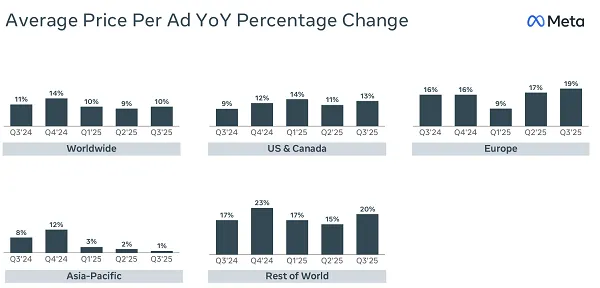
Meta’s ad costs are rising, which is a reflection of demand. Which means that on top of the direct revenue Meta gets from scam ads, their very presence would also driving up costs for all advertisers, which could mean that Meta’s actually gleaning way more overall revenue from this element.
Also this:
“The documents further note that users who click on scam ads are likely to see more of them because of Meta’s ad-personalization system, which tries to deliver ads based on a user’s interests.”
Yeah, this is not a good report for Meta, with the notes also indicating that Meta refuses to act on likely scams unless its system can determine that they are indeed scams “with 95% accuracy.”
And with more and more people falling victim to online scams, this is already becoming a bigger focus for enforcement.
According to the Global Anti-Scam Alliance, which monitors scam activity, victims around the world lost at least a trillion dollars to scams in the last year alone. According to its “2025 Global State of Scams” report, around 23% of adults globally have had money stolen by scammers, with that figure rising to 41% in South America and Africa.
Given the scope of such, and Meta’s global presence, you can bet that many regulators, in many regions, are already looking for more info on these reports.
Meta, meanwhile, has refuted the claims, noting that these internal documents were not intended for public consumption, and are not necessarily indicative of the full scope of the issue.
Meta has also pointed to its evolving scam ad detection processes, which have reduced user reports of scam ads globally by 58% in 2025.
As such, maybe the situation isn’t as bad as it was. But again, it’s not a good look for Meta, and it could end up seeing the company cop significant fines for knowingly allowing such, if the claims are correct.
But then again, if those fines are less than what it generates from these ads…
Again, it seems very likely that regulators will be poring over these documents and claims, and digging into Meta’s ad business, to find more evidence that supports this data. And presumably, any fine would have to exceed what Meta’s gaining from these ads to make it effective.
It could be another major blow for the company’s reputation, and could also slow its investment in its next-level bets. But then again, maybe Zuckerberg’s renewed ties with Trump will help to ease scrutiny, and reduce any related impact.



 Troy Sanders
 Maya Kensington