 Ethan Carter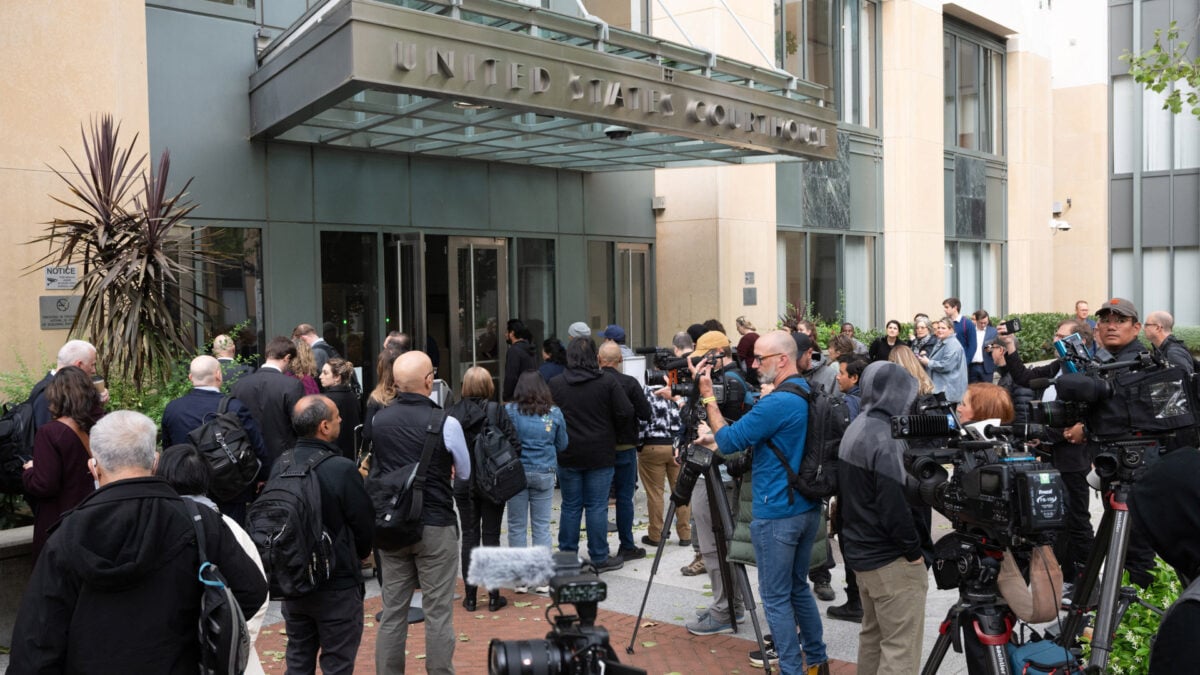

A highly anticipated trial featuring Elon Musk and Sam Altman’s OpenAI commenced in a federal court located in Oakland, California on Monday morning.
Exactly https://t.co/hd6rx0aF2i
— Elon Musk (@elonmusk) April 27, 2026
In 2024, Musk, who is a significant early investor and co-founder of OpenAI, initiated a lawsuit against OpenAI, its CEO Sam Altman, President Greg Brockman, and major investor Microsoft. He accused them of defrauding him of billions of dollars by transforming OpenAI from a nonprofit to a for-profit entity.
Judge Yvonne Gonzalez Rogers has assembled a nine-member jury, with opening statements set to commence tomorrow. The trial will unfold in two distinct phases. The first phase focuses on liability and is expected to continue until May 21, at which point the jury will provide an advisory verdict. Afterward, the court will enter the remedies phase. Several prominent figures within the AI sector, including Musk, Altman, Brockman, and Microsoft CEO Satya Nadella, are anticipated to provide testimony. Both Altman and Brockman were present in the courtroom on the trial’s first day, according to reports from CNBC.
For now, here’s a comprehensive overview of the situation.
What led to the conflict between Elon Musk and OpenAI?
When OpenAI was established as a nonprofit AI lab in 2015, Elon Musk was among its founding members and a major early financial backer.
However, Musk departed from the organization in 2018. Prior to his exit, internal emails revealed Musk’s concerns that “OpenAI is on a path of certain failure relative to Google” and that his company, Tesla, represented “the only path that could even hope to hold a candle to Google.”
In 2023, Musk founded a competing company named xAI, which he later merged with his other firm, SpaceX. The combined entity, xAI-SpaceX, is set to launch its market presence later this year, shortly before a rumored OpenAI IPO. Through xAI, Musk also made an unsolicited offer to acquire OpenAI for $97.4 billion in February 2025.
After Musk’s departure, OpenAI, under Altman’s direction, altered its corporate structure, transitioning first to a “capped” for-profit model in 2019 and eventually evolving into a for-profit public benefit corporation by late 2025. The launch of ChatGPT in 2022 proved to be extraordinarily successful, propelling the company to the forefront of the AI industry.
What specific actions is Musk pursuing against OpenAI?
Musk filed charges against the defendants in August 2024, alleging damages exceeding $130 billion for orchestrating a “deceit…of Shakespearean proportions,” as stated in the complaint. He claims they manipulated him into believing he was contributing to a nonprofit while the intention was always to convert OpenAI into a for-profit venture.
“Do you want to set a legal precedent in the United States that it is acceptable to loot a charity?” Musk expressed in a post on X on Monday. “I could have initiated OpenAI as a for-profit corporation. Instead, I established it, financed it, recruited vital talent, and imparted my knowledge on building a successful startup for the public good. Then they stole the charity.”
In a recent amendment submitted this month, Musk indicated that he wishes for the damages to be allocated to OpenAI’s nonprofit arm rather than to himself. Additionally, he seeks for the court to reverse OpenAI’s transformation into a for-profit entity and to remove both CEO Sam Altman and President Greg Brockman from their positions.
Just last week, Musk’s legal team retracted the fraud allegations and opted to focus solely on accusations of breach of charitable trust and unjust enrichment.
How has OpenAI defended itself against Musk’s claims?
OpenAI has strongly denied the accusations of fraud, asserting that Musk was involved in discussions regarding the transition to a for-profit structure as early as late 2017. Allegedly, Musk expressed a desire for the company to merge with Tesla or for him to gain majority control over the for-profit structure. OpenAI contends that they rejected Musk’s terms for the for-profit model, which purportedly led to Musk’s departure based on a misperception that OpenAI was doomed to fail.
“Driven by jealousy, regret for leaving OpenAI, and a desire to disrupt a competing AI company, Elon has spent years targeting OpenAI with unfounded lawsuits and public attacks,” OpenAI stated in their defense.
The company has previously accused both Musk and Meta of engaging in “improper and anti-competitive behavior,” and in their Monday statement, they claimed Musk coordinated with Meta CEO Mark Zuckerberg to undermine OpenAI’s mission.
What are the potential implications of this trial?
The trial holds the potential to reveal new insights into the actions and motivations of both Elon Musk and Sam Altman, particularly as both figures and their companies are under increased scrutiny.
Over the course of the previous year, Musk and his ventures have been embroiled in one controversy after another. His actions during the Trump administration incited riots targeting Tesla dealerships. Following his contentious exit from Trump’s inner circle, reports emerged regarding his alleged frequent ketamine abuse, further tarnishing his public image. In March, Musk was found to have misled investors during his Twitter acquisition; however, his legal team contended that he did not receive a fair trial because “many jurors harbored negative feelings toward Mr. Musk,” preventing the court from excusing those individuals.
Now, his joint company, xAI-SpaceX, is approaching a potentially pivotal IPO later this year, as it grapples with mounting public and regulatory scrutiny due to concerns surrounding Grok’s creation of non-consensual explicit images of women and children on X.
OpenAI is reportedly preparing for its own IPO later this year, despite both the company and Altman facing a challenging year. ChatGPT has been implicated in contributing to tragic mental health incidents, such as a murder-suicide in Connecticut and the suicide of a 16-year-old boy. The organization has also faced significant backlash for entering into an agreement with the Pentagon shortly after Anthropic expressed concerns regarding domestic surveillance and autonomous weaponry.
A recent investigation by The New Yorker—which Musk amplified on X, increasing its visibility—sparked renewed public scrutiny on Altman, with multiple sources labeling him as untrustworthy and even sociopathic. Shortly after the article’s release, Altman’s residence in San Francisco was targeted with a Molotov cocktail.

 Daniel Mercer