David Bridges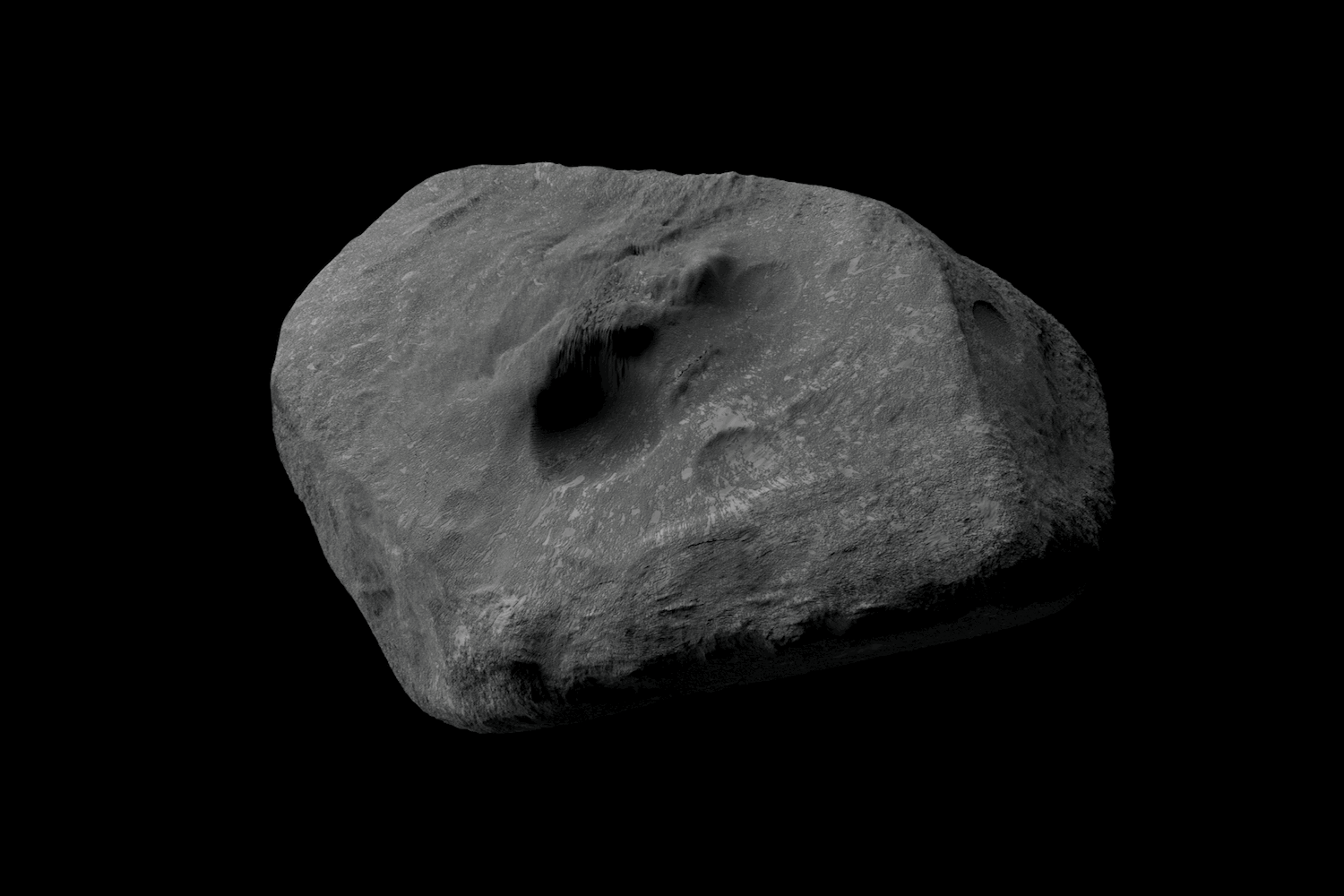
A recently identified asteroid is on a trajectory that could lead to a close encounter with Earth—and it may even collide with the Moon. Astronomers have recently conducted an in-depth analysis of this massive space rock, uncovering its tumultuous origin story that adds layers of intrigue to its journey through the universe.

Utilizing the powerful Keck Observatory located on Maunakea, Hawaiʻi Island, a dedicated team of astronomers successfully characterized the physical attributes of asteroid 2024 YR4 and traced its potential origins. This threatening asteroid is believed to have separated from a larger celestial body following a violent collision. Furthermore, it appears to have emerged from an asteroid family within the main asteroid belt situated between Mars and Jupiter—a relatively uncommon location for asteroids that intersect with Earth’s orbit.
“The unique shape of this asteroid provides valuable insights into its formation and structural integrity,” stated Bryce Bolin, a research scientist with Eureka Scientific. “Understanding these characteristics is critical for assessing the necessary techniques or efforts required to deflect the asteroid, should it be classified as a threat.” This groundbreaking research is scheduled for publication in The Astrophysical Journal Letters.
The Asteroid Terrestrial-impact Last Alert System (ATLAS) based in Chile first detected asteroid 2024 YR4 on December 27, 2024. Shortly after its discovery, NASA classified it as a potentially hazardous object, noting a nearly 3% chance of impact with Earth on December 22, 2032. After generating some alarm (or offering a thrilling prospect), NASA subsequently reassessed the asteroid, determining that it held a near-zero probability of colliding with Earth.
However, the Moon is not entirely out of danger from this wandering space rock. Recent updates from NASA’s Center for Near Earth Object Studies have increased the likelihood of asteroid 2024 YR4 impacting the Moon, raising the probability from 1.7% in late February to 3.8%. This adjustment is based on new data gathered by the Webb telescope and observations from various ground-based telescopes.
If a collision occurs, the asteroid is not expected to alter the Moon’s orbit; rather, it would create a fresh and substantial impact crater. “This is one of the largest objects in recent times that could potentially strike the Moon,” remarked Bolin, the leading author of the study. “If it does collide, it would provide scientists with a rare opportunity to examine how the size of an asteroid correlates with the dimensions of the crater it produces—something we have not yet been able to measure directly.”
Measurements estimate asteroid 2024 YR4 to be between 174 and 220 feet (approximately 53 to 67 meters) in width—comparable to the height of a 10-story building. Its irregular and flattened shape indicates that it possesses a density similar to that of solid rock, based on the findings from the study. Additionally, the asteroid rotates in a retrograde direction approximately every 20 minutes.
Larger asteroids, typically measuring 100 meters (328 feet) or more, are often referred to as “rubble piles.” These remnants are fragments that have detached from a larger parent asteroid resulting from a collision. As the name implies, rubble pile asteroids consist of loosely aggregated pieces that coalesce to form a loosely bound structure. Often, sizable boulders are found resting atop these rubble pile asteroids. At its current size, 2024 YR4 may have originally been a boulder situated on the surface of a larger rubble pile asteroid, as suggested by the study.
The research team also compared the orbit of the newly identified asteroid with that of other near-Earth objects, concluding that 2024 YR4 likely originated from a region located between the inner and central main belt. Earth-crossing asteroids—those whose paths intersect with Earth’s—frequently come from the inner sections of the main belt. As these asteroids evolve in their orbits, they can be displaced into trajectories that lead them toward Earth.
It is posited that the asteroid may have originated in the central main belt and drifted inward due to its retrograde spin, which indicates it travels in the opposite direction of most other celestial bodies within the solar system. This unique characteristic could elucidate why 2024 YR4 distinguishes itself from the majority of other celestial objects that cross paths with Earth.
Upon its initial detection, asteroid 2024 YR4 was located 515,116 miles (829,000 kilometers) away from Earth. Since that time, the space rock has continued to move away from our planet, and its next significant approach will not occur until December 2028. Ground-based telescopes operated by the International Asteroid Warning Network are actively monitoring the asteroid; however, it is expected to be too faint for observation until June 2028, as reported by NASA. This underscores the importance of directing the Webb telescope and the telescopes at Keck Observatory to gather as much data as possible before it becomes challenging to detect.
“The data generated from our study will be instrumental in assessing the physical properties and shapes of asteroids that may potentially impact Earth, providing an excellent test case for the kind of rapid-response observations necessary to characterize a potential threat like this one,” stated Bolin. “Understanding an asteroid’s physical characteristics (whether it is a rubble pile or solid rock) is essential for devising mitigation strategies if such actions become necessary.”



 Daniel Mercer