David Bridges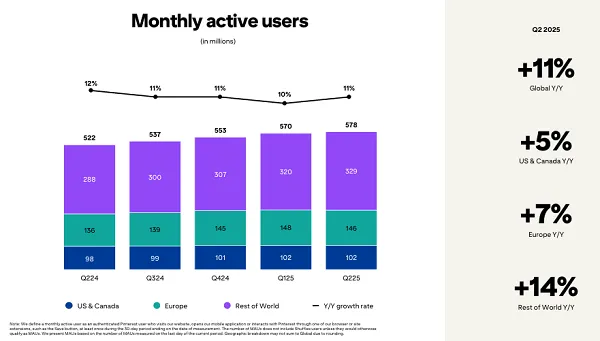

Pinterest has released its most recent performance report, revealing impressive double-digit year-over-year increases in both user engagement and revenue generation.
However, despite these encouraging figures, the platform’s user growth in key revenue-generating markets is either stagnant or declining, particularly in Europe, which may limit future business opportunities.
To start with user statistics, Pinterest has now reached a total of 578 million monthly active users, reflecting an increase of 8 million compared to its Q1 metrics.
This chart illustrates that Pinterest’s audience growth is predominantly attributed to the “Rest of World” category, where the platform successfully added 9 million additional users.
A major concern, however, is the reported loss of 2 million active users in Europe, coupled with a flat user growth in the U.S. from the previous quarter.
This scenario poses a significant issue, as these regions are responsible for generating the majority of Pinterest’s revenue streams:
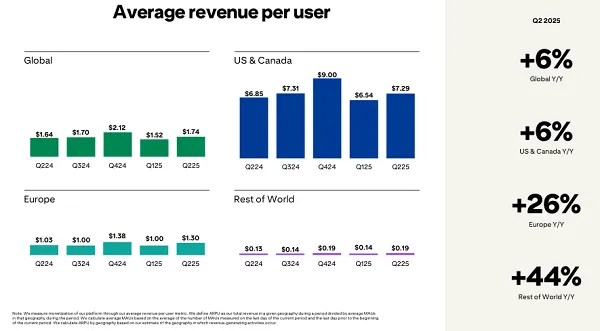
As evident from this data, Pinterest’s revenue generation from users located outside these key regions remains relatively low. Therefore, while the growth in developing markets may suggest future potential, the underdeveloped digital advertising sectors in these areas mean that Pinterest isn’t currently reaping substantial financial benefits, despite the user expansion.
On a brighter note for marketers, Pinterest has highlighted that Gen Z users now constitute half of its total user base.
In terms of revenue streams, Pinterest reported earnings of $998 million for the quarter, marking a robust 17% increase compared to the same period last year.
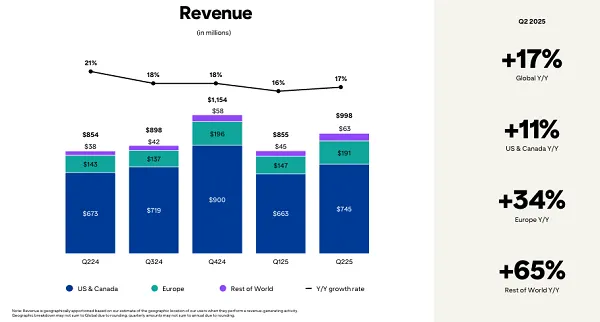
This indicates that Pinterest is becoming increasingly adept at monetizing its audience and optimizing its opportunities. However, it is essential to note how dependent the platform is on the U.S. and EU markets, which makes the declining growth a critical issue to monitor.
With 578 million users, many of whom engage with the platform driven by shopping intent, there is much to appreciate about Pinterest’s evolving online shopping ecosystem. The platform is enhancing its discovery and purchase-oriented tools, positioning itself as a valuable resource for many users.
Pinterest continues to innovate in this area, introducing improved Pin recommendations, AI-driven collages, and advanced visual search functionalities.

This progress is encouraging as Pinterest converts a larger portion of its audience into revenue, which is a positive indicator for the app’s future. Even at its current user activity levels, if Pinterest continues to generate more sales opportunities, it remains a solid business proposition. Nevertheless, market analysts express concern about potential limits on its growth, particularly if audience numbers plateau in vital markets.
What does the data suggest about user growth in the U.S.? It appears that Pinterest has only attracted an additional 3 million users over the past year. In contrast, it has gained 7 million in the EU during that same timeframe, despite the recent decline, which indicates that it may be premature to claim stagnation in that region. However, the evidence suggests that all potential American users may have already explored the platform. Thus, Pinterest must maximize the value of its existing user base in its primary revenue market.
It seems Pinterest is effectively managing this challenge, making several positive strides in its growth strategy.
If the trends in EU user statistics continue to decline, it will raise alarms. Additionally, a decrease in revenue figures will be another crucial factor to monitor. Nevertheless, overall, Pinterest appears to be improving its monetization strategies and enhancing its shopping features, even in the absence of significant new user acquisitions.


 Maya Kensington
 Mason Thompson