David Bridges

As I delve into my projections for the landscape of social media in 2025, there’s one prediction that stands out as particularly urgent. This insight isn’t groundbreaking for those closely monitoring the trends, but its implications are profound.
The destiny of the platform now known as X (formerly Twitter) hinges significantly on the results of this week’s U.S. Presidential Election. A victory for Trump could mean substantial gains for both X and its owner, Elon Musk. Conversely, a loss for Trump could spell disaster for the platform, which is already grappling with serious challenges. If the latter occurs, I question whether X can endure for another year.
Here’s the rationale behind this prediction:
Elon Musk has staked his reputation on supporting Trump, actively working to bolster Trump’s chances of re-election. His commitment goes beyond mere financial investment; it reflects his strategy to influence the political arena through X.
So, what drives Musk’s newfound allegiance to Trump?
This question takes on added significance considering that just two years ago, Musk stated:
I don’t hate the man, but it’s time for Trump to hang up his hat & sail into the sunset.
Dems should also call off the attack – don’t make it so that Trump’s only way to survive is to regain the Presidency.
— Elon Musk (@elonmusk) July 12, 2022
At that time, Musk believed Trump was too old for the presidency and that his previous term was marred by excessive drama, which distracted from governance.
Trump, known for his characteristic retorts, responded to Musk’s critique:
Trump suggested that Musk should concentrate on resolving his issues with Twitter, implying that Musk’s $44 billion investment might be for a platform with diminishing value.
Fast forward two years, and Musk and Trump appear to be allies, collaborating towards goals that Elon previously opposed, all while utilizing X, the platform Trump deemed as potentially worthless.
This transformation seems significant, yet it suggests a shift less about shared beliefs and more about the pursuit of power from both sides of the aisle.
Musk’s acquisition of Twitter reflects a desire for political leverage, allowing him to sway public opinion regarding policies and politicians that challenge his business ambitions.
This dynamic has been evident as Musk has openly criticized governments and regulators that he finds disagreeable, while simultaneously amplifying support for allies or quietly complying with their demands.
One glaring instance was in Brazil, where X defiantly opposed a court order to suspend accounts identified by Brazilian authorities as sources of misinformation. This defiance resulted in a month-long ban of X in Brazil, after which Musk’s team acquiesced to the government’s requests to regain access to the market.
The Brazilian government’s demands targeted users who perpetuated the narrative that the 2022 election was “stolen,” leading to the removal of former President Jair Bolsonaro. Despite various investigations yielding no evidence to support these claims, Brazilian officials sought to eliminate them by urging platforms like X to de-platform these users.
Musk initially resisted the request, launching into tirades against corruption in the Brazilian government and judicial system, even encouraging voters to remove their government in future elections.
Today, we launch the daily data dump on the crimes – under *Brazilian* law – that fake “judge” @alexandre has committed!
He can block this platform in Brazil, but he can’t stop the whole world from knowing his illegal, shameful & hypocritical deeds. Karma’s a b*tch bro.
???????????? https://t.co/hoxcpmkzOK
— Elon Musk (@elonmusk) September 1, 2024
In contrast, when other governments have made similar requests for account removals due to alleged legal violations, X has complied, albeit with statements of opposition to such actions.
We object to a decision from the Turkish Information and Communication Technologies Authority to block a news organization within Türkiye. Providing a platform committed to defending everyone’s right to free speech is paramount at X, and we believe this decision from the Turkish…
— Global Government Affairs (@GlobalAffairs) October 15, 2024
Why, then, did Musk express such outrage regarding Brazil while being relatively subdued in his response to Turkey, given that the underlying issues are fundamentally similar?
The answer lies in Musk’s financial interests; he suffered losses when Bolsonaro was ousted, and he aims to leverage his influence at X to retaliate against those who have obstructed his business ventures.
Bolsonaro and Musk had cultivated a business relationship that promised significant advantages for Musk’s projects, including favorable lithium deals for Tesla from Brazilian mines. Given that lithium is a crucial element in electric vehicle batteries, Musk is pursuing advantageous arrangements across several South American nations.
For instance, Musk secured a lithium supply agreement with Bolivia in 2021 after the ousting of President Evo Morales, who had resisted allowing American companies access to Bolivia’s natural resources.
At that time, Musk’s tweet regarding the situation was quite revealing:
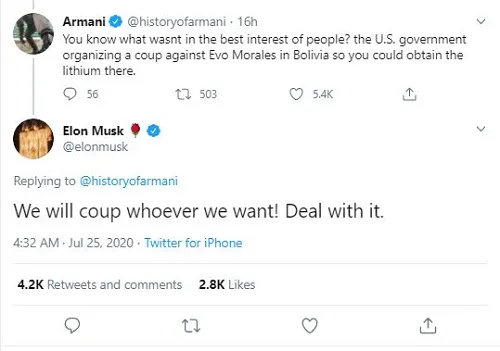
This highlights Musk’s perspective on Twitter and its potential for political influence. Notably, after this tweet, Musk began acquiring Twitter stock, which ultimately led to his purchase of the platform.
Another noteworthy example is Argentina, where Musk has openly praised President Javier Milei.
Interestingly, Milei is also negotiating a lithium supply agreement for Tesla. Earlier this year, Milei met with Musk at Tesla’s Austin headquarters to discuss potential lithium projects that would benefit both parties.
Musk’s strategic motivations are apparent in all his dealings at X. The platform has complied with governmental requests from India, where Tesla is working to establish new distribution agreements for its vehicles.
Additionally, X has also met Turkish government demands, which are exploring opportunities for both Tesla and Starlink.
The strategy is evident: Musk sees Trump’s re-election as pivotal for unlocking new opportunities for X, whether through governmental initiatives or business negotiations leveraging political influence.
If Trump succeeds in the upcoming election, Musk will capitalize on fresh opportunities for X, either via government projects or business agreements tied to this newfound political sway. This is the crux of Musk’s agenda, promoting X as a tool to influence voters and policies by utilizing his own position on the platform to shape public discourse.
A Trump victory would translate into an endorsement of Musk’s capability to impact voter behavior, a valuable asset he could market to various political factions across the globe.
However, if Trump loses, it could severely restrict X‘s opportunities for growth and influence.
Moreover, X desperately needs to regain its footing. Reports indicate that the platform’s revenue has plummeted by approximately 70% since Musk’s takeover, coupled with a significant loss of users.
Advertisers are distancing themselves from Musk’s controversial management style, creating little incentive for them to return to the platform. Coupled with the overwhelming debt burden Musk has imposed on the company as a result of the acquisition, it appears unlikely that X will generate profits anytime soon.
In fact, X is projected to report significant losses in 2024.
If the situation fails to improve, there are limits to how much Musk and his investors can absorb, regardless of his significant personal wealth.
Ultimately, the fate of X is intrinsically linked to Trump’s performance in this election. Should Trump lose, both X and Musk could face dire consequences.
A victory for Harris would accelerate X towards potential bankruptcy, leading to my prediction that Musk will seek to exit the social media arena by the latter half of 2025.
Musk recently remarked in an interview that if Trump loses, “I’m f*ed.” While analysts don’t foresee immediate repercussions for his other ventures like Tesla or SpaceX, a win for Harris would place X in a precarious position.
Beyond the immediate implications for TikTok, which might find relief if Trump returns to the White House, the broader social media landscape could witness the gradual decline of X, potentially erasing what remains of Twitter’s legacy.


 Troy Sanders