 David Bridges

Indeed, the increasing reliance on technology raises questions about its future implications, and it seems this trend may come with significant challenges. Is this shift simply a part of the progress we are witnessing in our society?
A recent report released by Common Sense Media revealed that an astonishing 72% of U.S. teenagers have interacted with an AI companion, with a significant number engaging in regular social interactions with these virtual entities. This statistic highlights the growing acceptance and integration of AI technology into daily teenage life.
While this study, based on a survey of 1,060 teens, provides a snapshot of current trends rather than a comprehensive view of AI usage, it raises some critical concerns. As technology companies push to develop AI bots that can potentially fulfill roles as romantic partners, we must consider the ethical and psychological implications of such advancements.
To begin with, the data indicates that 72% of teenagers have experimented with AI companions, and a noteworthy 52% have become consistent users of these digital friends. This trend reflects a significant shift in how young people perceive and interact with technology.
It is important to recognize that the current capabilities of AI bots are still far from their future potential. Tech companies are investing billions of dollars in enhancing these bots to make them more relatable, conversational, and capable of mimicking genuine human engagement.
However, it is crucial to remember that these are still bots. They respond to conversational cues based on available context and the algorithms their creators have implemented. Therefore, they cannot replicate the genuine human interaction that fosters true emotional and physical connections, which is fundamental to our social existence.
As we progress towards a future where AI companions may serve as substitutes for authentic social interactions, it’s essential to consider the risks involved. What if these bots are compromised by harmful code, hacked, or shut down unexpectedly? Such events could have dire consequences for their users.
The long-term effects of fostering connections with AI companions remain largely unknown, particularly regarding their potential impact on mental health. As we embrace these advancements, it is crucial to remain vigilant and aware of the possible implications they may have on our well-being.
Despite the uncertainties, data shows that 33% of teens utilize AI companions for social interactions and relationships, indicating a growing trend that could redefine how adolescents engage with one another.
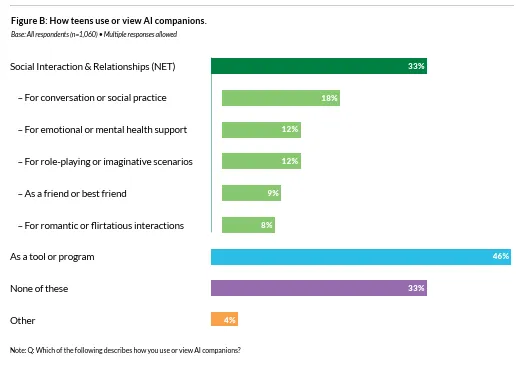
While the integration of AI companions may offer benefits, such as providing a safe space for individuals to express themselves, it also raises important questions. For instance, the ability to seek advice from an AI companion can be invaluable; survey results indicate that 18% of users turn to these bots for guidance.
Nonjudgmental interactions with AI companions can yield significant advantages. Moreover, 39% of users have reported that they successfully transferred social skills learned while interacting with bots into real-world situations. This is particularly notable as 45% of female users have experienced this transfer compared to 34% of male users, showcasing distinct patterns in usage.
There are undoubtedly positive aspects to this trend. However, similar to the evolution of social media, one must question whether the advantages of using AI companions will ultimately outweigh the potential downsides associated with an over-dependence on non-human interactions for traditionally human connections.
Interestingly, 31% of survey participants reported finding conversations with AI companions equally or more satisfying than those with their real-life friends. Furthermore, 33% stated they prefer AI for certain discussions. This raises concerns about the diminishing value placed on human relationships.
It’s vital to address the fact that these bots can be programmed to respond based on specific ideological perspectives, which presents a significant concern. Additionally, the propensity for AI tools to “hallucinate” and present incorrect assumptions as factual could mislead young users, posing potential risks to their decision-making processes. The shift towards viewing AI companions as romantic partners further complicates the landscape of modern relationships.

It appears inevitable that the use of AI tools will become more prevalent, and as we develop relationships with these human-like simulators, many may seek to deepen these connections. Real individuals may struggle to understand us as well as our algorithmically-aligned AI bots do, potentially leading to a worsening of the loneliness epidemic rather than alleviating it, contrary to popular belief.
As young individuals adopt these new relational behaviors in their formative years, one must wonder how this will shape their understanding of genuine human connections, which are essential for emotional and social development.
The necessity for human connection is well-documented, with centuries of research emphasizing its importance for personal development and community building. While AI companions may replicate some aspects of social interaction, they cannot replace the value of authentic physical connections and real-life participation.
Unfortunately, we seem to be drifting away from these essential aspects of life. Current trends indicate rising levels of severe loneliness, which the WHO has labeled a “pressing global health threat,” highlighting the significant health consequences that stem from isolation.
Research has demonstrated that loneliness correlates with a 50% increase in the risk of developing dementia and a 30% higher risk of experiencing coronary artery disease or stroke, underscoring the profound implications of social disconnection.
Will the introduction of AI bots mitigate these effects? If not, why are we so aggressively promoting their use? Why are we seeing a surge in applications encouraging users to engage with these non-human entities and share their innermost thoughts with evolving AI technologies?
Is this movement more advantageous for society or merely beneficial for the tech giants developing these AI models? It raises important ethical questions about the future of human interaction.
If you lean towards the latter perspective, it appears that the pursuit of progress is prioritized above all else, reminiscent of the early days of social media. AI providers are already advocating for the European Union to ease regulations on AI development, and the competitive race among nations to advance AI technologies is intensifying the pressure on governments to relax restrictions in favor of innovation.
Yet, should we feel optimistic about Meta’s aspirations for “superintelligence,” or should we be concerned by the rapid proliferation of these tools with significant potential impacts on society?
While the development of AI itself is not inherently negative, there are numerous applications of the latest AI tools that promise to enhance efficiency, foster innovation, and create new opportunities. However, caution is warranted in areas where over-reliance could pose risks to society as a whole.
Although it seems unlikely that we will slow down this trajectory, in ten years, we may find ourselves evaluating these developments from an entirely new perspective, one that considers the broader implications of our relationship with AI.
For more insights, you can access Common Sense Media’s “Talk, Trust, and Trade-Offs” report here.


 Cameron Steel
 Tessa Everly