 Maya Kensington

Meta has released new statistics about its compliance efforts regarding Australia’s ban on social media usage for individuals under 16, revealing that since June 2025, the company has terminated access to over 750,000 accounts on Facebook and Instagram, determined to belong to users below the minimum age requirement.
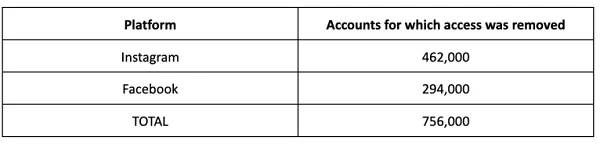
That number has increased from the 550,000 teen accounts reported by Meta in January. The company has been enhancing its detection mechanisms and enforcement strategies as Australian regulators intensify scrutiny on social media platforms to comply with the new legislation.
According to Meta: “Our enforcement efforts are ongoing, and these figures will continue to rise. We regularly report our enforcement actions to the eSafety Commissioner and will provide updates periodically to maintain transparency with the public.”
Meta indicated that the surge in account removal actions is attributed to the ongoing enhancement of its detection systems, particularly its AI-driven tools that are increasingly effective at identifying underage accounts.
“We utilize AI to assess profiles — examining posts, comments, bios, and captions — for contextual indicators that suggest an account may belong to someone under 16, such as mentions of birthday celebrations or school-related activities,” Meta explained.
Furthermore, Meta has simplified the process for parents and the community to report suspected underage accounts. The company also launched an educational initiative on both Facebook and Instagram, detailing how Meta identifies and removes accounts belonging to users under 16 and the consequences for teens when their accounts are deleted.
As a result, this has led to a notable increase in enforcement actions. the Australian eSafety Commission’s data indicates that, at present, a significant number of under-16s in the country are still gaining access to social media applications, despite the heightened efforts from platforms and authorities.
Earlier this month, the eSafety Commission of Australia published an update assessing the effectiveness of the social media ban for users under 16. The report revealed that 81.5% of underage users continued to access restricted platforms.
The Commission attributed this primarily to the platforms themselves.
“Among age-restricted platforms, the primary reason children cited for maintaining an age-restricted account was that the platform had not yet requested them to verify their age (50.2%) [while] while others reported that the platform had incorrectly assessed their age (18.2%),” the Commission stated.
Consequently, the eSafety Commission pledged to impose stricter penalties on applications that fail to adhere to the new regulations. these requirements remain somewhat ambiguous and open to interpretation.
Meta has consistently highlighted this as a significant issue, advocating for more standardized enforcement across the board to create a fair environment.
“Our main concern is that platforms are not uniformly addressing the removal of teens,” Meta stated in its most recent update. “There should be a single, dependable age verification method implemented at the operating system or app store level. Age could be validated once when a young person sets up their device or downloads an application, rather than repetitively across numerous apps they utilize.”
Meta has frequently asserted that age verification at the app store level and consistent guidelines are more effective strategies than requiring individual platforms to create their own age-checking systems.
However, the eSafety Commission has categorized initial concerns as part of the early implementation phase, indicating that it will take time to assess the true impact of these restrictions.
In addition to the shortcomings in enforcement, the Commission’s update also indicated that most children reported no noticeable improvement in the negative effects associated with problematic online behavior.