David Bridges

Our growing dependence on subsea cables as a backbone for global connectivity raises critical concerns about their vulnerability to various forms of sabotage, which can disrupt entire industries and impact millions of users worldwide.
This issue came to the forefront with Meta’s new subsea cable initiative, a groundbreaking project where the company is set to invest over $10 billion to lay more than 40,000 kilometers of subsea cables. This ambitious effort aims to significantly enhance connectivity in diverse regions, addressing the ever-increasing demand for internet capacity.
According to a report by TechCrunch:
“The proposed cable route is designed to stretch from the east coast of the U.S. to India, passing through South Africa, and then back to the U.S. west coast via Australia, creating a distinctive “W” shape around the globe.”
This diagram illustrates how the “W” cable project will provide Meta with enhanced connectivity across nearly every continent, while also building upon the company’s earlier 2Africa cabling project, which specifically targeted the African continent to improve internet access and services.
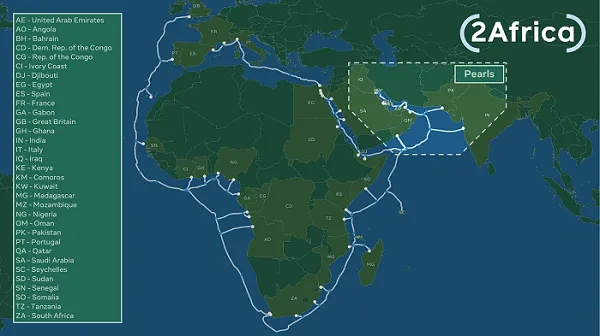
These two strategic projects will effectively position Meta as a major player in the global data network, with the “W” project being notable for marking the first instance where Meta will independently manage a significant subsea operation without relying on partners.
In contrast to the 2Africa project, where Meta collaborated with various regional providers to broaden connections and service options, this new cable initiative adopts a more individualized approach. By taking control of its own network, Meta aims to primarily enhance connectivity in India, aligning with its broader objectives in artificial intelligence and virtual reality advancements in that region.
This shift could provide Meta with greater authority over the utilization of its cable infrastructure, as well as enhanced influence in those regions. Consequently, this strategy would grant Meta a stronger position in the increasingly lucrative Indian market. Observers are keen to see how Indian authorities will respond to these plans, and what requirements they may impose on Meta for project approval.
Moreover, the vulnerability of subsea cables presents significant concerns. These cables face threats from natural phenomena—such as marine life, specifically sharks that are known to damage cabling—as well as potential state-sponsored sabotage and attacks.
Recently, reports surfaced about a Chinese commercial vessel allegedly involved in a deliberate act of damaging subsea cables by dragging its anchor, purportedly at the request of Russian operatives. This incident highlights the geopolitical complexities surrounding subsea infrastructure.
As reported by The Wall Street Journal:
“International investigators reportedly believe the crew aboard Yi Peng 3, a bulk carrier laden with Russian fertilizer, dragged its anchor across the Baltic seabed for over 100 miles, causing extensive damage to the cables running through the area. This disruption resulted in the failure of two distinct internet links—one connecting Sweden’s Gotland Island to Lithuania and another between Finland and Germany—prompting investigations by authorities from all four involved countries and additional nations.”
Such incidents raise serious concerns about the capability of entire nations to be effectively isolated due to these actions. Yet, the reality remains that expanding cross-border connectivity is essential for global communication and digital infrastructure growth.
In the future, satellite connectivity may eventually overshadow traditional physical cables. However, we are not quite there yet. The emergence of satellite internet providers like Starlink, which is led by a politically controversial billionaire, adds another layer of complexity to this evolving landscape. The control of such technology could raise concerns about its use for personal or political gain.
The ongoing discourse surrounding these issues is essential as the internet continues to play an increasingly vital role in modern society and daily life.
Ultimately, the entities that provide and govern these critical infrastructures will increasingly influence global connectivity, which appears to be the strategic direction Meta is pursuing with its latest initiatives.



 Tessa Everly
 Cameron Steel