David Bridges

Discover the Latest Trends in Social Media Usage and the Relevance of X Among U.S. Adults
Pew Research has recently released an insightful overview of current social media usage trends, revealing that YouTube stands out as the leading social media application, even though categorizing it strictly as a social platform might be somewhat contentious. Meanwhile, Facebook and Instagram continue to dominate the landscape, significantly outpacing other social media applications in terms of regular engagement and active user numbers.
The findings are based on a comprehensive survey involving 5,626 U.S. adults, conducted from February 1st to June 10th this year. While this sample represents only a fraction of the total social media user base, it provides a substantial enough dataset to illustrate notable trends that likely reflect the overall social media landscape. These trends can guide marketers and brands in understanding where to focus their efforts.
As illustrated in the accompanying chart, the platform previously known as Twitter is experiencing a decline, although it has not yet faced a dramatic drop in user engagement. This situation is noteworthy as it suggests an ongoing interest despite the challenges the platform is currently facing.
According to Pew Research:
“YouTube and Facebook are the most-widely used online platforms. Half of U.S. adults say they use Instagram, and smaller shares use sites or apps such as TikTok, LinkedIn, X (formerly Twitter) and Snapchat.”
This succinct statement encapsulates the current landscape of social media usage effectively. There you have it: YouTube and Meta’s</b suite of applications lead the pack, while all other platforms follow behind in terms of regular user engagement.
It’s important to note that this data does not account for the amount of time users spend on each platform—an essential metric that could provide a more nuanced understanding of user engagement. Reports indicate that TikTok users, for example, tend to spend significantly more time on the app compared to those using platforms like Facebook. Nevertheless, in terms of sheer user numbers, these three platforms have consistently maintained their positions at the top since 2018.
Interestingly, the data reveals that TikTok’s usage has not seen an increase in the past year according to Pew’s findings (indicated by the dark green line), while Pinterest (shown in light green) has experienced growth, which is noteworthy for marketers. Additionally, LinkedIn (dark orange) and WhatsApp (dark gray) have also observed slight increases, along with Reddit (light orange), while Snapchat (represented in apricot) has maintained a steady user base.
While X has indeed seen a gradual decline, it’s essential to note that this decrease is relatively minor. Contrary to popular belief, it is not experiencing a rapid fall from grace, and continues to retain a dedicated user base.
The only notable newcomer indicated at the bottom of the chart is BeReal, which garnered excitement for a brief period but has yet to solidify its place among the major social platforms.
When it comes to user demographics, Facebook continues to resonate with older generations, while TikTok and Snapchat remain favored by younger audiences. This division highlights the need for brands to tailor their strategies based on the unique demographics of each platform.
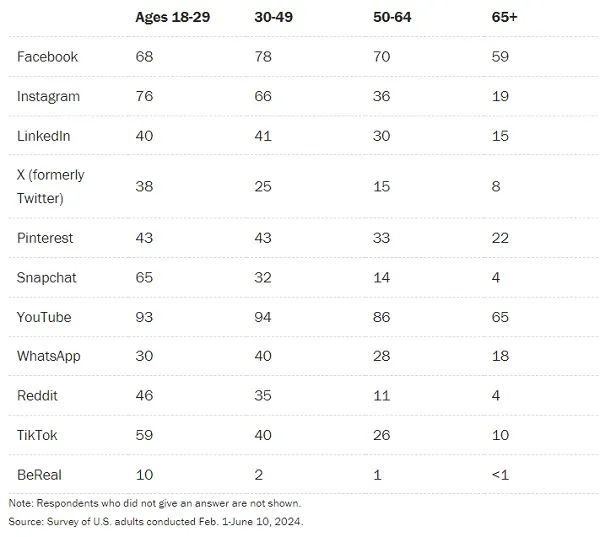
YouTube undeniably reigns supreme across all demographics; however, there is hesitation to compare it with traditional social platforms, as the primary usage revolves around video consumption rather than interaction. The social aspect is often secondary to the experience of watching content.
Nonetheless, it can be argued that TikTok, Instagram, and even Facebook share similar characteristics, as they too facilitate both content consumption and social interaction. Thus, these observations provide valuable insights into the evolving dynamics of social media trends and the age demographics most engaged on each platform.
This analysis could be instrumental in shaping your strategy for 2025, ensuring that your brand remains present and relevant in the spaces where your audience is most active.
To dive deeper into the findings, you can access Pew Research’s comprehensive “Social Media Fact Sheet” for 2024 here.


 Tessa Everly
 Maya Kensington