David Bridges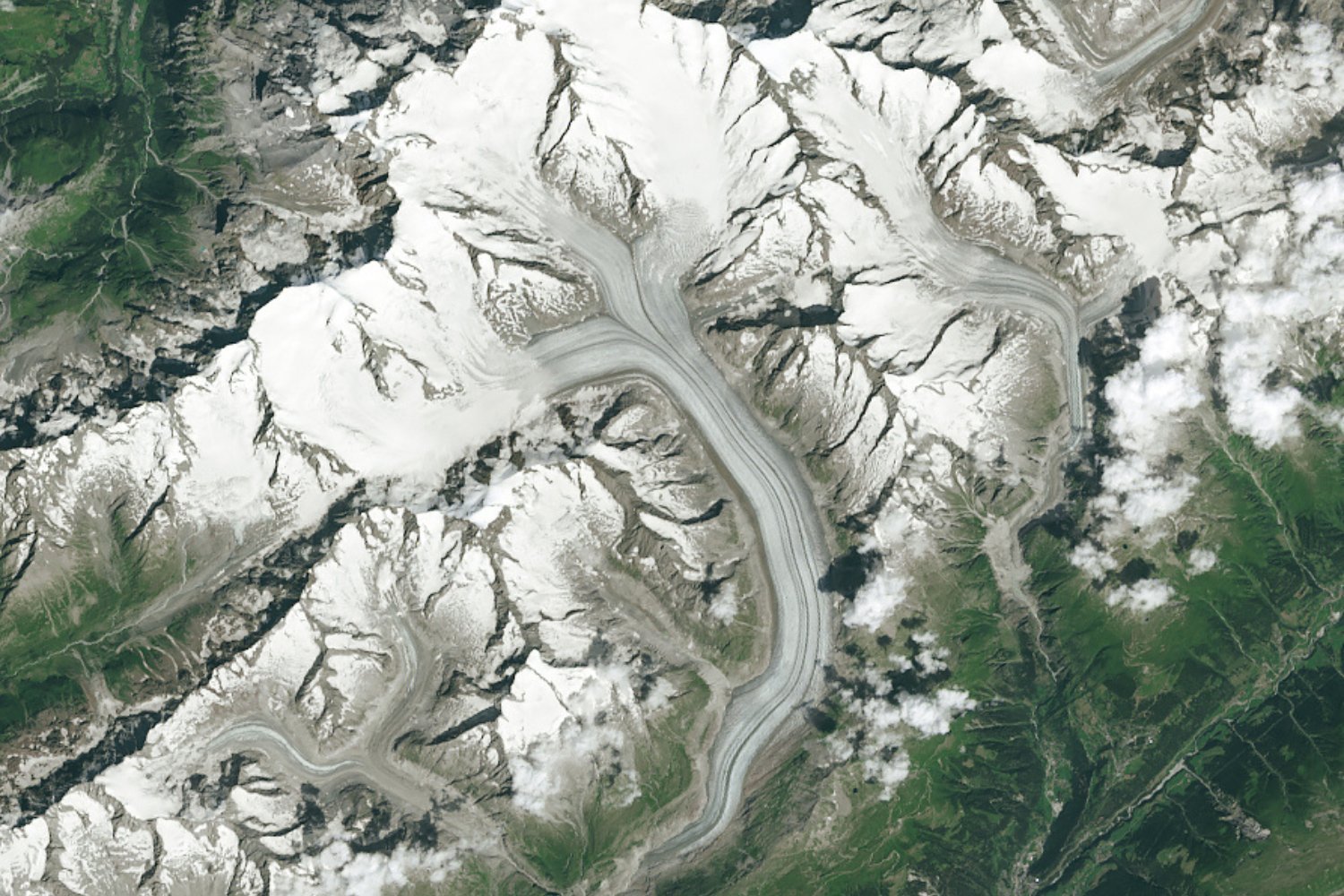

Explore the Dramatic Transformation of the Great Aletsch Glacier in the European Alps
The European Alps span an impressive distance of over 600 miles (1,000 kilometers) across eight distinct countries, showcasing a stunning landscape dominated by thousands of glaciers nestled in their cooler upper regions. However, a recent analysis utilizing NASA satellite imagery has unveiled alarming changes, particularly in the Alps’ largest glacier, the Great Aletsch Glacier. Over the last 40 years, this majestic ice mass has experienced significant regression, raising concerns about climate change and its impacts on glacial environments.
The satellite images presented below, captured in 1984 and 2024, reveal a stark contrast in the glacier’s dimensions. The photographs, taken by NASA’s Landsat 5’s Thematic Mapper and Landsat 8’s Operational Land Imager (OLI), clearly illustrate a retreat of more than 4,300 feet (1,300 meters) in both length and width over the four decades. This dramatic alteration highlights the urgent need to understand and address the factors contributing to such rapid environmental changes.
According to a recent release from NASA Earth Observatory, the Great Aletsch Glacier has also thinned considerably during this period, losing approximately 141 feet (43 meters) of water. This data was derived from the Swiss Glacial Monitoring Network (GLAMOS), emphasizing that the glacier’s footprint has diminished in both length and depth. Such changes are indicative of broader trends affecting glaciers worldwide, underscoring the critical nature of ongoing climate monitoring and research efforts.

Despite the presence of some cloud cover in the most recent image, the extent of ice loss is unmistakable. Areas that once sparkled with bright white ice have now transformed into grayish-brown rock, starkly visible in the imagery. As noted in the NASA release, the timing of the photography was early in the year, making it challenging to capture the glacier devoid of seasonal snow, which further obscures the extent of glacial melt that has occurred over the years.
The trend of retreating Alpine glaciers is not an isolated phenomenon; it is occurring across the region. For instance, the nearby Oberaletsch glacier has receded more than 787 feet (240 meters) since 1984, while the Fiescher Glacier has experienced an astonishing retreat of 3,281 feet (1,000 meters) during the same timeframe. These figures paint a concerning picture of the ongoing impacts of climate change on glacial systems.
According to a report from Reuters published late last year, Swiss glaciers have been melting at an alarming rate, exceeding historical averages in 2024 despite experiencing heavy snowfall during winter and spring. Unfortunately, the winter storms proved insufficient to counterbalance the record ice losses attributed to an unusually warm August and the presence of Sahara desert dust, which inhibited the glaciers’ ability to reflect sunlight back into the atmosphere effectively.
In 2024 alone, Swiss glaciers lost approximately 2.5% of their total volume, as reported by Reuters. Moreover, a comprehensive study published in Nature revealed that central Europe, with Switzerland at the forefront, has experienced a staggering 39% loss of its glacial ice from 2000 to 2024. This data underscores the urgent need for climate action and enhanced environmental protection initiatives to mitigate further losses.
The NASA imagery provides a compelling visual representation of these changes, starkly illustrating the rapid transformation of the glaciers. Following a record warm February—the third-warmest on record as noted by the National Oceanic and Atmospheric Administration—there are growing concerns about the future of these glacial environments. Observers anticipate that more images reflecting continued glacial losses will emerge in the near future, emphasizing the critical nature of monitoring and addressing climate change.


 Daniel Mercer