 David Bridges
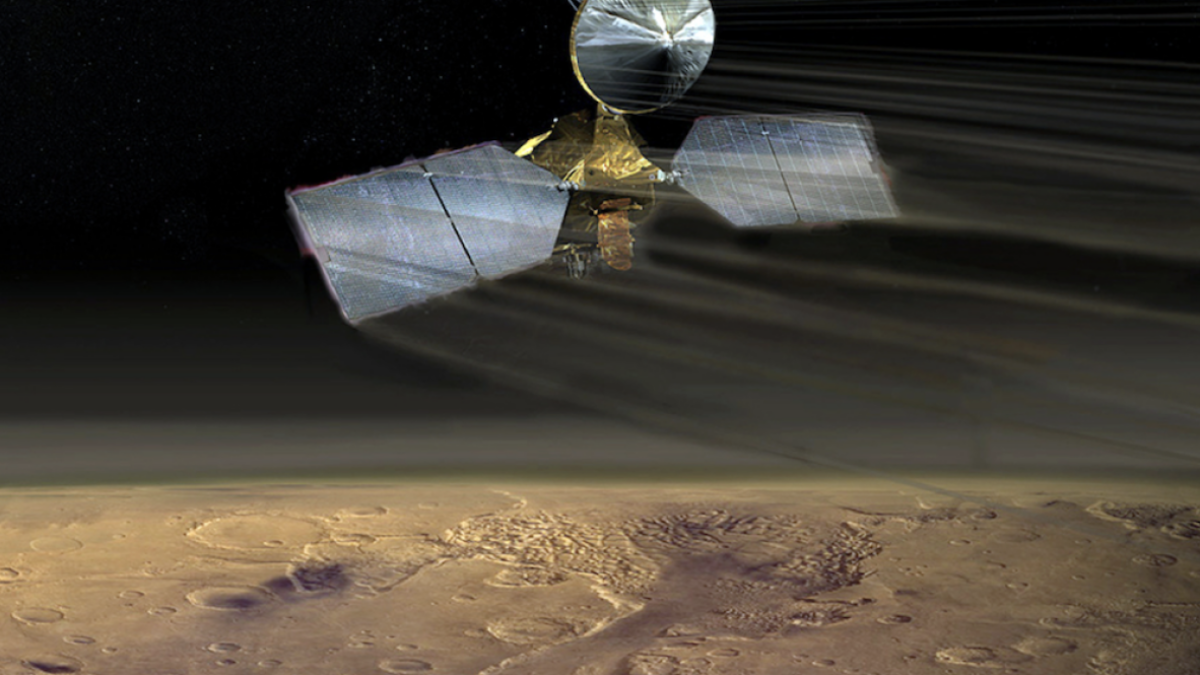

Mars is a desolate, irradiated, lifeless, windswept land. However it’s additionally the positioning of dramatic exercise, as area rocks pummel the Martian floor.
Asteroids or chunks of comets typically scar Mars’ desert, partly as a result of the Purple Planet orbits close to our photo voltaic system’s asteroid belt, a area teeming with thousands and thousands of asteroids. And once they do collide with Mars, the Martian environment is only one p.c the density of Earth’s, that means these area rocks are much less prone to warmth up and disintegrate.
But NASA not too long ago discovered proof of an object that did certainly break aside within the Martian environment after heating up — it fragmented however did not totally disintegrate. The company’s spacecraft in orbit, the Mars Reconnaissance Orbiter, noticed a brand new cluster of impacts subsequent to a bigger crater.
“Because the impactor was falling in direction of Mars, the friction with the environment led to the physique fragmenting into smaller items shortly earlier than placing the floor creating this notable sample,” Mohamed Ramy El-Maarry, a planetary scientist and member of the spacecraft’s digicam staff, wrote on-line. The weblog is amusingly titled “Mars Environment Fights Again!”
NASA rover finds broken helicopter in the course of Mars desert
The picture under was snapped by the spacecraft’s high-resolution digicam (known as HiRISE, or Excessive Decision Imaging Science Experiment), which from a whole bunch of miles above Mars can see issues as little as a kitchen desk.
Mashable Mild Pace
This Martian view, taken from about 165 miles (265 kilometers) above, is about 0.6 miles, or 1 km, throughout. The bigger impression is on backside left; the principle scattering of smaller impacts is simply to the precise.
A scattering of impression websites not too long ago captured by NASA’s Mars Reconnaissance Orbiter.
Credit score: NASA / JPL-Caltech / UArizona
Not like Earth, Mars would not conceal its impression strikes. Earth is a world with intense geologic exercise, shifting tectonic plates, and erupting volcanoes that may cowl up or wash away impression websites. Mars is not almost geologically useless — marsquakes regularly happen there — nevertheless it’s not almost as lively as Earth.
Though the brand new impacts proven above are comparatively small, Mars is blanketed in sizable craters. NASA estimates there are over a quarter-million impression craters in regards to the dimension of Arizona’s well-known Barringer Crater, which is a few 4,000 toes throughout. And there are over 43,000 Martian craters bigger than three miles vast.
Mars, nonetheless, wasn’t at all times a dry, crater-blanketed desert with a skinny environment. The Purple Planet as soon as teemed with water, and vigorous rivers as soon as fed expansive lakes. Planetary scientists suspect these watery locations may have doubtlessly harbored primitive Martian life — although no such proof has but been discovered.



 Daniel Mercer