David Bridges

Are you seeking effective strategies to enhance your Meta Ads targeting and connect with more precisely defined audiences for your promotions? You might be in luck, as there’s now a method to achieve just that.
Recently, you may have observed the introduction of a new “Value Rules” feature within your Meta campaign setup options. This feature offers another strategy to target your ads by allowing you to increase your bid limits for specific audience segments.
The Value Rules feature has been accessible to a select group of advertisers for a while, but it has recently been expanded to include a broader range of accounts. Essentially, as the name suggests, Value Rules allow you to concentrate on different user segments based on precise behaviors, demographics, and other factors to effectively reach the most valuable potential customers for your offerings.
In simpler terms, Value Rules will enable you to target individuals who are more closely aligned with your business objectives.
As stated by Meta ads expert Jon Loomer:
“When executing sales campaigns, you can optimize for conversion value instead of mere volume. Meta will then display your ads to individuals most likely to make higher-value purchases.”
This concept is quite straightforward. In this context, Meta’s Value Rules essentially provide a method to target users who are more likely to spend greater amounts on your products, based on their past behaviors related to ad interactions, conversions, and other metrics.
However, this is not the sole application of this feature.
The Value Rules feature also allows you to refine your bids across various categories with greater precision.
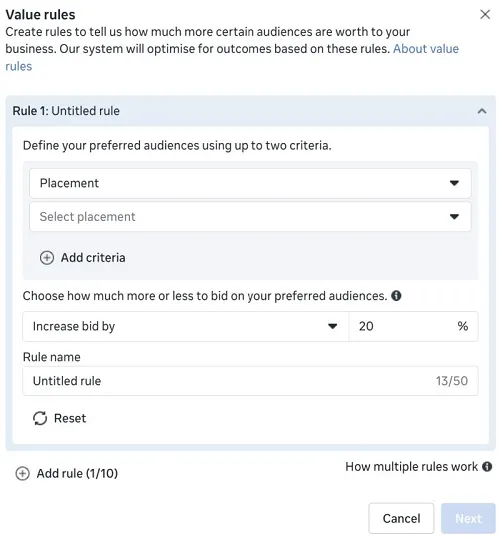
As explained by Meta:
“For instance, if you determine that men aged 25-44 hold an average lifetime value that is 60% higher, while women in the same age range present a 20% lower lifetime value compared to customers outside these demographics, you can apply value rules to increase your bid by 60% for the male 25-44 demographic and decrease your bid by 20% for the female 25-44 demographic. Individuals outside these value rules will receive a standard, non-adjusted bid.”
This enables you to concentrate on specific audience subsets by utilizing expanded targeting parameters, allowing you to set a variable value for your bids.
Value Rules can be based on several factors, including user age, gender, operating system, location, and placement (for example, Instagram feed, Facebook feed, Stories, Reels, and Marketplace), providing a multitude of options for potential optimization in targeting.
Does this sound intriguing?
Indeed, there are additional parameters and considerations to keep in mind.
First and foremost, Meta emphasizes that when you create a value rule set, the sequence of your rules will determine the priority of adjustments made by the system.
“If you establish rules that overlap in audience, we will only apply the first applicable rule to modify the bid. For example, if Rule 1 indicates that you are willing to bid 20% more for women in California, and Rule 2 states that you are willing to bid 50% more for women using a particular mobile operating system, then for a woman in California who uses that operating system, we will apply only Rule 1 to increase the bid by 20% because it is positioned first in the order.”
This factor could be significant, depending on the number of rules you implement and the complexity you wish to achieve with your various parameters.
Furthermore, Meta also notes that:
“When utilizing Value Rules, you may experience an uptick in conversions from your target audiences, although your overall cost per result may also rise.”
It’s another consideration worth pondering.
Moreover, Meta advises marketers to depend on their own business order data to guide their bid rules:
“If you generate $115 in ROAS from women and $100 from men, women may represent 15% more value to your business. You could establish a +15% value rule for women.”
While this point may seem obvious, it’s crucial to measure the efficacy of your ads and factor that into what you prioritize, which can add layers of complexity.
Additionally, Meta indicates that you can consult the value rules breakdown in Ads Manager at the ad set level to examine results categorized by each rule.
Meta ads expert Jon Loomer further highlights that while Value Rules provide advertisers with enhanced control, they may not be necessary in many scenarios and could potentially restrict your outcomes.
This aligns with Meta’s ongoing promotion of its Advantage+ AI-driven ad targeting, which is becoming increasingly proficient at identifying your ideal ad audience for you. This often results in displaying your ads to individuals that you might not have targeted through manual methods.
Consequently, it might be beneficial to experiment with Value Rules compared to Advantage+ targeting to assess which method yields superior results. In its Q2 performance update last week, Meta noted that its AI-powered recommendation model for ads led to a 5% increase in ad conversions on Instagram, and a 3% improvement on Facebook. While these increases may not be extraordinarily high, they do indicate that Meta’s Advantage+ targeting is improving and could assist in reaching audiences that might have been overlooked through more specific manual targeting.
In essence, Value Rules will offer you greater control, and if you possess data pointing to specific audiences you wish to exclude, or if your order information highlights key demographic qualifiers that deliver increased value for your brand, they may be beneficial. However, it is vital to have data to support your decisions, as relying solely on intuition could result in suboptimal outcomes.



 Tessa Everly
 Troy Sanders