David Bridges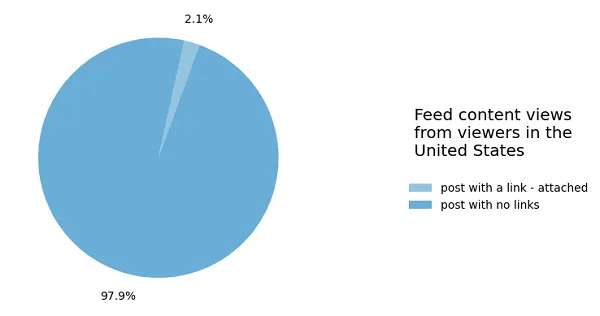

Meta has released its latest comprehensive overview detailing content violations, hacking attempts, and feed engagement trends. This report provides a wealth of statistics and insights into user interactions on Facebook, highlighting what users are reporting and the content that is garnering the most attention at any given moment.
For instance, the Widely Viewed Content Report for Q4 2024 unveils significant insights, offering a treasure trove of data, including notable statistics like this:
Unfortunately, the findings are discouraging for publishers, as a staggering 97.9% of the views on Facebook posts in the U.S. during Q4 2024 did not link to any external sources outside of Facebook itself. This statistic underscores a troubling trend for content creators seeking to drive traffic from the platform.
This percentage has progressively increased over the last four years, with the first Widely Viewed Content Report published for Q3 2021 indicating that 86.5% of posts shown in feeds lacked links to external content. This steady rise indicates a significant shift in user engagement and platform dynamics.
This radical increase signifies that obtaining organic referrals from Facebook is increasingly challenging. Moreover, Meta has actively de-prioritized external links as part of its strategy to shift away from news-focused content. Despite potential adjustments allowing for greater political discourse, the current data suggests that the platform remains largely averse to linking out.
If you’ve been perplexed by a decline in your Facebook traffic, this report certainly sheds light on a major contributing factor.
The list of the top ten most viewed links in Q4 reflects the typical assortment of seemingly random content that has inexplicably resonated with Facebook users.
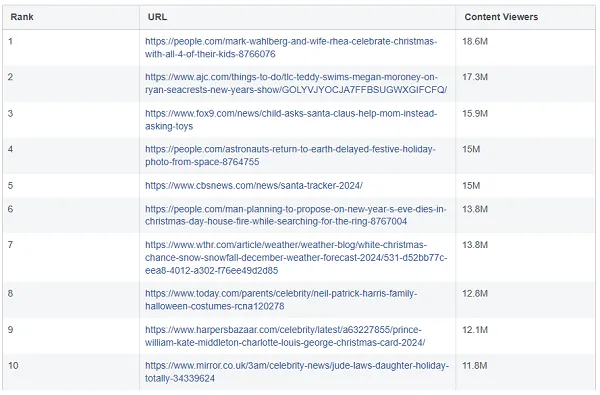
Examples include astronauts celebrating Christmas, Mark Wahlberg sharing a family photo for the holiday, and Neil Patrick Harris performing a Christmas song. These instances highlight the trend of supermarket tabloid-style content dominating discussions on Facebook, alongside heartwarming tales of seasonal cheer.
For example: “Child Asks Santa Claus to Help Mom Instead of Asking For Toys.”
Charming? Yes. But also, somewhat disheartening.
The most shared posts overall aren’t significantly better either.

If you aim to capture attention on Facebook, consider emulating the content strategies of celebrity magazines, as this type of material tends to gain traction. Displays of virtue or “intellectual” content still find their audience, but the platform’s current trends lean heavily towards sensationalism.
Interpret that as you will.
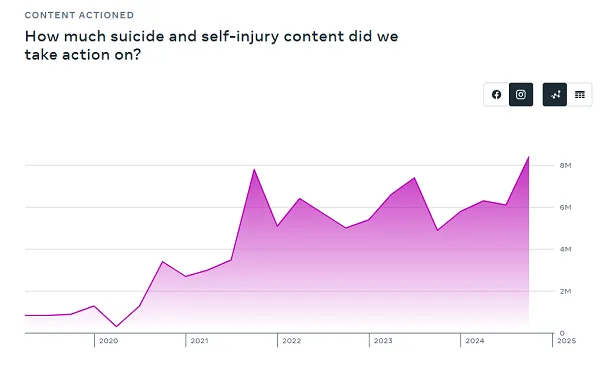
Regarding rule violations, there were no notable spikes during this period. However, Meta did report a rise in instances of Violent & Graphic Content on Instagram, attributed to enhancements in its proactive detection technology.
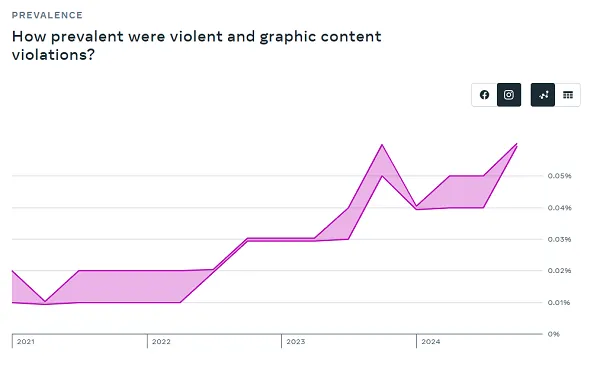
This raises some important concerns:
Additionally, it is noteworthy that Meta reported that fake accounts “made up approximately 3% of our worldwide monthly active users (MAU) on Facebook during Q4 2024.”
This is significant because Meta typically estimates this number at around 5%, which has become an industry standard, as accurately determining this figure is quite challenging. The reduction suggests that Meta may have enhanced confidence in its detection capabilities or simply adjusted its calculation methods.
Meta also shared an intriguing update:
“This report is for Q4 2024, and does not include any data related to policy or enforcement changes made in January 2025. However, we have been tracking those changes and thus far have observed no significant impact on the prevalence of violating content, despite no longer proactively removing certain content. Additionally, we have noted a decrease in enforcement errors with this new approach.”
This change reflects Meta’s controversial shift to a Community Notes model, which entails the removal of third-party fact-checking. Furthermore, Meta has revised several of its policies, especially concerning hate speech, aligning them more closely with political preferences observed during the Trump Administration.
Meta claims that these adjustments have not led to major shifts in the nature of violative content, at least not yet, while also indicating a reduction in mistakenly banned accounts.
On the surface, this may sound like a positive development, suggesting that the changes are yielding beneficial outcomes.
Right?
However, this assertion may not hold much significance.
The decrease in enforcement errors aligns logically with the reduction in overall enforcement actions. Consequently, it is expected that mistaken enforcement will decline. The pressing concern remains whether legitimate enforcement actions persist at a consistent rate as Meta adopts a more lenient approach towards content moderation, granting more freedom regarding certain types of speech.
As a result, the current statement appears somewhat meaningless at this point, serving more as a dismissive response to critics of these policy changes.
In terms of threat activity, Meta identified several minor operations during Q4, originating from nations such as Benin, Ghana, and China.
More notably, Meta detailed a Russian-based influence operation known as “Doppleganger,” which it has been monitoring for several years:
“Beginning in mid-November, the operators ceased targeting users in the U.S., Ukraine, and Poland on our platforms. They are still focusing on Germany, France, and Israel, while making some isolated attempts to reach audiences in other countries. Based on open-source reports, it appears that Doppleganger has not made this same transition on other social media platforms.”
This indicates a shift in strategy after the U.S. elections, with Russian influence operations showing less interest in swaying public sentiment in the U.S. and Ukraine. This transition presents an intriguing development.
You can access all of Meta’s latest enforcement and engagement metrics in its Transparency Center, which offers valuable insights into what types of content are resonating on Facebook, as well as the evolving nature of its safety initiatives.



 Sophie Langley
 Clara Hastings