Ethan Carter

The relentless quest of humanity to explore the vastness of deep space continues to inspire innovative methods to traverse unimaginable distances. Traditional rocket propulsion systems would require thousands of years to reach our closest stellar neighbor, Alpha Centauri. In contrast, researchers are investigating the potential of using light as a faster, more cost-effective, and sustainable propulsion method that could pave the way for exciting deep space travel.
A dedicated team of researchers at Texas A&M University has successfully demonstrated the capability of using laser beams to lift and maneuver tiny engineered devices without any physical contact. The groundbreaking findings from their recent experiment, published in Newton, hold promising implications for the application of light propulsion as a scalable technology that could one day enable missions to Alpha Centauri.
Harnessing the Power of Light for Space Travel
The concept of utilizing light to propel objects in the vacuum of space is not a recent invention. Light particles, known as photons, carry momentum that can be transferred to an object’s surface, producing small yet effective thrust. This revolutionary technology has already been proven with solar sails, which harness sunlight to propel small spacecraft through space, mimicking the way wind propels sailboats across water.
The latest research builds upon this fundamental principle, with the ambitious goal of using lasers to drive an entire spacecraft toward distant deep space destinations. The scientists behind this study have developed cutting-edge micron-scale devices called metajets—ultrathin materials that are thinner than a human hair. These innovative devices are etched with intricate patterns that function as a lens, allowing researchers to manipulate how light interacts with them.
Through this sophisticated design, the scientists successfully controlled the momentum transfer induced by the laser beam, enabling precise steering of the metajets in all three dimensions. This capability for full 3D maneuverability distinguishes this experiment from earlier research into light propulsion systems and represents a significant leap forward in the field, as acknowledged by the researchers.
Exploring the Mechanics of Light Propulsion
The phenomenon is akin to a ping pong ball rebounding off a surface, as explained by Shoufeng Lan, assistant professor and director of the Lab for Advanced Nanophotonics at Texas A&M. When light reflects off an object, it transfers its momentum, generating a small but significant force that propels the object forward.
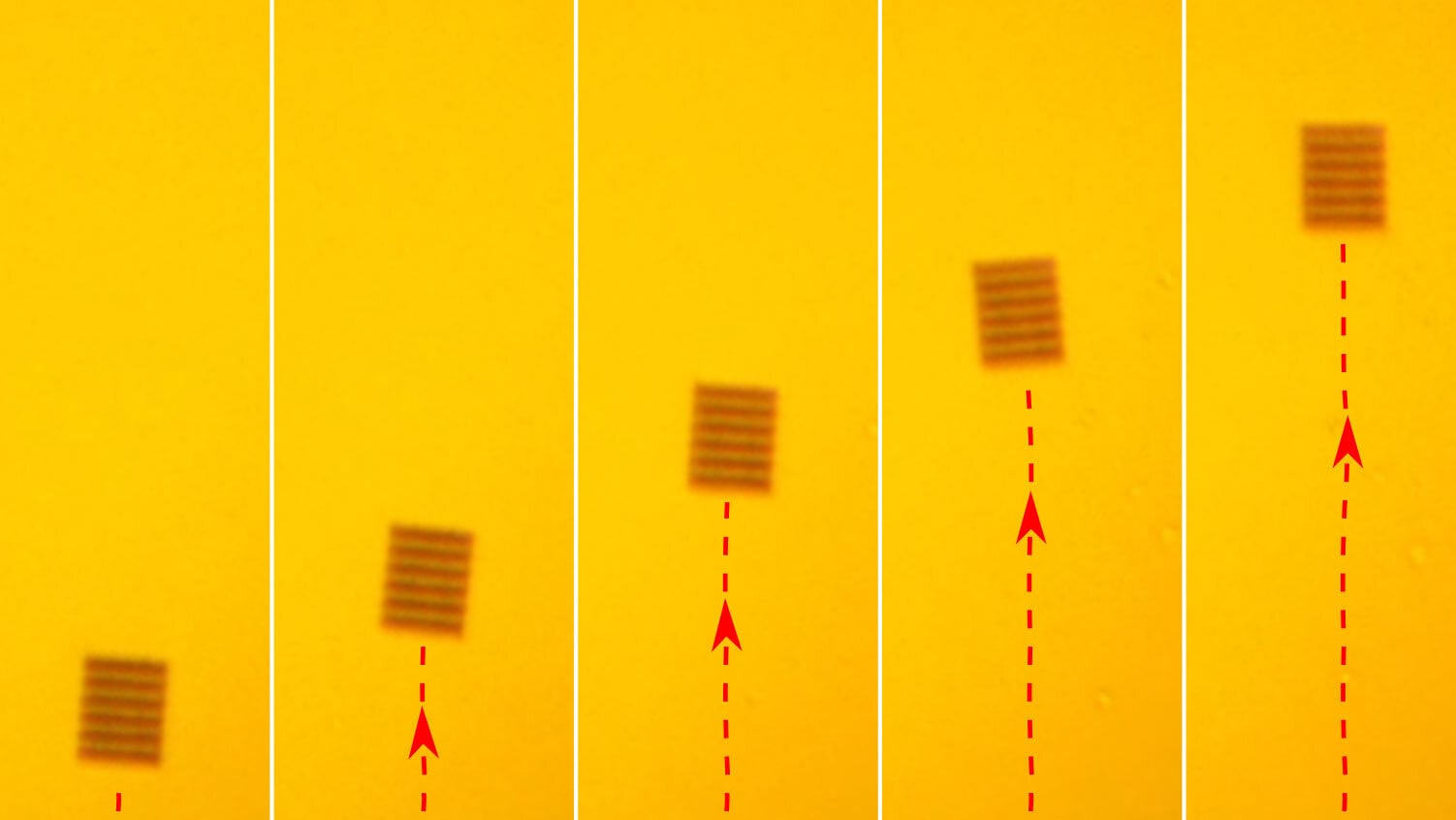
The experiment was conducted in a fluidic environment to counteract gravity and enhance the visibility of the metajets’ movements. Although the devices utilized in this experiment are remarkably small, the research team is confident that the underlying principles can be scaled up to accommodate larger objects given adequate optical power.
Differing from traditional methods that manipulate an object by shaping the light itself, this innovative approach embeds control directly into the material through tiny patterns, enabling a more flexible generation of force. Consequently, the force generated relies more on the inherent power of the light rather than the dimensions of the object being propelled.
The researchers believe that their groundbreaking device could eventually be adapted for a mission to Alpha Centauri, potentially allowing for a relatively swift journey of around 20 years to the star system. They aspire to test these devices in a microgravity environment to investigate how the metajets would perform in the conditions of space.
In a similar vein, the European Space Agency has recently experimented by directing a laser beam at graphene aerogels, successfully propelling the material forward using only light. This experiment aims to contribute to the development of a propellant-free future for space travel.

 Daniel Mercer
 Brandon Fletcher