David Bridges

TikTok has recently revealed its newest content moderation and user engagement statistics for the EU, as part of its compliance with the Digital Services Act (DSA). This disclosure sheds light on various aspects of content moderation, user growth, and other relevant metrics within the region, offering insights that are vital for understanding the platform’s evolving dynamics.
The latest report spans the timeframe from July to December 2024 and marks TikTok’s fourth DSA report. According to the regulations set forth by the EU Digital Services Act, prominent online platforms like TikTok are mandated to provide periodic updates regarding their operations in critical areas, thus enhancing transparency and accountability in the digital space.
While much of the information aligns with previous trends observed in earlier reports, there are noteworthy developments that merit attention.
To begin with, TikTok reported a staggering removal of nearly 21.2 million pieces of content during this period due to violations of its Community Guidelines. Additionally, it took down around 1.5 million items for breaches of its advertising policies, reflecting a robust approach to maintaining platform integrity.
The number of content removals related to Community Guidelines is consistent with TikTok’s previous DSA reports; however, the recent spike in ad removals is remarkable, showing a 3.4-fold increase overall since the last update. This indicates a heightened vigilance in monitoring advertising practices.
What could be driving this trend?
During this reporting period, TikTok experienced a fourfold escalation in content removals linked to “Misleading and False Content,” alongside a similar surge in removals for “Adult and Sexual Content.” This highlights the platform’s commitment to ensuring a safer and more reliable environment for its users.
Moreover, there was a sixfold increase in content removals due to “IP Infringement,” illustrating TikTok’s intensified enforcement in response to its expansion into in-stream shopping, which demands stricter adherence to intellectual property rights.
However, the most significant surge reported was a staggering 19-fold increase in removals categorized under “Politics, Religion, and Culture.”
This escalation is not entirely unexpected, considering the major elections that occurred during the reporting period. It is intriguing to note that several politically motivated groups seemingly attempted to leverage TikTok to amplify their messages. While these efforts may have had some success, the high removal numbers indicate that TikTok’s moderation processes effectively identified numerous misleading advertisements.
This trend may also suggest increased scrutiny and potential censorship of content related to cultural issues, although the report lacks a detailed breakdown regarding the specifics of these removals.
In terms of its content moderation workforce, TikTok reported employing 5,807 individuals dedicated to content moderation within the EU as of the end of December 2024.
This figure represents a decline from its previous reports.
In its prior update, which was published in October of the previous year, TikTok disclosed having 6,354 moderators operating in the EU, indicating a reduction of 547 staff members over a span of six months. This decrease may raise concerns among EU regulators regarding the company’s commitment to effective content moderation.
The slight increase in moderation staff reported in the last update (+67) may suggest a temporary adjustment, but this significant reduction indicates a potential shift towards greater reliance on artificial intelligence systems to identify and address content issues.
Indeed, TikTok emphasized its advancements in technology:
“In the second half of 2024, the accuracy rate for our automated moderation technologies was 99.1%. This builds upon the high accuracy we achieved in the first half of the year, even as moderation volumes increased, reflecting our continued investment in improving precision and reducing incorrect removals.”
Therefore, it appears that TikTok is gradually decreasing its dependence on human moderators, which is an important trend to monitor moving forward.
Finally, regarding user engagement, TikTok has reported a total of 159.1 million monthly active users in Europe during this reporting period.
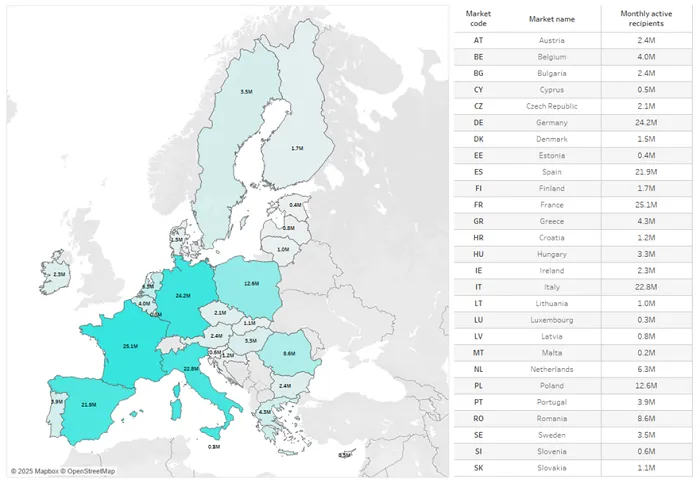
This figure represents an increase of approximately 9 million users compared to the previous report, illustrating TikTok’s consistent growth within the region and its expanding influence in the digital landscape.
This is positive news for TikTok, particularly as its future in the U.S. market remains uncertain. The company is also planning to enhance its focus on TikTok shopping within Europe to leverage its growing popularity and user base.
Germany, France, Italy, and Spain continue to be TikTok’s primary markets within the EU, each boasting over 20 million users.
For comparison, the U.S. currently has around 170 million TikTok users, emphasizing the platform’s significant reach and engagement potential.
This report highlights some compelling insights into TikTok’s ongoing efforts to eliminate specific problematic content, particularly in the arenas of intellectual property violations and misleading advertisements.
Such issues could potentially undermine user trust in its in-app sales functionalities. Thus, TikTok must continue to enhance its detection systems to identify such violations. It will also be intriguing to observe how the trends in content removals related to politics and religion evolve over time.
You can check out TikTok’s latest DSA report here.



 Maya Kensington