 Daniel Mercer


Sony has unveiled its latest cinema camera, the FX5, which introduces several long-anticipated features that may soon appear in its consumer mirrorless lineup. Positioned between the FX3 and FX6 in the “Cinema Line,” the FX5 includes enhancements like RAW video recording and open gate capabilities—features previously absent in Sony’s offerings. With its impressive 16.6-megapixel stacked sensor, five-axis stabilization, and three base ISO settings, this camera promises to deliver exceptional cinematic quality, albeit at a premium price point.
The standout feature of the FX5 is its innovative 16.6MP fully stacked full-frame sensor, designed to provide an optimal blend of speed and resolution.
For 5K RAW recording, Sony employs its proprietary X-OCN codec, which stands for “Extended tonal range original camera negative.” This codec offers creators a groundbreaking 16-bit linear RAW recording capability, allowing for an astounding 280 trillion colors—significantly more than the 12-bit ProRes RAW or Canon’s 12-bit C-RAW codecs. Video is recorded through dual CFexpress Type A card slots, compatible with Sony-validated cards. The FX5 also supports high frame rate recording, capable of capturing 4K at 240 fps, 4.5K at 120 fps, and 5K at 60 fps, all of which are firsts for Sony’s FX series cameras.
The open gate recording feature, which captures video at a 3:2 aspect ratio, utilizes the full width of the sensor, making it easy to crop or create vertical videos during post-production. a new de-squeeze function simplifies the use of anamorphic lenses. Looking ahead, Sony has announced plans for 4K 240p functionality in RAW mode and Open Gate 3:2 XAVC-I modes, along with an updated user interface optimized for vertical shooting, expected to roll out by August 2027.
A unique addition to this model is the three base ISO settings, which are 800, 4000, and 12800. This feature enhances dynamic range, providing cleaner shadows and improved sharpness compared to standard dual base ISO cameras. For filmmakers working in low-light conditions, the ability to capture clean video at ISO 12800 will be transformative. For even greater dynamic range, reaching up to an impressive 16 stops, users can leverage the Dual Gain mode, although this may increase rolling shutter effects.
Stabilization is often a concern with cinema cameras, but Sony has prioritized this aspect in the FX5. The level of stabilization varies based on the lens used, but the updated electronic Dynamic Active mode is designed to deliver smooth footage even during movement. Interestingly, Sony offers a service for filmmakers who prefer not to use In-Body Image Stabilization (IBIS), allowing for a permanent locked sensor conversion.
 Sony
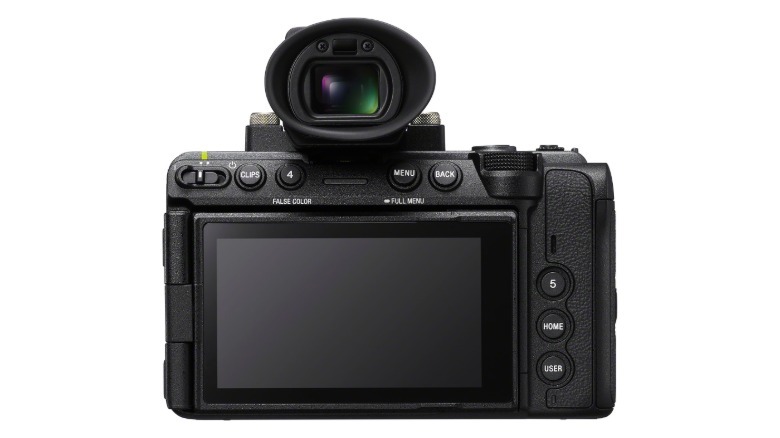
The FX5 boasts a lightweight (1.62 pounds) and compact design, similar to the FX3. Its body is equipped with quarter-inch mount screws for attaching cinema accessories and features a comfortable grip reminiscent of Sony’s A7 models. It includes an array of manual controls, featuring numbered buttons similar to Canon’s C50, which enhances usability.
The removable OLED electronic viewfinder (EVF) offers 3.68 million dots and 2,500-nit brightness, accompanied by a wide color gamut. The rear display measures 3.5 inches with a 16:9 aspect ratio, providing superior brightness and clarity (2.76 million dots), and utilizes Sony’s four-axis articulating design, making it a great option for vloggers. Similar to Sony’s higher-end mirrorless cameras, it includes two CFexpress and two SDXC UHS-II card slots, as well as ports for microphones and headphones, a full-sized HDMI port, Ethernet, and tri-band Wi-Fi. The camera is powered by Sony’s new NPSA100 battery from the A7R VI, which enables up to 130 minutes of recording time.
The FX5 is now available for pre-order, starting at $4,898 (body only), with plans for availability in mid-August. Alternatively, buyers can opt for a version with a handle that provides XLR audio connectivity for $5,498, or purchase the handle separately for $798. Many hope that features such as RAW recording and Open Gate video will eventually be incorporated into Sony’s vlogging and mirrorless camera lines.



 Brandon Fletcher