 David Bridges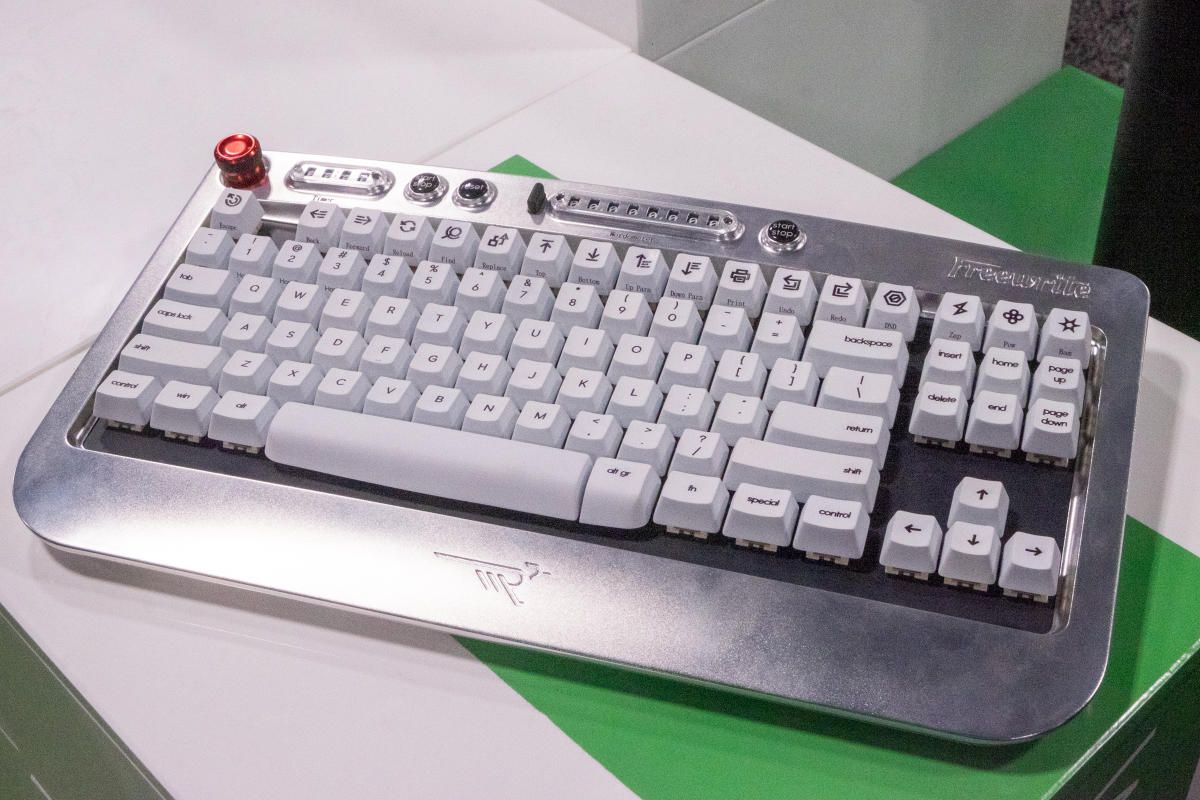

The Detroit-based company Astrohaus has been crafting its innovative “distraction-free writing tools” under the Freewrite brand for nearly a decade. Until now, these products have consisted solely of standalone, single-purpose devices designed specifically for text drafting. However, at CES 2025, Astrohaus is expanding its horizon with the introduction of a new mechanical keyboard called the Freewrite Wordrunner, which is uniquely engineered with the needs of writers in mind.
This announcement follows a three-year period of quiet development after Astrohaus initially revealed plans for a keyboard, initially dubbed the Maestro. Although the company postponed its intended 2022 launch, it appears they have been diligently refining the concept throughout this time. According to CEO Adam Leeb, the team has been working on this project for almost four years, focusing on creating a product that meets the specific demands of the writing community.
While mechanical keyboards have predominantly catered to the gaming community, Astrohaus aims to create a device that serves professional writers. Though I can’t provide a definitive assessment without firsthand experience, the Wordrunner showcases several interesting features that promise to enhance the writing process.
The Wordrunner features a tenkeyless design that resembles conventional keyboards at first glance. However, a closer inspection reveals that the function row has been replaced with a custom set of keys tailored to streamline navigation within text documents. This includes essential functions like find and replace, undo and redo, as well as paragraph navigation keys. While I might miss the media controls typically found in the function row, the Wordrunner compensates with a bright red joystick/button, which can navigate in all four directions, turn like a knob, and be pressed to control playback, volume, or pause music effortlessly.
On the opposite side of the keyboard, three customizable macro keys feature whimsical names: “zap,” “pow,” and “bam.” These keys can be programmed for a variety of functions, and Astrohaus suggests employing them to launch specific writing applications, convert text to title case, or insert the current date. While I am still contemplating their potential uses, having customizable keys is a standard feature expected by most keyboard enthusiasts, so it’s encouraging to see them included here.
An eye-catching aspect of the Wordrunner is the two mechanical counters located at the top. One is a timer designed for writing sprints or to help maintain focus, while the standout feature is the Wordometer positioned prominently in the center. This mechanical counter tracks your word count with its impressive eight-digit display, allowing users to monitor their progress continually. You can save your word count indefinitely or reset it whenever necessary, which is ideal for writers who want to challenge themselves or pause the count while engaging in other activities like chatting or sending emails.
The mechanical keys are backlit and equipped with Kailh switches; while the keycaps are replaceable, the switches themselves are not. The design incorporates sound dampening features, allowing the keyboard to be used without disturbing those nearby with excessively loud keystrokes, which may appeal to various users. In terms of connectivity, the Wordrunner supports both Bluetooth and USB-C, enabling pairing with three different devices and effortless switching between them using dedicated hotkeys.
Having had the opportunity to test a prototype of the Wordrunner, my initial impression was one of surprise at its substantial weight. The keyboard boasts a thick slab of polished aluminum, which emulates the premium finish of the Hemingway edition of the Smart Typewriter. According to Astrohaus founder and CEO Adam Leeb, the goal was to create a keyboard that conveys a premium, limited-edition feel, even though it is intended to be a permanent fixture in their product lineup.
Although I did not connect the Wordrunner to a computer for testing, I was able to observe the mechanical Wordometer in action as I typed. It was incredibly satisfying to see the counter increment while I composed an imaginary story, and a small LED indicator lights up green when the counter is active and red when it is off. The keys felt excellent, and the travel distance was satisfying, while the joystick provided a delightful tactile experience. I am eager to utilize its functionality as a volume control for media playback. Leeb mentioned that while this keyboard is still in the prototype stage, it already feels impressively polished and nearly ready for market.
Finally, the critical question of availability arises. Astrohaus is set to launch the Wordrunner on Kickstarter, in line with its approach for most of its hardware over the past decade. The campaign is expected to debut in February, featuring early bird pricing, although the exact price remains undisclosed. Fortunately, interested parties can secure the best pricing with a minimal commitment by placing a $1 reservation for priority access. The company plans to deliver the first batch of keyboards before the end of the year, making this an enticing opportunity for those intrigued.
Update, January 8 2024, 9:27PM ET: This article has been updated to include hands-on impressions and photographs of the Wordrunner.



 Daniel Mercer
 Ethan Carter