David Bridges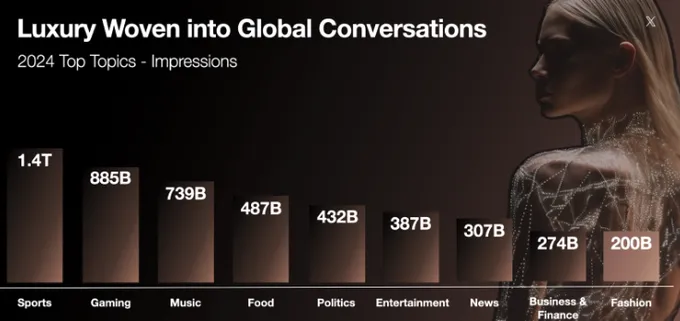

Recent insights shared by X shed light on the evolving landscape of fashion discussions within its platform. However, the data supporting these insights raises questions due to its ambiguity and lack of clarity in certain areas.
This trend of vague communication has unfortunately been prevalent in many of X’s announcements.
X begins its overview of the fashion sector by asserting that its platform has become the central hub for ongoing fashion discussions, indicating a significant shift in how fashion is communicated and perceived.
According to X:
“Luxury is no longer confined to exclusive boutiques and high-end runways – it’s happening in real-time, where culture is shaped, trends are born, and digital influence drives desirability. X has become the epicenter for luxury conversations, where fashion, sports, AI, and technology intersect to define the future of high-end experiences.”
This statement is certainly compelling; one can only wonder what concrete data supports such a bold claim.
The accompanying chart reveals that “Fashion” ranked as the 9th most discussed topic on X in 2024, with a staggering total of 200 billion impressions. This statistic indicates a significant level of interest and visibility within the platform.
However, the impact of this data is diluted by the lack of context surrounding what these impressions truly signify.
In X’s terminology, impressions denote the instances when a post appears on a user’s screen, which does not necessarily correlate with user engagement or interactions. If the focus remains on impressions, and considering that X has control over the algorithm that dictates visibility, it raises concerns about the authenticity of trends presented on the platform.
A more insightful metric would be total engagement, which would require comparative data for relevance. X attempts to provide this by showcasing fashion’s performance against other topics regarding total impressions.
Interestingly, previous reports from X indicated that all other topics, with the exception of fashion, exhibited identical impression statistics for 2023:
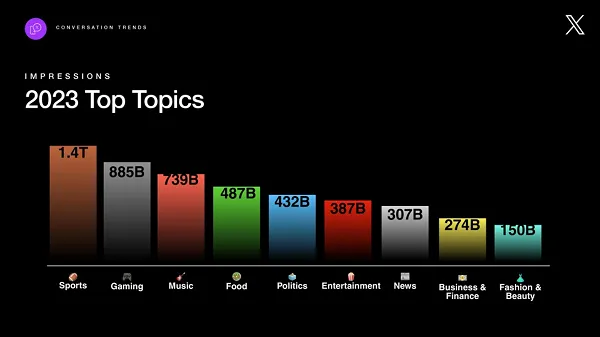
This discrepancy raises suspicions that X may have inflated the “Fashion” figures, as it seems improbable that all other topics would share the same impression statistics year-over-year.
While I would expect engagement rates to show some similarity, having identical numbers across the board is quite dubious.
As previously mentioned, this pattern of questionable data consistency has become a hallmark of X’s reporting, often leading to the perception that figures are fabricated or that presented data lacks meaningful context.
Data points like “200 billion impressions” lack substantive detail, while contradictory figures can undermine trust in X’s overall claims, prompting skepticism regarding the authenticity of all provided statistics.
Without access to X’s internal metrics, we must rely on their reported figures, and conflicting data raises legitimate concerns about their accuracy.
This issue of data credibility has become increasingly apparent since Elon Musk’s acquisition of X, leading to a series of communication missteps that would likely be avoided with a dedicated PR team.
Nonetheless, we must work with the information that X has made available.
In addition to the previously discussed points, X has also presented another chart:
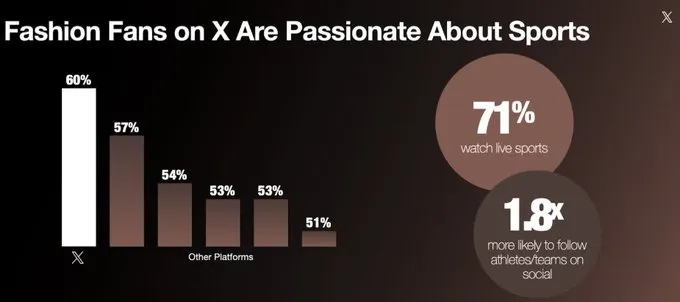
What does this data represent? I’m at a loss. What is the significance of the 60% figure?
X further elaborates that:
“Luxury brands are tapping into the sports ecosystem on X by leveraging high-profile athlete partnerships, runway collaborations, and premium sports event sponsorships. The intersection of sportswear and high-end fashion has given rise to sporty elegance, a key trend shaping the luxury industry in 2025.”
This statement, while intriguing, fails to clarify the meaning of the 60% statistic, leaving us to ponder its relevance.
X also mentions that:
“The luxury conversation on X is fueled by a global community of tastemakers, from industry insiders to digital creators who shape the future of fashion. X is the ultimate space where fashion conversations reach mass audiences instantly.”
However, the examples provided feature posts from individuals with fewer than 10,000 followers, raising questions about who qualifies as these so-called “tastemakers.”
X has also compiled an overview of luxury fashion conversations and ongoing trends that persist over time.
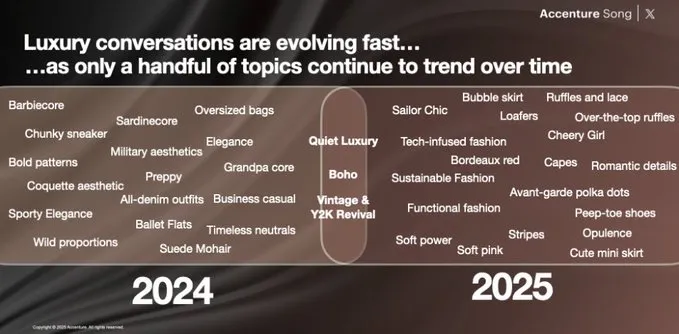
Nevertheless, my confidence in X’s data analysis capabilities remains low, making it difficult to place significant trust in this overview. However, the highlighted crossover trends appear to align with Google’s top holiday product trends reported in November last year.
Ultimately, the information provided does not effectively convey X’s true influence and value for fashion marketers. The latter part of the report discusses how to utilize its Grok AI chatbot to discover emerging trends and its Radar analytics tool to monitor similar insights.
Radar appears to be a promising resource, offering insights into real-time trends derived from X’s data, making it a valuable tool for marketers aiming to stay ahead.
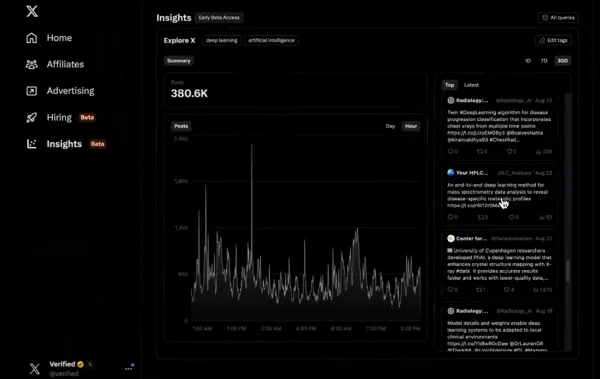
However, it is only accessible to Premium+ subscribers, requiring an additional investment to benefit from these insights.
So, what can we conclude from this data? Clearly, discussions surrounding fashion are taking place on X, with a notable volume of impressions suggesting significant engagement. Yet, without comprehensive context or clarity regarding the topics categorized under “Fashion,” it is challenging to assess the true depth of this engagement, and X’s report does little to clarify this.
For fashion brands contemplating marketing investments, it may be worthwhile to review X’s report independently and derive your own conclusions from the data presented.
For more information, you can access X’s fashion trends report here.


 Sophie Langley
 Ivy Caldwell