David Bridges

Recent studies reveal that social media platforms have surpassed television as the primary source of news for Americans. Additionally, influencers are increasingly playing a significant role in the dissemination of news and information, reshaping the landscape of how we consume media.
This finding comes from the latest Reuters Institute “Digital News Report,” which surveys 100,000 participants across 48 countries, offering insights into their digital content consumption behaviors and preferences.
While you can download the complete 171-page report for an in-depth analysis, this article will highlight some of the most impactful findings.
To begin with, the report indicates that social media has officially become the leading source of news for adults in the United States.
According to the report:
“The proportion of individuals accessing news through social media and video networks in the United States (54%) has significantly increased, surpassing both TV news (50%) and news websites/apps (48%) for the first time.”
If you’ve been questioning why sensational, divisive, and fear-inducing content tends to dominate news cycles, this data might provide some clarity.
The algorithms used by social media platforms often reward content that sparks arguments and generates emotional responses. These interactions are valued as engagement, which subsequently leads to increased reach, more conversations, and a larger audience. Consequently, both social media and the broader digital media landscape effectively encourage divisive and polarizing content, amplifying voices that may prioritize sensationalism over accuracy.
This dynamic significantly impacts current political discourse, illustrating why figures like Elon Musk were eager to acquire platforms like Twitter to influence narratives around their personal brands and business interests.
It’s also enlightening to analyze which social media platforms users turn to for news engagement:
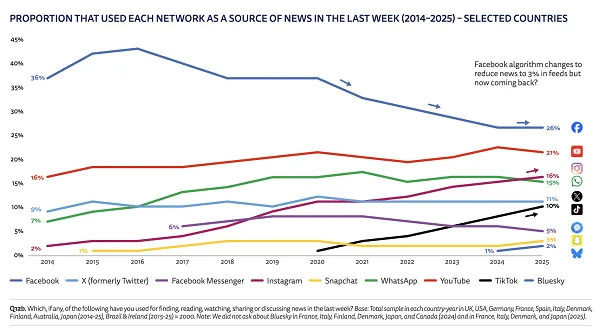
The utilization of X has seen only a modest increase, while the popularity of Instagram and TikTok as news sources has surged recently. Despite this, Facebook and YouTube continue to be the primary news sources for many, particularly among older demographics.
However, this trend may shift in the future:
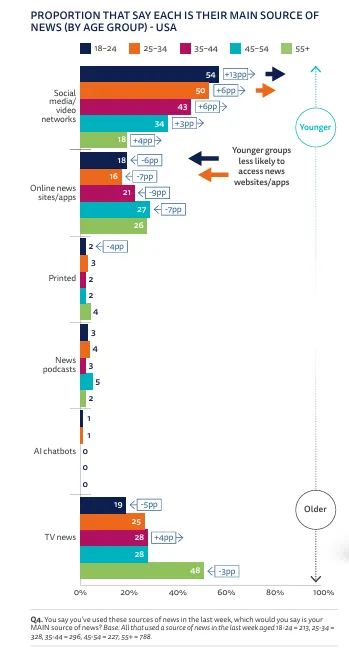
Young audiences are increasingly inclined to depend on social media for news updates. Observing the usage patterns of the most popular apps within these demographic segments reveals significant trends:
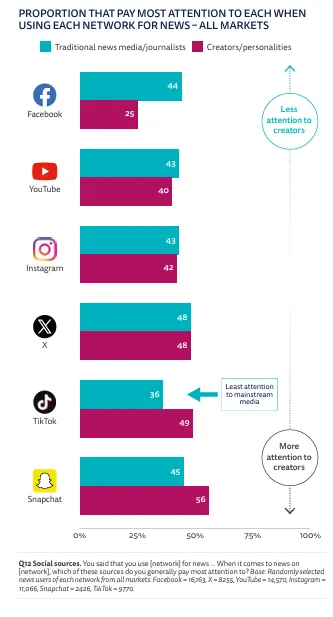
This trend also indicates that influencers are gaining considerable influence over the opinions of younger audiences.
As these younger viewers mature, their reliance on trusted voices, rather than traditional “mainstream” media, is likely to reshape the media landscape. The key factor remains the personalities that resonate with their audiences, delivering information that aligns with their preferences. This shift may heighten the effects of confirmation bias, as individuals seek validation from their favorite content creators rather than relying on established media outlets.
Is this development a positive change?
The answer largely hinges on your viewpoint. A growing number of individuals express skepticism toward the media and the information disseminated by news sources. This sentiment has been intensified by experiences such as the COVID-19 pandemic, which revealed inconsistencies in messaging regarding how to manage and mitigate its effects.
As younger users continue to mature alongside these influencers as their peer guides, it’s evident that this new cohort of digital media voices will significantly impact future elections.
Could we see a future where a figure like MrBeast runs for president? This scenario seems increasingly plausible as these creators amass more influence and authority within their spheres.
The report also examines the emergence of video content specifically, detailing how audiences engage with news material online:
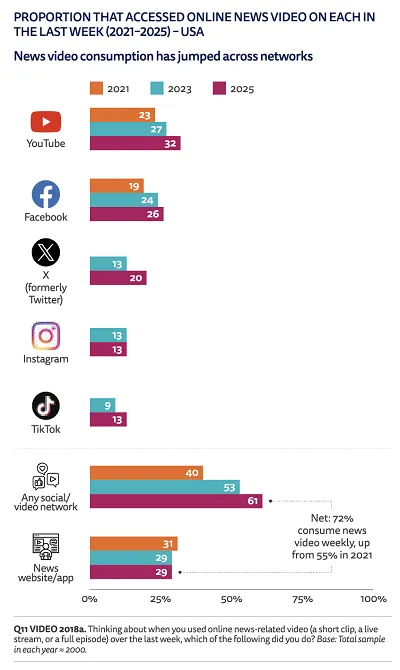
This trend reflects a broader movement where an increasing number of people are turning to video as a primary source of engagement and entertainment.
With the availability of video content now at our fingertips, particularly on mobile devices, it’s no wonder that audiences prefer watching clips over reading lengthy articles.
This shift raises questions about the potential impact on learning and comprehension regarding complex topics. Reading encourages a slower, more deliberate thought process, allowing for a thorough understanding of presented facts. Yet, as we adapt to a constantly evolving array of inputs, this may counterbalance some of the absorption loss typically associated with reading and writing.
Perhaps.
The growing reliance on video also highlights the potential dangers of generative AI, particularly concerning hyper-realistic generated videos. Such advancements could lead to an increase in convincing video hoaxes, although this issue has not yet reached a critical point.
Overall, it appears we are heading toward a model of news consumption that favors rapid information processing over in-depth understanding, which makes us more vulnerable to misinformation and disruptions from various sources.
The pivotal question remains: Can traditional media outlets regain public trust and reestablish themselves as significant sources of news and information, or has the opportunity passed, leaving us to depend on personalities like Joe Rogan to keep society informed?
The statistics presented suggest the latter is more likely.
For further insights, you can download the complete “Reuters Institute Digital News Report 2025” here.


 Maya Kensington
 Mason Thompson