Brandon Fletcher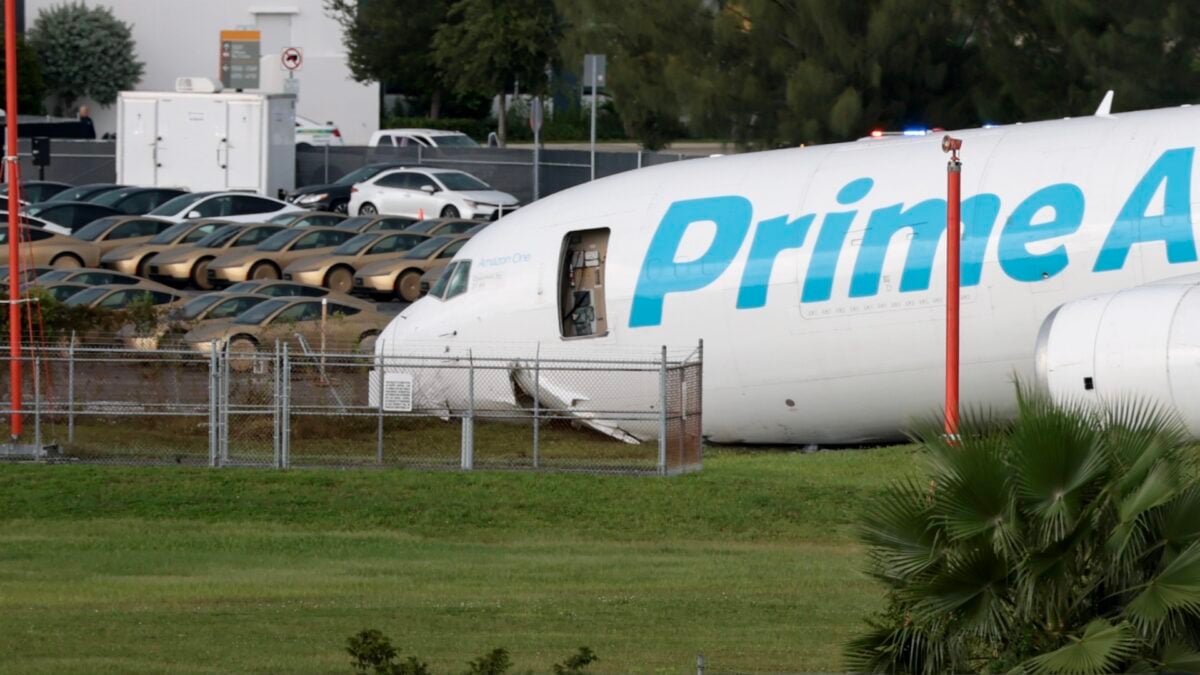

In a bizarre incident described by Elon Musk as “Weird,” an Amazon cargo plane tragically crashed in Miami, nearly landing in a parking lot filled with Tesla Cybercabs.
Tesla recently unveiled its gold-colored autonomous vehicles known as Cybercabs, which operate without traditional steering wheels or pedals. These vehicles are currently available for rides through the company’s app-based ride-hailing service, albeit within a very limited area in Austin, Texas.
On Sunday, an Amazon Prime Air cargo plane malfunctioned shortly before landing at Miami International Airport, ultimately overshooting the runway. The aircraft collided with a cargo van that was transporting an airport cleaning crew, as well as an SUV parked nearby. This tragic event resulted in five fatalities.
The plane came to a halt mere feet away from a parking lot where, for reasons not yet explained, a number of Tesla Cybercabs were stationed.
🔴 La FAA annonce la fermeture jusqu’à nouvel ordre de l’aéroport de Miami suite à la violente sortie de piste du Boeing 767 de Prime Air.
Les services d’urgence de l’aéroport signalent plusieurs victimes après l’accident. pic.twitter.com/bQrNaNw97l
— air plus news (@airplusnews) September 6, 2026
Mapping the crash site using data from FlightRadar24 and the Federal Aviation Administration (FAA), it appears that the wrecked plane’s final position aligns with a rental lot for truck trailers. The day before the incident, EV influencer Sawyer Merritt shared a video showcasing that very lot, which had 35 Cybercabs parked within it.
While the Tesla website notes that there is a Robotaxi service in Miami, it clarifies that there is no Tesla Cybercab Robotaxi service available. Currently, the Robotaxis operating in Miami’s autonomous fleet consist of Model Y vehicles equipped with traditional pedals and steering wheels. Until recently, Tesla’s rides were monitored by human safety operators, but the company seems to have transitioned to a fully unsupervised model in Austin ahead of the limited Cybercab launch.
Tesla’s fleet of Model Y vehicles in Miami is reportedly operating unsupervised, starting with just two vehicles at launch in early July and expanding to three shortly thereafter.
Elon Musk has indicated that Cybercabs will not be exclusive to Tesla. He envisions that individuals will be able to purchase them for personal use or as a means to generate passive income. Earlier this year, Musk stated that private Cybercabs would be priced at $30,000 or less and expected to be available before 2027, which is just a few months away.
Production of Cybercabs commenced in April at Tesla’s Gigafactory in Texas, with a capacity to manufacture 125,000 units annually. A cheeky headline from Sherwood News referred to Cybercabs as “piling up,” suggesting they remain largely unused. Social media accounts dedicated to tracking Tesla’s progress occasionally report on the number of Cybercabs accumulating in the Gigafactory’s outbound lot, sometimes exceeding 100.
Currently, there are approximately 45 registered Cybercabs operating on Texas roads, with a portion conducting commercial operations in Austin. This limited deployment has prompted a safety investigation by the National Highway Traffic Safety Administration, which will scrutinize Tesla’s certification process for ensuring Cybercabs meet NHTSA safety standards. The NHTSA’s memo highlights that the investigation will assess the degree to which Tesla’s certification relied on specific determinations that certain [vehicle standards] do not apply to the Cybercab.
Social media users frequently spot Cybercabs on public roads beyond Texas, often with Texas license plates. Positive news about Cybercabs sometimes fuels memes from Tesla enthusiasts who mock critics, suggesting that America’s roads will soon be filled with these gold vehicles. Just last month, some were seen in a lot behind a Tesla dealership in Pittsburgh, and a couple of weeks ago, others were observed in a Las Vegas lot. When spotted outside Texas, these vehicles typically still have steering wheels and pedals.
The near-miss of a plane crashing into a parking lot filled with Cybercabs that have yet to fully launch serves as a powerful reminder that, while America’s roads may not be golden yet, many of its empty parking lots might soon be.
Gizmodo attempted to reach out to Tesla for clarification regarding the presence of Cybercabs in Miami and whether the plane incident would impact future rollouts of Cybercabs as part of its ride-hailing service. As of publication, no response had been received.


 Daniel Mercer