 David Bridges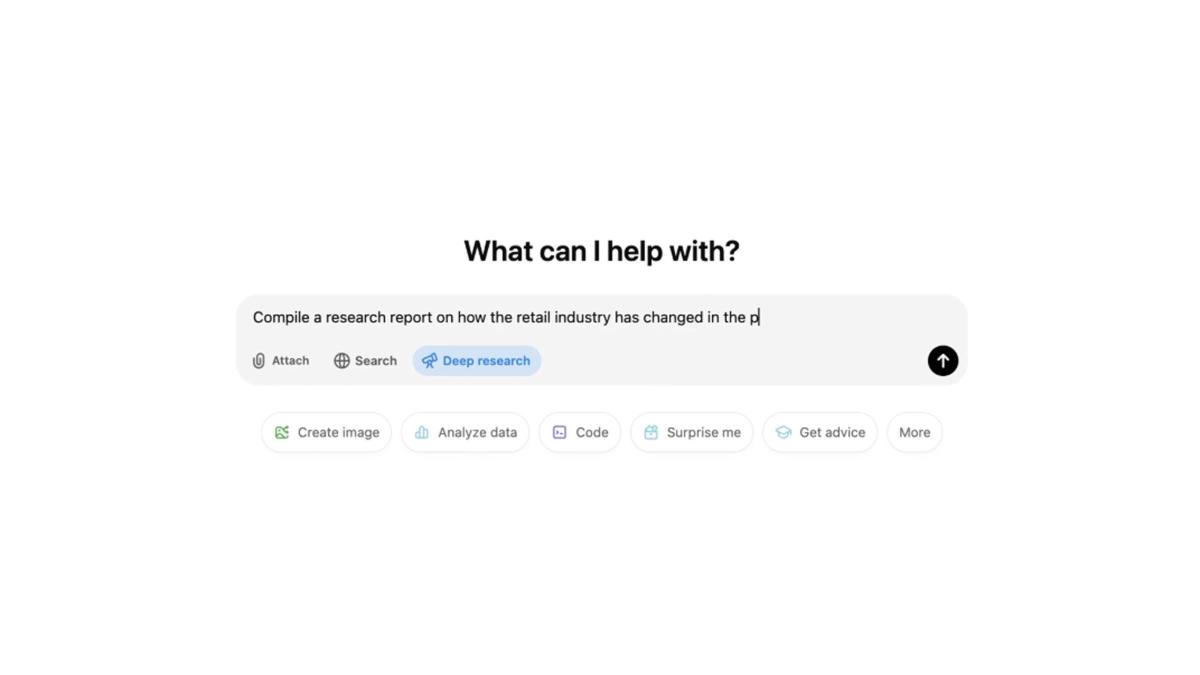
A palpable sense of urgency has emerged at OpenAI, particularly evident following the recent launch of o3-mini. Just two days post-launch, the company made a groundbreaking announcement on Sunday evening, introducing Deep Research. This revolutionary feature empowers ChatGPT to search, assess, and consolidate information from hundreds of websites and online resources, effectively generating reports comparable to the work of a seasoned research analyst.

Beyond simple text inquiries, users have the capability to upload various file types, such as PDFs and spreadsheets, which can be analyzed during interactions with ChatGPT. The chatbot requires “anywhere from 5 to 30 minutes” to compile a comprehensive response, with a side panel illustrating the agent’s progress and providing citations throughout the process. OpenAI emphasizes that this feature achieves in mere minutes what would typically take a human several hours to complete.
During the live reveal, Mark Chen, OpenAI’s chief research officer, articulated the company’s ambitious goal: “Our ultimate aspiration is a model that can uncover and discover new knowledge for itself.” This objective is integral to their roadmap for artificial general intelligence (AGI), highlighting the potential of AI to evolve beyond its current capabilities.
Despite its advanced capabilities, OpenAI acknowledges certain limitations inherent in ChatGPT’s Deep Research function. Occasionally, the AI may produce hallucinated facts or draw incorrect conclusions during its research process. However, the frequency of such errors is “notably lower” compared to existing models. Additionally, the AI sometimes faces challenges in distinguishing between credible information and mere rumors, leading to potential formatting inconsistencies. OpenAI is optimistic that user feedback and increased usage will facilitate rapid improvements in these areas.
For those familiar with similar tools, Google’s Advanced suite features its own Deep Research capability, which shares both the name and general functionality of OpenAI’s offering. A key distinction lies in the access model: Google provides its Gemini Advanced feature via a $20 monthly subscription to its One AI Premium plan, whereas OpenAI requires a $200 monthly ChatGPT Pro subscription to utilize its Deep Research tool.
OpenAI elaborates that the high computational demands of Deep Research necessitate limiting Pro users to 100 queries per month. This restriction arises from the principle that the longer the research query takes, the more inference compute is consumed, resulting in operational constraints.
In an effort to enhance accessibility, OpenAI is actively developing a more cost-efficient version of Deep Research. This improvement is expected to enable significantly higher rate limits for users. Meanwhile, OpenAI plans to extend access to Plus users within a month, contingent upon successful safety assessments. As with many recent releases from the company, users in Europe, particularly in the UK, Switzerland, and other parts of the European economic zone, will need to wait for the rollout of this innovative tool.


 Daniel Mercer
 Brandon Fletcher