David Bridges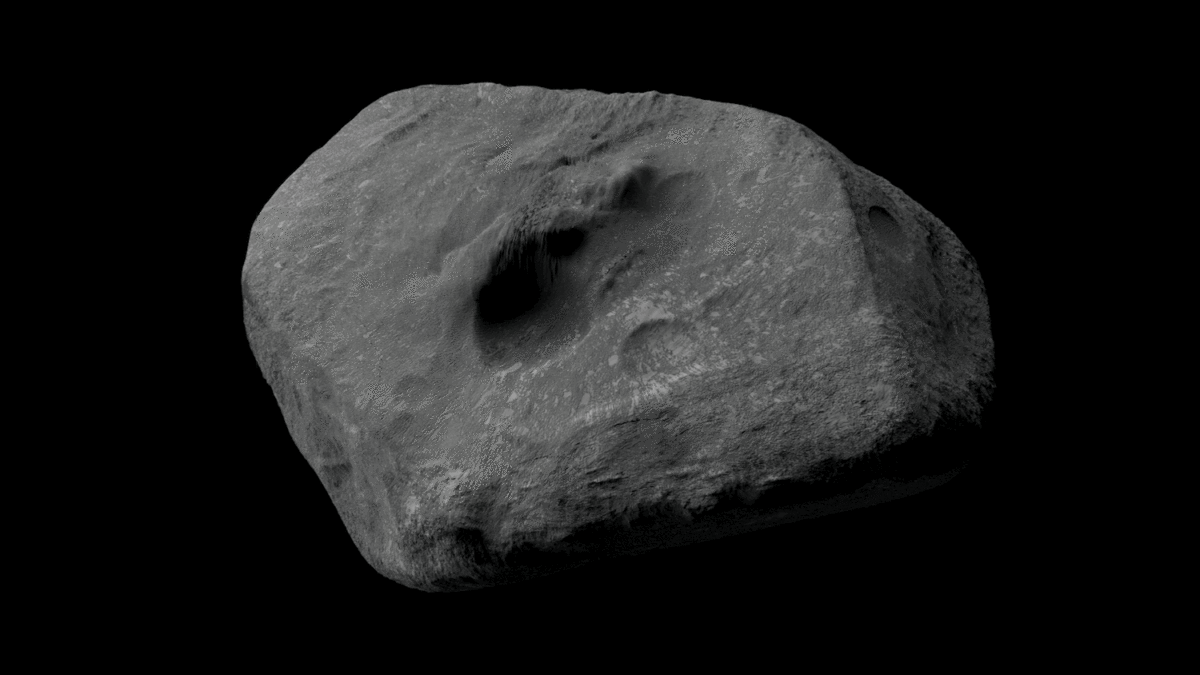
Recent updates from NASA indicate that the likelihood of an asteroid, comparable in size to a 10-story building, striking the Moon in 2032 has increased slightly. On June 5, the agency reported that Asteroid 2024 YR4 now has a 4.3% chance of impacting the lunar surface, up from a previous estimate of 3.8%. This minor adjustment reflects ongoing observations and data analysis of the asteroid’s trajectory.

Earlier this year, this notorious celestial body attracted significant attention when initial assessments suggested it could potentially collide with Earth within an eight-year timeframe. However, as scientists accumulated further data, it became evident that this asteroid does not pose a threat to our planet. Nonetheless, there remains a possibility that 2024 YR4 could impact the Moon. Enhanced observations from the James Webb Space Telescope have enabled scientists to refine the asteroid’s orbit, leading to this slight increase in the probability of a lunar collision.
“As data continues to arrive, it is typical for the impact probability to change,” noted NASA in their announcement, emphasizing the dynamic nature of tracking such celestial objects.
When the Asteroid Terrestrial-impact Last Alert System (ATLAS) in Chile first identified 2024 YR4 in December 2024, NASA promptly classified it as a potentially hazardous object. Initial assessments indicated a concerning 1% chance of the asteroid impacting Earth on December 22, 2032. In the weeks that followed, the odds alarmingly surged to nearly 3% before ultimately declining back to zero by late February, showcasing the importance of continuous monitoring.
At the time of its discovery, 2024 YR4 was located approximately 515,116 miles (829,000 kilometers) from Earth. Since then, it has continued to drift further away from our planet. By mid-April, the asteroid had become too distant for ground-based telescopes to observe effectively. Its next close approach to Earth is not expected until June 2028, but the Webb Telescope’s infrared capabilities allowed scientists to monitor this object for about a month after it became invisible to terrestrial instruments.
A team of researchers, led by Andy Rivkin, a planetary astronomer at the Johns Hopkins Applied Physics Laboratory, has been utilizing Webb’s Near-Infrared Camera to study 2024 YR4 and evaluate its potential impact threats, even as it receded from view. In May, they successfully captured a final observation of this asteroid before it veiled behind the Sun. This additional information improved their predictions regarding the asteroid’s position on December 22, 2032, enhancing accuracy by 20%, as reported by NASA.
Although the probability of 2024 YR4 colliding with the Moon remains relatively low, even a lunar impact would not alter the Moon’s orbit, according to NASA. Observations from Webb have also refined measurements of the asteroid’s size, revealing that it measures approximately 174 to 220 feet (53 to 67 meters) in width, which is considered relatively small for an asteroid. A direct hit would likely result in the formation of a new crater without significant consequences.
However, the significance of such an event should not be underestimated. Anticipating a lunar impact would present scientists with a rare opportunity to observe the formation of a crater in real-time, particularly if it strikes the Moon’s Earth-facing side. Although 2024 YR4 no longer poses a direct threat to our planet, its discovery has provided valuable insights that allow scientists to refine their planetary defense strategies, which could be crucial for future asteroid threats.
In light of these developments, NASA is already preparing for the asteroid’s next pass near Earth in 2028, as indicated in the June 5 statement. Continued observations from both ground-based telescopes and Webb will be essential for scientists to gather further information about the asteroid’s shape and composition, which are critical factors that influence its behavior and potential impact consequences. For now, we can only bid farewell to this intriguing cosmic traveler as we continue to monitor its journey through space.


 Brandon Fletcher
 Daniel Mercer