 Clara Hastings
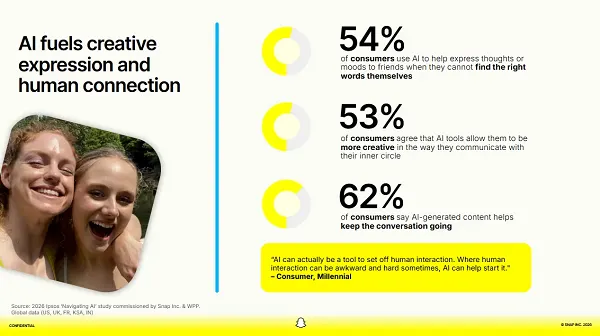

Snapchat has released a comprehensive report that explores the changing dynamics of artificial intelligence chatbot usage and the shifting perceptions surrounding AI tools as they become integrated into everyday life.
According to a survey conducted by Ipsos and WPP involving over 4,200 AI users, Snapchat’s findings indicate that AI is increasingly viewed as a reliable and trustworthy partner by many individuals. The report highlights that AI is playing a significant role in influencing decision-making, particularly concerning product recommendations.
Snapchat stated: “The results are clear: AI adoption is widespread, with 48% of consumers utilizing AI on a daily basis and 50% of creators and marketers considering it an essential part of their daily activities.” “
The survey data reveals that a majority of AI users believe these tools enhance their ability to communicate effectively and foster creativity.
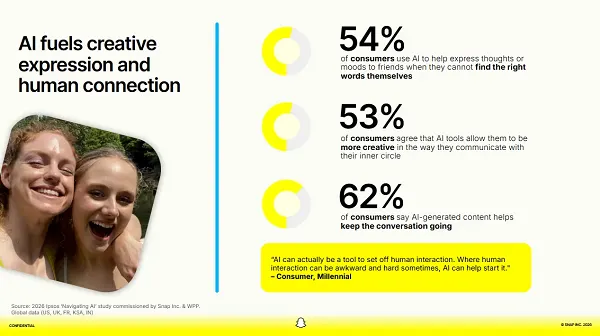
According to the report, 62% of AI users indicated that AI tools assist them in maintaining conversations, suggesting that more individuals are turning to AI for guidance in articulating their thoughts and ideas.
The data also indicates that Snapchat users are 2.2 times more likely to agree that AI enhances their social interactions and 1.6 times more likely to use AI for organizing real-world activities.
Snapchat noted: “Over 80% describe [AI] as friendly and collaborative. 74% view AI as a judgment-free environment that can privately guide them in expressing complex emotions before sharing with their peers.”
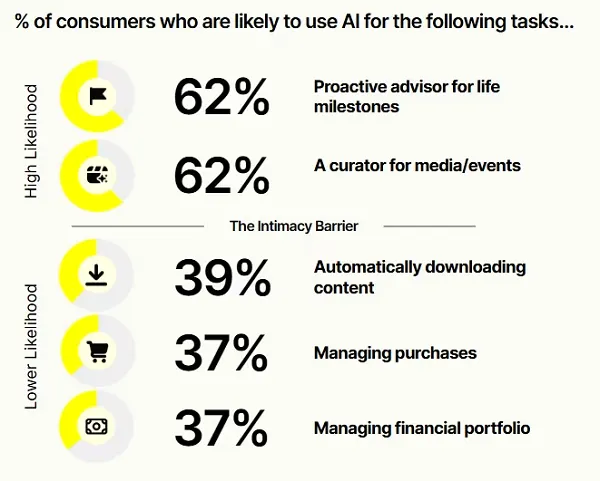
However, as illustrated in this overview graphic, AI users still harbor concerns about employing the technology for managing finances or making purchases.
Snapchat suggests that users’ perceptions may be more adaptable than many assume.
“Privacy today isn’t an absolute — it’s a sliding scale,” the report states. “Consumers aren’t asking, ‘Is this private?’ They’re asking, ‘Is this worth it?’ The reality is that users are willing to exchange their data for personalized AI experiences when the immediate benefits are clear. Yet, this value exchange does have its limits.”
The notion that users might sacrifice privacy and security for functionality has been a foundational aspect of social media business models. It is noteworthy that Snapchat openly acknowledges this dynamic, promoting it as a way for businesses to encourage AI adoption. This essentially legitimizes data collection as a reasonable trade-off for offering valuable services.
While this may not be an ideal exchange, the rationale holds true, particularly after decades of social media platforms gathering user data that individuals have willingly provided due to the utility these applications offer.
Nonetheless, Snapchat’s concluding remark somewhat contradicts this same premise.
“70% of consumers find personal data used in hyper-personalized AI advertisements to be intrusive, and 56% perceive 100% AI-generated content as lacking depth,” the company reported.
This presents an intriguing contrast. On one side, individuals are becoming more at ease interacting with AI chatbots and tools, sharing their personal information with these technologies, as long as they perceive tangible benefits.
However, while Snapchat users believe that AI tools enhance their creativity in communication, many express that AI-generated content feels hollow and intrusive.
The key takeaway is that people are increasingly relying on AI tools for private conversations that assist in decision-making. they are less enthusiastic about their data being used for targeted advertising.
This somewhat contradicts Snapchat’s assertion that consumers are open to trading privacy for value in various contexts.


 Sophie Langley
 Ivy Caldwell