 Troy Sanders

ChatGPT continues to dominate as the leading artificial intelligence chatbot among American users. Most individuals in the U.S. utilize chatbots primarily for search assistance rather than for generating images or professional tasks.
This finding stems from the recent study conducted by Pew Research, which surveyed over 5,000 Americans to gain insights into the increasing usage of AI chatbots amidst the broader AI revolution.
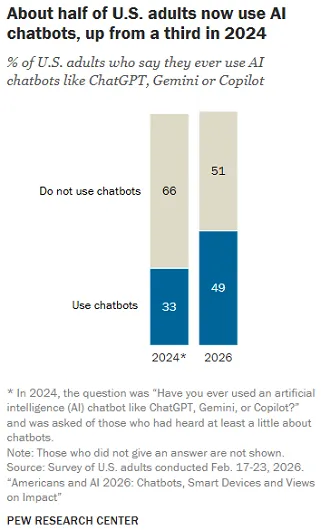
Clearly, AI adoption is on the rise. The results revealed that approximately half of U.S. adults now engage with AI chatbots, up from 33% in 2024.
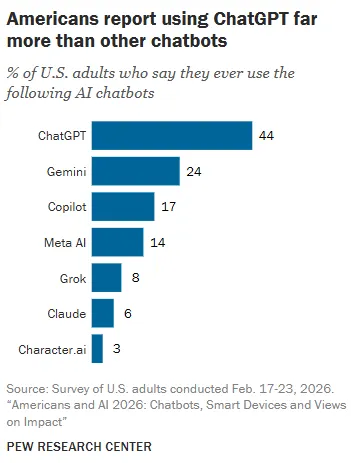
The survey also indicated that 44% of U.S. adults utilizing chatbots are opting for ChatGPT, despite increasing competition from other platforms like Claude.
Interestingly, only 24% of users are employing AI chatbots for image or video creation. Despite the rapid introduction of new features by social media platforms aimed at this capability, it appears that this usage remains unpopular.
What motivates major platforms to encourage this type of usage? The reasoning remains unclear. Perhaps they are simply captivated by the potential of their own systems.
The chart above illustrates that Google’s Gemini ranks as the second most popular AI chatbot, followed by Microsoft’s Copilot, Meta AI, Grok, Claude, and Character.ai.
While Claude has been gaining traction lately, the data highlights the substantial lead that ChatGPT has established by being an early entrant, making it synonymous with AI utilization.
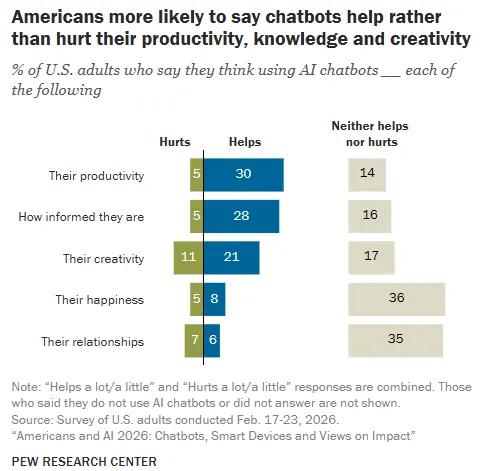
In terms of practical benefits, 30% of survey participants stated that AI chatbots enhance their productivity and keep them informed.
This benefit largely pertains to discovery, as most AI users primarily rely on these tools for search purposes:
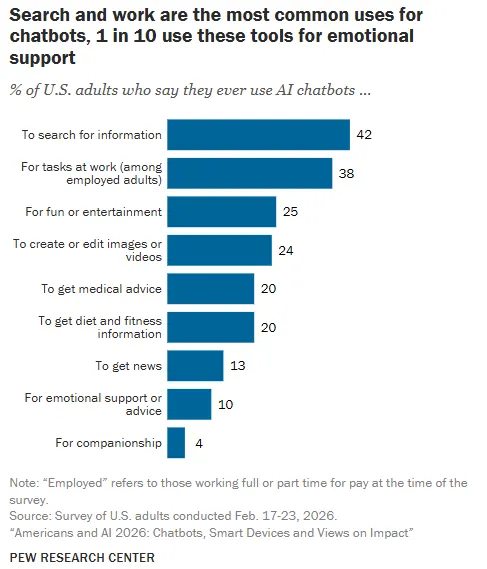
This observation serves as a stark reminder for web publishers and businesses that rely on referral traffic.
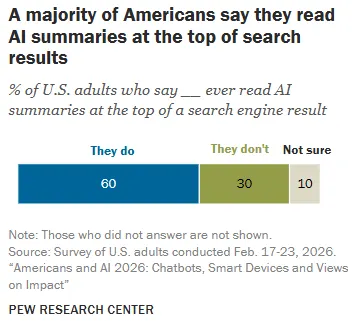
It appears that a significant number of individuals who encounter Google’s AI summaries are utilizing them instead of navigating further to access links.
Last August, Google indicated that its AI summaries had not substantially influenced referral traffic, with users exposed to AI summaries seeing increased links and engaging with a wider array of websites.
Nonetheless, it appears that directly addressing user inquiries has had some effect.
Pew’s findings offer deeper insights into the increasing adoption of AI tools and the context around the value they are providing, or failing to provide, during this significant phase of digital connectivity transformation.
The insights gathered suggest that while the shift may not be as pronounced as some claim, there are evident changes in user behavior that reflect the evolving landscape.


 Tessa Everly
 Sophie Langley