 Clara Hastings

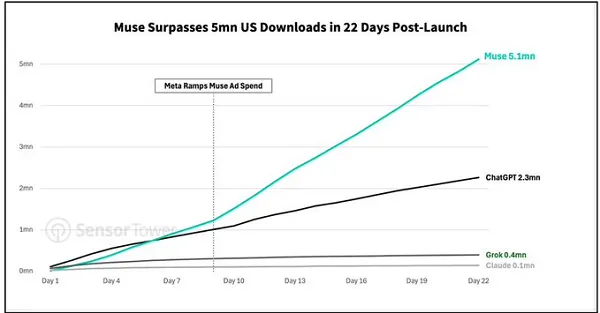
Meta appears to have a promising hit with its Muse artificial intelligence agents. Insights from Sensor Tower reveal that the Muse app has achieved an impressive milestone of 5 million downloads, making it one of the fastest-growing applications in download history.
According to Yahoo Finance, only 23 apps have recorded over 5 million downloads within their first 22 days of launch.
Muse is currently outpacing both ChatGPT and xAI’s Grok in terms of initial user interest.
The Information has also reported that the Muse app boasts over 3 million weekly users, indicating that user engagement is not only high but also sustained.
Meta’s Muse agents represent a key component of the company’s strategy to advance consumer AI technology. With plans to monetize its significant investment in AI development, Meta has committed to spending over $600 billion on AI infrastructure projects in the U.S. over the next three years, questions regarding the effectiveness of its AI initiatives have emerged.
However, Muse could be the pivotal solution, as Meta CEO Mark Zuckerberg recently outlined the company’s plans for monetizing the app.
During Meta’s Connect conference last week, Zuckerberg mentioned that users will have access to Muse for free, with the goal of generating revenue by collecting a small fee from transactions conducted within the app.
Zuckerberg emphasized that Muse is designed to help users save money by optimizing their daily lives, identifying potential efficiencies, and alerting them to savings opportunities.
One significant feature involves subscription management. Many users have reportedly utilized Muse to cancel payments for unnecessary services.
According to CNBC, approximately 44% of U.S. consumers increased their subscription spending in 2025, creating an excellent opportunity for Meta’s Muse agents to demonstrate value by assisting users in saving money through reducing unnecessary subscription costs.
This could highlight the app’s potential to enhance users’ quality of life. Meta envisions this as just one avenue among many through which Muse can prove its usefulness and establish its relevance.
However, this also relies on users being willing to share more of their personal information with Meta, enabling the Muse bot to analyze their financial situations and more. Essentially, the more data Muse can access, the more tailored and effective its recommendations will be. Whether a significant number of users will trust Meta enough to share this information remains uncertain.
For Meta, the optimal strategy is to demonstrate Muse’s value. If a substantial number of users can save money by downloading the app and utilizing its features, concerns about privacy may diminish over time.
The early signs support this, with the app experiencing rapid growth.


 Troy Sanders
 Ivy Caldwell