 Ethan Carter

Targeted Challenges to NVIDIA’s AI Systems
AMD’s ambitious vision for 2026 centers around the idea of local AI processing: “Why rely on cloud AI when you can handle it all on your own machine?” At this year’s CES, AMD introduced its Ryzen AI Halo PC, a compact system that’s designed for intensive AI tasks. This innovative PC will start at a price point of $3,999 featuring Ryzen AI Max 300 CPUs, with future enhancements expected to include the next-gen Ryzen AI Max 400 chips. Preorders for this high-performance unit are set to commence in June.
Despite its high cost, AMD markets the Halo as a cost-efficient solution compared to ongoing cloud AI computing expenses. For instance, if developers are spending around $773 monthly for 6 million daily AI tokens, the Halo could effectively pay for itself within six months. For users with heavier workloads, AMD claims that its $4,000 Radeon R9700 Pro GPU could recoup costs within just three months for those paying $2,253 per month for 18 million daily tokens.
These machines are not intended for the everyday consumer. Instead, AMD is setting its sights on competing directly with NVIDIA’s DGX Spark AI PC, which retails for $4,699 following its initial $4,000 launch price. While NVIDIA’s AI PC is limited to Linux, the Ryzen AI Halo offers the flexibility to run both Windows and Linux due to its x64 architecture. the Halo boasts a 50 TOPS NPU and a Radeon GPU equipped with 40 compute units, whereas the DGX Spark relies solely on NVIDIA’s Blackwell GPU for AI operations. Both systems also feature 128GB of unified system memory, crucial for executing large AI models. Notably, this exceeds the memory capacity found in popular AI development machines like the Mac Mini and Mac Studio.
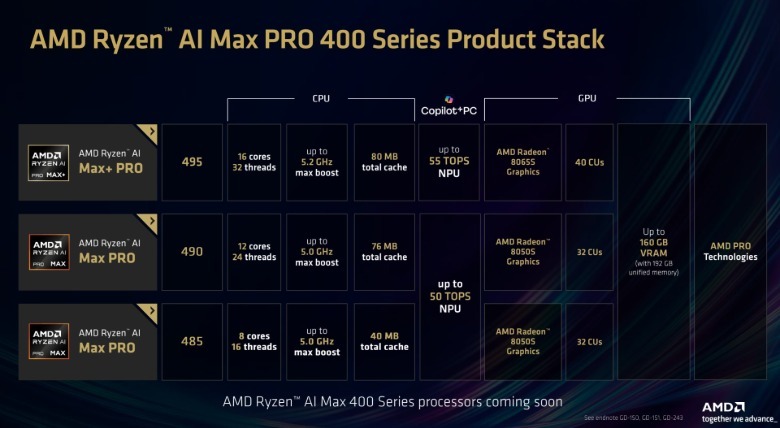
The upcoming Ryzen AI Max 400 chips will be spearheaded by the AI Max+ Pro 495, a robust 16-core processor with an impressive 5.2GHz boost speed, a 55 TOPS NPU, and integrated Radeon 8065S graphics. These advanced chips will support up to 192GB of unified memory, allowing for a substantial 160GB of GPU VRAM. While these specifications show only a marginal increase over the AI Max 395, which features a 5GHz CPU boost clock, AMD has yet to release comparative benchmarks. The Ryzen AI Max 400 chips are expected to launch in the third quarter of 2026.


 Daniel Mercer