David Bridges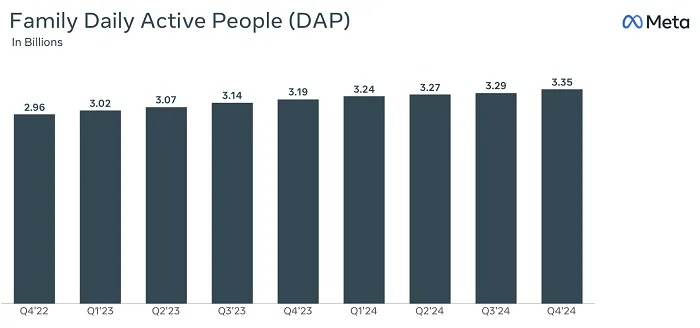

Meta has revealed its impressive earnings results for Q4 2024, showcasing resilience despite ongoing speculation about the potential decline of Zuckerberg’s Facebook empire. The actual performance data reflects that Meta is not only surviving but thriving, demonstrating robust growth and adaptability in a competitive landscape.
To begin with, regarding user engagement, Meta reported an increase in active users during Q4, reaching an impressive total of 3.35 billion users across all its platforms. This significant growth highlights the company’s ability to attract and retain users, reinforcing its dominance in the social media space.
The growth of Threads has contributed positively to this increase, although Facebook remains the frontrunner in terms of user engagement. Notably, Instagram has surpassed Facebook in user numbers within Europe, indicating a diverse and expanding audience across Meta’s platforms. This broadening user base presents enhanced opportunities for marketers, driving increased advertising revenue for the company.
In line with this growth, Meta has initiated the testing of Threads ads, marking a strategic move to further monetize its platforms. This development is expected to enhance the advertising ecosystem within Threads, providing businesses with innovative ways to reach their target audiences effectively.
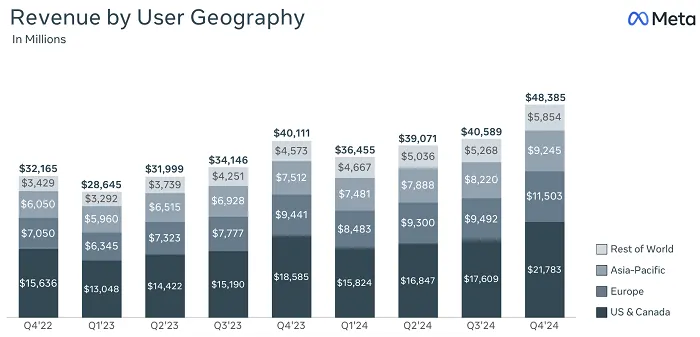
Financially, Meta achieved remarkable revenue of $48.39 billion for Q4 alone, culminating in a total of $164.5 billion for the entire year. This represents a substantial increase from the $134.9 billion recorded in 2023, illustrating the company’s strong financial health and growth trajectory.
A significant portion of Meta’s revenue continues to stem from advertising, accounting for 96% of total income. While the company is exploring other ventures, these initiatives are still in the early stages and have yet to significantly impact the overall financial landscape of the business.
However, alternative revenue sources are starting to show promise, as evidenced by their contributions to the latest financial results:
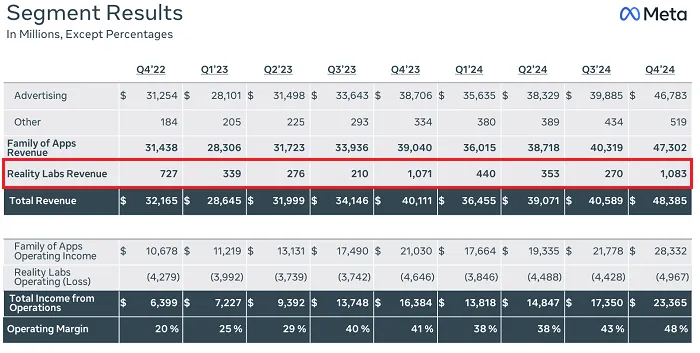
Meta’s Reality Labs, which focuses on virtual reality (VR) and augmented reality (AR) technologies, achieved a record revenue in Q4, driven by a surge in sales of Ray-Ban Meta glasses and VR headsets. This growth underscores the increasing consumer interest in immersive technologies and Meta’s innovative product offerings.
Indeed, sales of Ray-Ban Meta glasses have exceeded initial expectations, positioning them as a significant future revenue driver for Meta as their capabilities evolve, especially with potential expansions into AR functionalities. Additionally, the Quest app reached the top of the App Store charts during the holiday season, indicating strong consumer demand and engagement.
While the company is currently incurring losses on these new ventures, it has projected an expenditure of $65 billion on AI development this year alone. Despite the ongoing challenges, early indicators suggest that Meta’s investments may pave the way for future successes, demonstrating the company’s commitment to innovation and growth in an evolving tech landscape.
Ultimately, these strategic investments could position Meta for market dominance, particularly in the VR space, where it currently faces little competition. The company’s increasing revenue, which is up 22% year-over-year, highlights the importance of making these critical investments now to secure future growth and leadership in the industry.
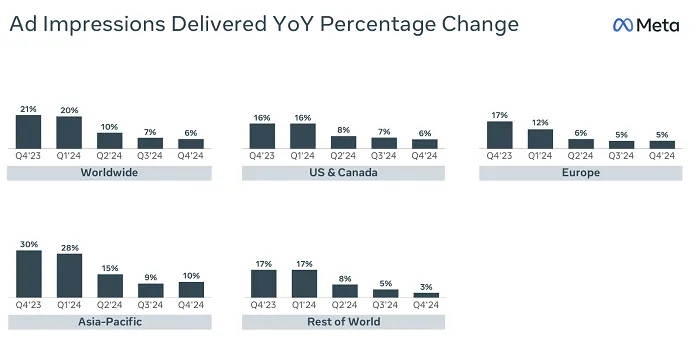
Additionally, Meta is enhancing its advertising strategies by integrating more ads into in-stream content. This approach not only increases revenue potential but also improves user engagement, allowing for a more seamless advertising experience.
Moreover, the rapid growth of Threads, which is now at 300 million users and continues to rise, opens up new opportunities for Meta’s advertising strategies, providing a vast platform for promotional activities and enhanced revenue generation.
(Update: In a separate post, Zuckerberg also announced that Threads is now up to 320 million active users.)
This positive chart performance is likely to please Meta’s investors. Although some users have voiced concerns over the increasing number of ads within Meta’s applications, this has not deterred overall engagement, as evidenced by the upward trends in key performance metrics.
However, it is essential to consider the potential implications of Meta’s updated moderation strategy, which shifts to a Community Notes model while phasing out third-party fact-checking. This change has prompted some users to reconsider their engagement with Meta’s platforms, viewing it as a concession to political pressures.
Despite this, Zuckerberg’s decisions may ultimately be beneficial for the company’s business strategy, as this could facilitate smoother expansion efforts in Europe, drive advancements in AI models, and accelerate the development of VR technologies.
Furthermore, Meta aims to mitigate the risks associated with foreign tariffs on imports, particularly given that many of its wearable components are sourced from China and other regions. The potential for increased tariffs, particularly under Trump’s administration, could significantly impact Meta’s AR glasses project, which is still in the cost-reduction phase to enhance consumer appeal.
Consequently, establishing favorable relations with the Trump administration could yield substantial benefits for Meta. Reports indicate that Zuckerberg is contemplating purchasing a residence in Washington to solidify these connections and navigate the political landscape effectively.
While some may disagree with Zuckerberg’s tactics, they are strategically sound. The critical question remains whether the heightened risks of misinformation stemming from these adjustments outweigh the broader business advantages.
Furthermore, one must consider if Zuckerberg and his team genuinely prioritize these concerns in their decision-making processes.
In addition to these factors, Meta continues to grapple with stringent EU regulations, leading to an 1 million fine for antitrust violations. The company is also undergoing staff rationalization, with another wave of job cuts announced in October, even though its overall workforce has seen a 10% increase in 2024.
On a positive note, Meta stands to gain significantly from the current uncertainties surrounding TikTok’s status in the U.S. This situation is prompting brands and content creators to explore alternatives, potentially increasing traffic and engagement on Meta’s platforms.
Additionally, Meta is developing a strategy to implement AI bot profiles within its apps. While this may seem unconventional, it could enhance in-app revenue by fostering user engagement through interactive experiences, effectively increasing the time users spend on the platforms.
Overall, the results for Meta are outstanding, reinforcing its core strengths and solidifying its market position. The company is at the forefront of key technological advancements in AI, AR, and VR, while simultaneously driving revenue growth despite focusing on future innovations.
Although not every decision has been met with approval, the data speaks volumes, indicating that Meta is making strategic choices to propel the business forward effectively.
The implications for users remain a critical consideration, often assessed only in hindsight. However, as a business entity, few companies possess better growth prospects than Meta.


 Maya Kensington
 Ivy Caldwell