 David Bridges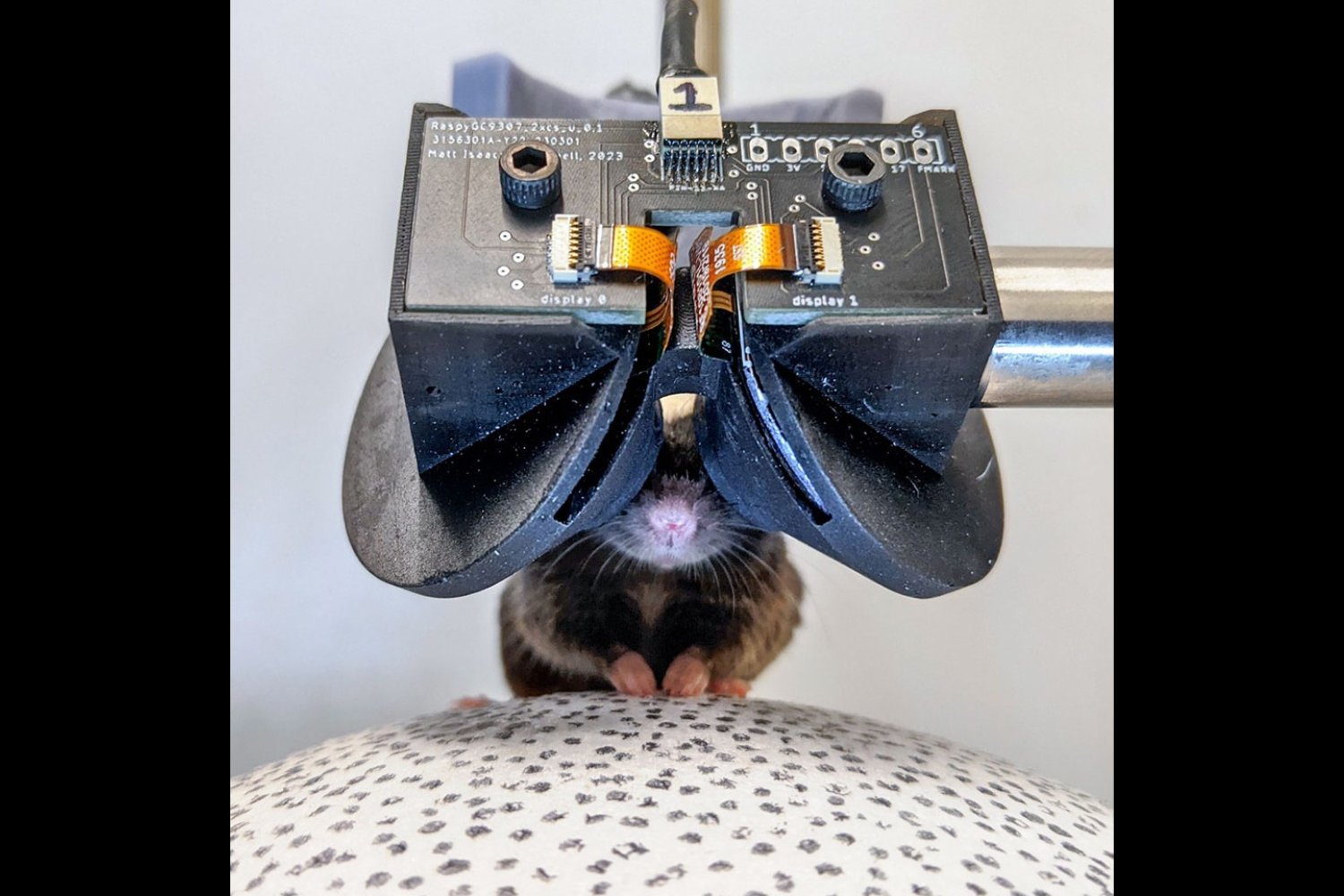
Revolutionizing Rodent Research with Innovative Virtual Reality Technology
Humans aren’t the only ones immersed in the fascinating world of virtual reality (VR). Scientists have recently introduced an exciting new technology that enables mice to engage with VR in a remarkably realistic—and undeniably cute—way within laboratory settings. This breakthrough opens up fresh avenues for understanding animal behavior in controlled environments, further blending the lines between technology and biology.

Introducing MouseGoggles: A Game Changer for Animal Studies
Researchers from Cornell University have pioneered this technology, aptly named MouseGoggles. During various experiments, the mice demonstrated significant and vivid reactions to simulated stimuli while donning these goggles. This innovative approach is poised to enhance the efficiency of animal studies that utilize VR, providing a more engaged and responsive subject pool for researchers.
Transforming Animal Testing with Realistic Virtual Environments
While the idea of mice experiencing VR may seem whimsical, there are substantial scientific applications for this technology. Ideally, VR can create more naturalistic environments for mice, allowing for controlled studies that mimic real-world scenarios. Current methodologies often rely on cumbersome setups, such as placing mice on treadmills surrounded by screens that fail to encompass their entire field of vision. This limitation can lead to delayed reactions from the mice, which hinders the accuracy of the experiments.
MouseGoggles: Bridging the Gap Between Technology and Biology
The team at Cornell believes that their MouseGoggles represent a significant advancement over traditional VR systems for mice. Instead of attempting to construct a miniature VR headset from scratch, they ingeniously utilized tiny, cost-effective components sourced from existing devices like smartwatches. In this setup, mice are placed on a treadmill, with their heads secured to the goggles while visual stimuli are presented, allowing them to interact with a virtual environment in a controlled manner.
“This project certainly benefited from a creative approach, taking components designed for other purposes and adapting them for our needs,” stated lead scientist Matthew Isaacson, a postdoctoral researcher at Cornell University, in an interview with the Cornell Chronicle. “We discovered that the size of the displays made for smartwatches was perfect for our mouse VR headset. This fortunate alignment allowed us to easily acquire all the affordable components required without starting from scratch.”
Enhancing VR Effectiveness Through Behavioral Observations
To validate their innovative system, the researchers subjected the mice to various stimuli while meticulously monitoring their brain activity and behavioral responses. Their findings revealed that the mice indeed perceived and reacted to the VR environment as intended. For example, in one experiment, the team observed how the mice responded to a dark blotch gradually moving closer, simulating a potential predator approaching.
“In traditional VR setups with large screens, the mice showed minimal reaction,” Isaacson explained. “However, in our experiments with the goggles, almost every mouse exhibited a pronounced startle response upon first viewing the approaching blotch. They genuinely seemed to perceive the threat of a looming predator.”
The Implications of Advanced VR Research on Alzheimer’s Studies
The research team’s findings were published in the esteemed journal Nature Methods earlier this month. The advancement of more realistic VR for mice could yield numerous benefits in future research endeavors. Specifically, accurately modeled VR experiments might enable scientists to better understand the brain activity of mice genetically engineered to exhibit symptoms of Alzheimer’s disease. This understanding could particularly illuminate how the brain navigates spatial memory and related functions, enhancing the development of potential therapies for brain disorders.
Future Innovations: Eye Tracking and Sensory Simulations for Rodent VR
Isaacson and his research team are not alone in their quest to enhance VR systems for mice; however, they claim to be the first to incorporate eye tracking and pupil measurement in their designs. They are currently working on creating a lightweight, portable VR setup that can also be utilized with larger rodents such as rats and tree shrews. Future iterations of their technology may even include the capacity to simulate taste and smell, further enriching the virtual experience for these animals.


 Daniel Mercer
 Brandon Fletcher