Ivy Caldwell

Australia’s eSafety Commissioner has published a report analyzing the impact of the social media ban for individuals under 16 years old. The findings reveal that the majority of underage teenagers continue to access social media platforms, despite gradual improvements in enforcement from major social media companies.
This report follows the Commission’s April update regarding the under-16 social media ban, which assessed the initial three months of the policy and evaluated its effects on teenagers.
The recent report surveyed a broader demographic, including 4,121 children aged 10 to 16 living in Australia, as well as one of their parents.
Data findings indicate that, while the bans led to a decrease in the number of underage users with accounts on major social media applications, they have not effectively curbed overall usage. Many young users now access social media through non-logged-in methods or find ways to bypass these restrictions.
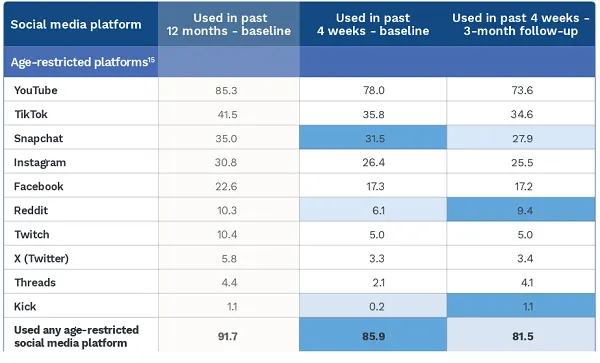
The table above illustrates that at the initiation of the teen social media ban, 85.9% of Australian teens reported using at least one age-restricted platform regularly. Recent statistics show a slight decrease to 81.5%, indicating that a significant number of underage users still access restricted applications.
The report states: “Several social media platforms can be accessed without logging into an account. Children may also utilize social media through accounts belonging to parents, siblings, or friends. the data likely reflects usage both with and without children being logged into their own accounts.”
This does indicate some level of impact, as users cannot fully experience the app without logging in. It could be argued that this situation has significantly reduced harmful exposure for teens. it remains clear that teenagers are still finding ways to access social media, despite the existing bans.
Regarding specific applications, Snapchat was the only platform that experienced a noticeable decline in usage among teens, dropping from 31.5% at the launch of the ban to 27.9% after three months.
Furthermore, the data suggests that a growing number of underage teens are turning to Reddit and Kik, possibly as a consequence of being pushed away from larger social media platforms.
The primary reason children cited for maintaining age-restricted social media accounts appears to be the “ineffective implementation of age verification measures by platforms.”
According to the report: “Among age-restricted platforms, the main reason children provided for still having an age-restricted account was that the platform had not yet required them to verify their age (50.2%). Others noted that the platform had inaccurately assessed their age (18.2%). While some evidence suggests children have attempted to circumvent age restrictions—most commonly by stating their age as 16 or older on their accounts (37.1%)—other methods such as parental assistance or VPN usage were less frequently reported.”
The concern that children would turn to VPNs to access social media has not materialized as anticipated. since most teens still have some form of access to social media, they may not feel the need to employ such strategies.
The report also indicated that young teens are spending increased time on messaging applications and playing online video games due to these changes.
“At the three-month mark, most children reported little to no change in their participation in offline activities, behaviors associated with problematic online use, or overall wellbeing,” the report concluded.
In summary, the majority of Australian teens are still engaging with restricted social media platforms in some capacity. they are spending more time on alternative digital communication tools as a result of the under-16 social media ban.
This outcome aligns with many expert predictions. The assumption that children would spend more time outdoors due to social media restrictions overlooks the fact that they have already adapted their social behaviors to prioritize online interactions, fundamentally shifting how they develop social skills and relationships.
It seems unlikely that this trend will change, even after years of enforcing these bans. The data indicates that teen social bans have not significantly impacted the harmful behaviors they were intended to address.
These findings could serve as valuable insights for shaping future approaches to similar teen bans in other regions.


 Maya Kensington