Ivy Caldwell

As debates continue over the necessity of social media restrictions for teenagers and measures to safeguard young users online, Pew Research conducted a comprehensive survey involving over 9,000 U.S. adults to gather their views on potential restrictions and assess the level of support for their implementation.
The survey results were striking.
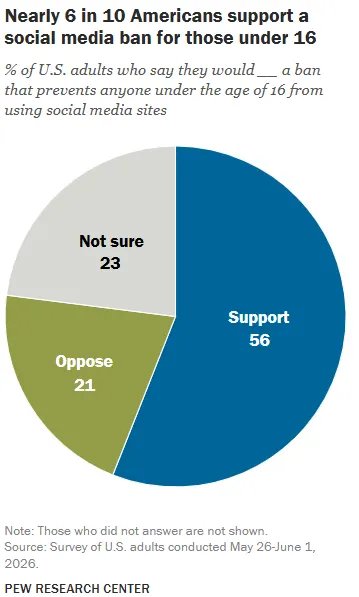
Sixty percent of participants expressed support for restrictions on teen social media use, while only 20% were firmly opposed to implementing bans for younger users.
This data underscores why the topic is currently so contentious, as various regions look to mimic Australia’s example of enforcing legal restrictions on social media usage for young individuals.
Australia enacted its under-16 social media ban in December, although early reports suggest that the ban has had minimal effect on restricting young users from accessing social media platforms.
Nevertheless, several other countries have announced their intentions to implement stricter social media regulations for teenagers.
Recently, the U.K. government revealed its plans to prohibit teenagers from livestreaming on social media platforms, while Turkey, Canada and numerous other regions are advancing their own initiatives for similar restrictions.
In the United States, California and Florida have begun implementing their own restrictions on teen social media use, with Pew’s survey data indicating strong public support for similar actions in other states.
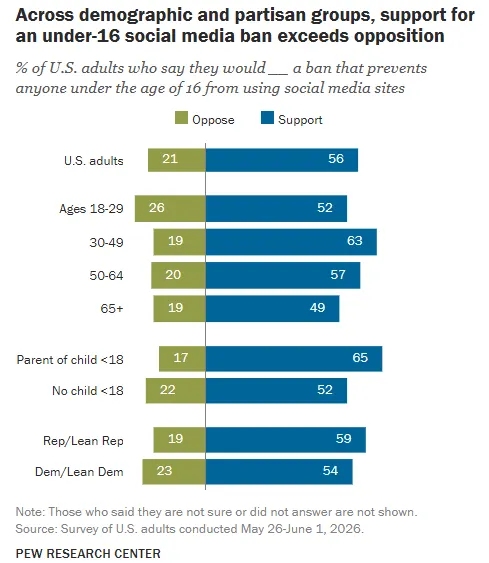
As for which demographic groups back these social media restrictions for teens, the survey data is also clear.
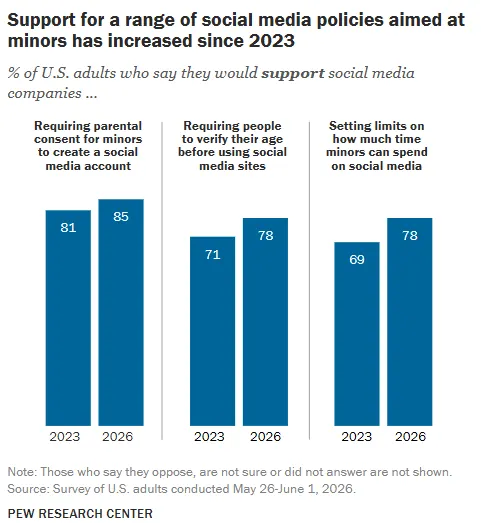
Pew also highlights that attitudes toward social media restrictions for teenagers have shifted significantly since a comparable survey conducted in 2023.
Despite the initial enforcement of teenage social media restrictions showing minimal impact, a majority of individuals still favor such bans. This preference likely stems from the perception that these measures can help divert children from screens and encourage them to engage more with the physical world.
However, this assumption may not reflect reality.
Social interaction has transformed, and meeting in person has changed compared to previous generations. The COVID-19 pandemic accelerated this shift, pushing many kids online as their primary means of social interaction. This transition highlighted the importance of social media and gaming platforms as avenues for connection.
The availability of these digital platforms has made social media an integral part of how young people interact. The latest generation has grown up with these tools at their disposal, forming friendships, connecting with others, and seeking support through these channels.
Reversing this trend is not feasible. The only way to eliminate this option would be to disconnect the internet entirely. As long as online connectivity exists, young people will find ways to engage with it.
Limiting access to certain applications may only drive young users to alternative platforms, potentially lacking adequate safety features. these bans do not consider connections made through gaming consoles or messaging applications.
While restrictions may complicate access to certain digital tools, children are too adept with technology to remain completely disconnected. They will naturally gravitate towards the same spaces as their peers who are online.
Should this lead governments to resign themselves to the idea that kids will inevitably encounter concerning content online and may be exposed to predators?
No, the answer lies in establishing more consistent approaches to online safety that hold all platforms accountable to uniform standards for safeguarding young users from harm. Standardized regulations could also tackle the incentives that drive the algorithmic promotion of divisive and potentially harmful content.


 Sophie Langley
 Tessa Everly