 Cameron Steel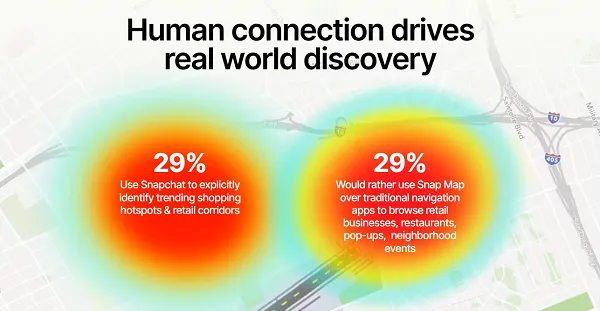

Snap has released a new report highlighting how Snap Map serves as an effective platform for businesses to promote themselves as popular meeting points, emphasizing the importance of recommendations from friends using the app.
However, the findings also reveal that while Snap Map aids in discovering new places, the majority of users prefer utilizing other mapping applications when searching for locations to visit.
Snap’s insights stem from a survey conducted with over 17,000 digital map users aged 13 to 44 in regions including the U.S., Canada, the U.K., France, Germany, and Saudi Arabia. Collaborating with eye square and Horizon, Snap’s study sheds light on how individuals leverage various mapping tools to explore new locations.
The data indicates a trend where users employ different mapping services for distinct purposes, ranging from immediate navigation to exploring new options.
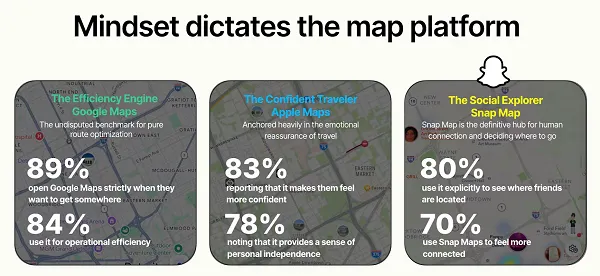
This overview indicates that while Google Maps is primarily used for navigation, Snap Map is favored for maintaining social connections and locating friends.
This distinction is logical, as such social interaction information is not accessible on platforms like Google Maps or Apple Maps. Snap suggests that this shift in user behavior is crucial for marketers to recognize.
According to Snap: “To engage an audience that is actively browsing, seeking social validation, and deciding where to go, brands must extend their reach beyond utility-focused maps and engage on social maps where consumers interact and discover cultural experiences.”
Snap also noted that features like bookmarking, which allow users to save their preferred locations, enable Snap Map to provide enhanced context for discovery and foster broader interest.
Survey results indicated that consumers are 2.9 times more likely to report discovering their favorite businesses through Snapchat compared to other social media platforms.
“Snapchat transforms traditional mapping into an interactive platform for social engagement, where 76% of users consult Snap Maps to see their friends’ locations, and 27% utilize it to coordinate in-person meetups,” the company explained. “With 450 million active users globally each month, Snap Map enhances real-world connections by helping individuals discover nearby happenings and guiding them to culturally significant locations.”
According to Snap, the main takeaway is that Snap Map “creates a ripple effect wherein social discovery encourages visits,” and this discovery subsequently boosts user engagement.
However, this does not encompass the entire scope of the data findings.
For instance, Snap highlights the fact that nearly one-third of survey respondents indicated using Snap Map to find businesses.
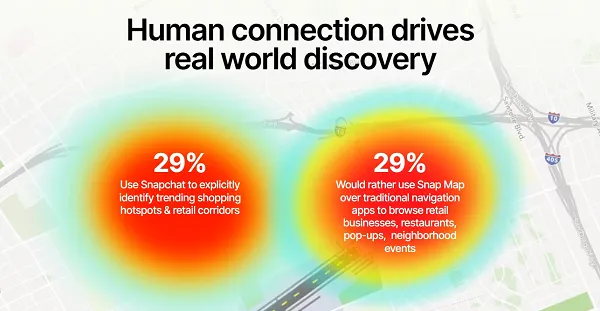
This is noteworthy because 29% of 17,000 map users represents a substantial number of individuals utilizing Snap Map. it also indicates that over 70% do not turn to Snap Map for this function.
While Snap aims to demonstrate the advantages of Snap Map for discovery, it inadvertently highlights that users primarily rely on other mapping applications to gather information about businesses. Google, for example, allows businesses to create a place listing on Google Maps, which, according to Snap’s findings, may present a more effective avenue for marketing and outreach endeavors.
Although the Snapchat platform does facilitate connections among friends, which can enhance recommendations and social marketing.
In comparison, Snap Map usage remains significantly lower than that of other mapping applications.
Snap concluded that brands could gain by encouraging user check-ins and utilizing its Promoted Places advertising feature to strengthen connections. The company also stated that improving brand listings on social maps could enhance overall performance.


 Ivy Caldwell
 Mason Thompson