 Brandon Fletcher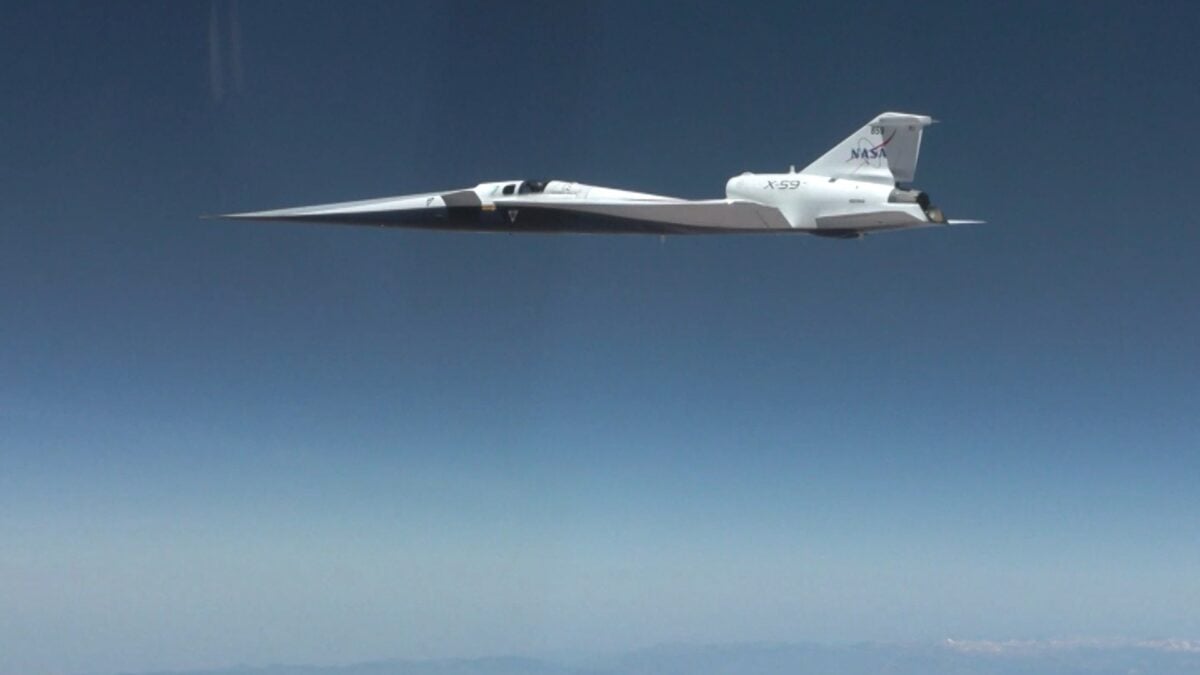

The X-59 aircraft from NASA has successfully crossed the threshold of the sound barrier, marking a significant advancement toward achieving supersonic flight that minimizes the disruptive noise typically associated with it.
On June 5 at 2 p.m. ET, this innovative aircraft departed from Edwards Air Force Base in California for its latest test flight. Throughout its 81 minutes in the air, the X-59 reached an impressive maximum speed of about Mach 1.1, equivalent to 713 miles per hour (1,147 kilometers per hour), effectively breaking the sound barrier for the first time.
The next phase involves a mission conditions flight where the X-59 will target a speed of Mach 1.4, or approximately 925 miles per hour (1,488 km/hr), at an altitude of around 55,000 feet (16,764 meters). This specific speed and altitude will allow NASA to collect valuable data from the public regarding the aircraft’s quieter thump sound.
Achieving High Speeds with Reduced Noise
The primary goal of the X-59 is to breach the sound barrier while eliminating the loud sonic boom. Instead of this disruptive sound, NASA’s design aims for the aircraft to produce a quieter sonic thump. If successful, this innovation could revolutionize commercial supersonic travel over land.
Since its first flight in October 2025, NASA has been rigorously evaluating the X-59’s capabilities at increased altitudes and higher speeds. In preparation for its supersonic flight, the aircraft has completed 16 test flights in recent months.
The recent test flight represents a crucial milestone as the X-59 advances into the supersonic segment of its flight envelope. During this flight, it achieved supersonic speeds at an altitude of 43,400 feet (13,100 meters).
Despite breaking the sound barrier, the anticipated quiet thump was not perceptible. A NASA F-15 chase plane accompanied the X-59 to monitor its performance, masking any sounds produced by the experimental aircraft with its own sonic booms.
NASA stated, “These tests are the initial phase of the X-59’s flight evaluation. They focus on assessing performance and involve monitoring from a chase plane. Once this phase concludes, the next phase will concentrate on evaluating its sound profile to confirm the quiet thump capability.”
Preparing for Overhead Testing in Communities
NASA is gearing up for the subsequent phase of test flights, where the X-59 will fly over various U.S. communities. These flights aim to collect data on public perception regarding the aircraft’s quieter thump sound.
In 1973, the Federal Aviation Administration banned non-military supersonic flights over land to prevent startling or disturbing residents in urban areas. The data obtained from the X-59’s test flights will play a crucial role in establishing new, data-driven noise regulations for commercial supersonic aircraft.
The development of this quiet supersonic aircraft began nearly ten years ago when NASA awarded Lockheed Martin a contract worth $247.5 million to construct the X-59. The aircraft measures 99.7 feet (30.39 meters) in length and has a wingspan of just 29.5 feet (9 meters), featuring a streamlined nose design. This specific shape is intended to minimize pressure changes that affect the ground, and the engine’s overhead placement helps reduce noise emissions that reach the ground.
As the X-59 approaches the testing of its capabilities at maximum speeds, there is hope that it will successfully produce the long-awaited thump sound.


 Daniel Mercer