David Bridges

Meta has recently released its latest performance update, revealing a modest yet positive increase in active users across its diverse range of applications, coupled with a substantial rise in revenue. This presents a promising outlook for the tech giant led by Mark Zuckerberg.
Despite its considerable investments in innovative projects, including virtual reality (VR) and artificial intelligence (AI), the company’s growth trajectory remains strong. Let’s delve into the most recent statistics from this tech powerhouse.
To begin with, regarding user engagement, Meta now reports an impressive 3.29 billion daily active users across its various platforms such as Facebook, Messenger, WhatsApp, Instagram, and Threads. This represents a slight uptick from the 3.27 billion users recorded in Q2, highlighting a consistent upward trend in user engagement.
While this figure may seem abstract, it translates to a staggering number of people engaging with Meta’s platforms on a daily basis, showcasing the extensive reach and impact of these applications in everyday life.
Considering the global population is approximately 8.1 billion, Meta’s apps engage nearly 40% of the world’s inhabitants daily. Excluding the 1.4 billion residents of China, where Meta faces restrictions, that percentage climbs to nearly 50%. This illustrates the remarkable scale of Meta’s operations and its significant influence on global communication.
Moreover, despite reaching what may seem like a saturation point in numerous markets, Meta continues to see an influx of new users signing up for its services. This ongoing growth is a positive indicator for the company’s future potential, particularly in enhancing its core advertising business.
In terms of revenue, Meta is also experiencing an upward trajectory. The company is generating more income from its expanded user base, which is especially encouraging for shareholders and investors.
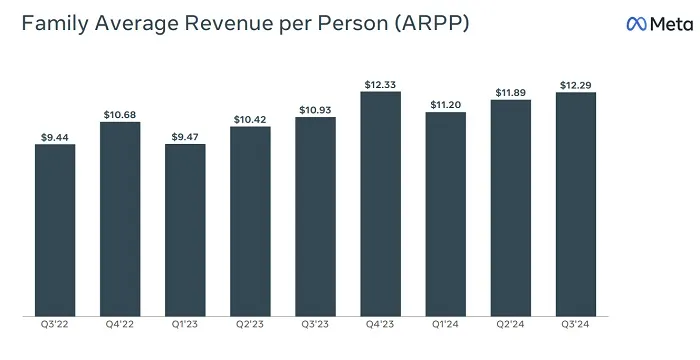
Although Meta no longer provides detailed breakdowns of its average revenue per user (ARPPU) by market, it is evident that the overall revenue per user is on the rise. With the holiday season approaching in Q4, we can expect further increases in revenue, which will significantly bolster the company’s financial standing.
This upward trend in revenue will enable Meta to maintain and enhance its financial performance:
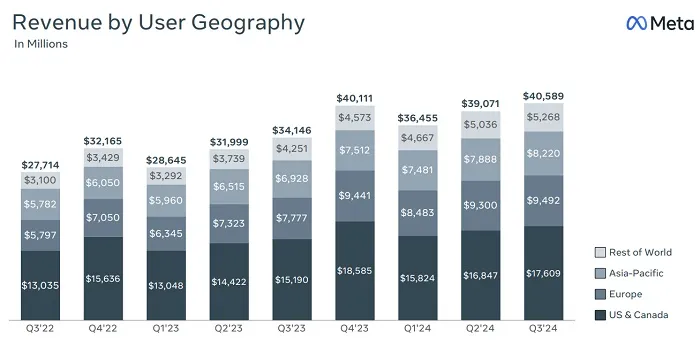
As illustrated in the chart, Meta still derives the majority of its revenue from North America and Europe, although it is gradually enhancing its revenue streams from the Asia Pacific market as well. This diversification is crucial for sustaining growth.
For this reporting period, Meta has posted a robust revenue figure of $40.59 billion, reflecting its ability to generate significant income despite ongoing investments in emerging technologies.
While Meta is investing heavily in VR and AI development, it continues to generate substantial revenue from its core business model, primarily by increasing ad placements across its platforms.
On the advertising front, Meta noted a 7% year-over-year increase in ad impressions across its applications. Additionally, the average cost per ad has also risen by 11% YoY, which may not be ideal for social media marketers but reflects the company’s advertising strength.
This means Meta is delivering more ads to a larger user base in various locations. While this creates more opportunities for marketers to engage with their target audience, the rising ad prices could pose challenges for advertisers. This scenario may benefit Meta’s shareholders but raises concerns for those investing in ads.
Perhaps as the adoption of Meta’s Advantage+ automated ad campaigns increases, which streamline ad placement, creative, budgeting, and bidding, there will be improvements. Meta claims these automated campaigns yield better results through enhanced behavioral insights, potentially enabling marketers to optimize their ad delivery and reduce overall expenses.
Ultimately, this could lead to improved outcomes, making the increased ad costs more justifiable for advertisers in the long run.
With the addition of more users to its already extensive network and increased revenue from advertisements, which are projected to rise again in Q4, Meta’s future looks encouraging under Zuckerberg’s leadership.
However, it’s important to note the following:
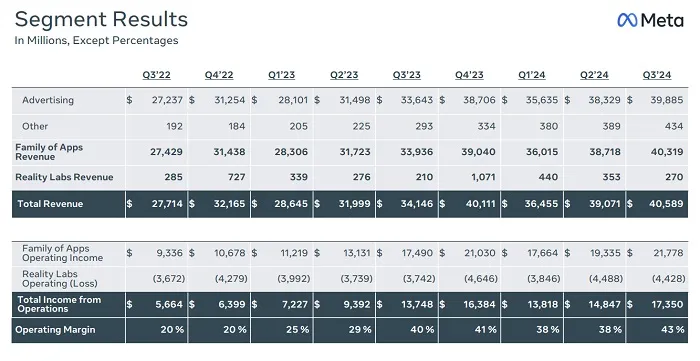
Meta is still incurring losses from its VR and AI initiatives, with total costs and expenses rising by 14% year-over-year.
These financial challenges are likely to persist in the near future.
According to Meta:
“We expect full-year 2024 total expenses to be in the range of -98 billion, updated from our prior range of $96-99 billion. For Reality Labs, we anticipate a significant year-over-year increase in operating losses due to ongoing product development and scaling efforts. Additionally, we expect our full-year 2024 capital expenditures to range between $38-40 billion, revised from our previous estimate of $37-40 billion.”
Furthermore, Meta is bracing for “substantial growth in capital expenditures in 2025” as it invests in developing new AI data centers and other essential infrastructures for its advanced projects.
Meta is arguably at the forefront of VR, AR, and AI development, leveraging its vast data resources, years of experience, and substantial financial backing. However, these innovations come with significant costs, and Meta must continue to absorb these expenses, as the revenue generated from these initiatives has yet to materialize meaningfully.
Nonetheless, there is optimism that these projects will eventually yield positive returns, although the timeline remains uncertain.
Meta’s new AR glasses are generating buzz, especially after showcasing their latest AR device at the Connect conference last month. This innovation could potentially capture consumer interest.

The emergence of functional AR capabilities is inevitable, and Meta is strategically positioning itself to lead in this burgeoning market. Additionally, with rising sales of its current Ray-Ban smart glasses, there are strong indicators of significant consumer demand for AR technology.
While the metaverse remains a long-term vision for Meta, the company is taking proactive steps in VR development. Its AI initiatives are also gaining traction, with Zuckerberg highlighting the popularity of their AI chatbot, which has become the most widely used AI chatbot tool available.
In fact, during his prepared statement, Zuckerberg credited the company’s impressive performance to advancements in Meta AI, the adoption of Llama, and the development of AI-powered glasses.
While some of these initiatives may still feel like speculative ventures, the trends suggest they could soon become mainstream methods of connection and interaction. The vision of widespread VR interactions may seem far-fetched, but the evolution of technology is paving the way for this reality, potentially augmented by AI to help users create personalized VR experiences.
In summary, while Meta’s current AI tools may appear somewhat basic and lack substantial enhancements to user experiences on Facebook or Instagram, the rising utilization of its AI chatbot suggests a growing scale rather than mere popularity. However, this should not be misconstrued as a reflection of Meta’s future direction in AI.
Overall, the results for Meta are satisfactory, aligning with expectations, as its advertising business remains robust while development costs continue to rise. It’s unlikely that there will be a significant market backlash against the company, even with projections indicating further cost increases, as the future outlook remains promising.
Nonetheless, the escalating costs may concern some investors, potentially leading to a short-term market response.


 Tessa Everly