 Troy Sanders

YouTube has recently made significant changes to how it calculates video views, prompting brands and marketers to rethink the definition of a view and its implications for audience engagement.Understanding these changes is crucial as the meaning of a view can differ widely across platforms.
For instance, the criteria for views on YouTube are as follows:
- A view is counted whenever a video is displayed on the screen and plays for longer than one second.
- An engaged view occurs when a viewer watches beyond the initial frame or actively clicks to view a clip.
- A qualified view refers to engaged views on public long-form videos or archived livestreams.
Ultimately, the interpretation of view counts can vary greatly based on the context. This shift is particularly relevant with YouTube striving to align its view metrics more closely with those of other applications.
To shed further light on this, Axios reporters Sara Fischer and Kerry Flynn detailed how each social media platform measures a view across diverse formats and types, and the implications of these measurements.
Social media expert Matt Navarra also created a simplified graphic representation of these metrics, enabling easier comparisons of how different platforms approach view measurement.
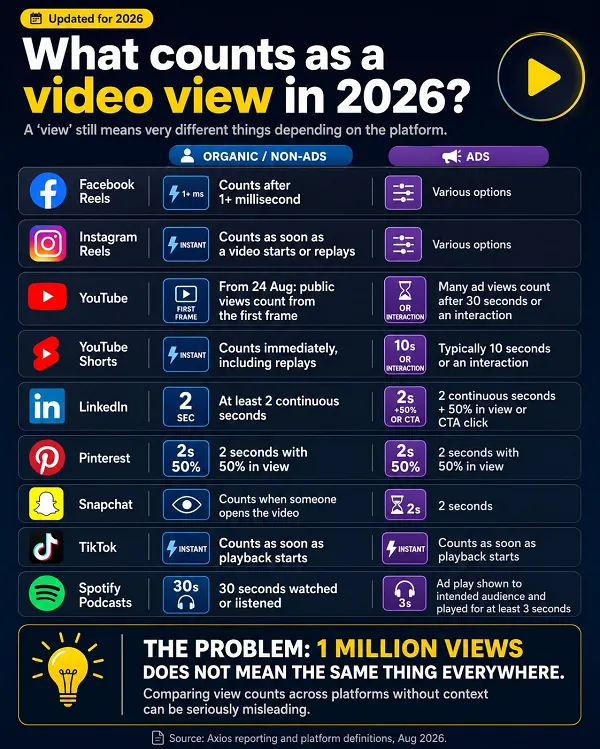
The differing definitions highlight various gray areas around what constitutes a view and how context and placement influence this interpretation.
In essence, view counts may not accurately reflect engagement levels and could be misleading indicators of audience interest. Marketers need to grasp the context behind these numbers to leverage them effectively.
For brands, particularly those negotiating partnership deals and sponsored content, understanding YouTube’s updated methodology is vital. Creators may promote their increasing view counts as a significant opportunity, yet the underlying cause might merely be a change in counting practices.


 Tessa Everly
 Mason Thompson