 David Bridges


What matters most about LinkedIn and AI citations?
LinkedIn posts from trusted, identifiable people may help brands appear in AI chatbot citations, but the cited research does not establish how individual AI tools select sources. This article examines the reported findings and the limits of the recommendations so brands can assess how LinkedIn activity might fit into AEO and GEO.
- Follower threshold: The cited Meltwater research says LinkedIn users with more than 10,000 followers are more likely to have posts cited by AI chatbots.
- Citation share: Accounts with over 10,000 followers and company pages make up 65% of the LinkedIn citations shown in the visual overview.
- Authority signals: LinkedIn’s guidance points to verified identity, professional profile details and a track record as signals associated with credibility.
- Research limits: The report describes correlations and does not explain how each AI tool determines which sources to cite.
How could LinkedIn influence AI chatbot citations?
LinkedIn says that posts from people with established professional identities can help brands gain citations in AI chatbot responses. The reported guidance connects creator credibility, profile details and audience size with the likelihood of being referenced.
LinkedIn’s report associates professional credibility with AI chatbot citations.
LinkedIn has shared new guidance on how brands can increase their chances of being cited in artificial intelligence chatbot responses. The platform says that drawing on the credibility and authority of influencers can help brands get referenced.
As Robert Yanik explained, AI Search Marketing Lead for LinkedIn Ads: “AI models like ChatGPT, Gemini and Copilot are built to reward credibility, and credibility, in their eyes, looks a lot like a real person with a demonstrated track record. LinkedIn ties every post to a verified identity, complete with employer history, skills and a professional network.”
According to research cited by Yanik and conducted by Meltwater, AI chatbots are more likely to refer to LinkedIn posts generated by individual users with more than 10,000 followers on the platform.
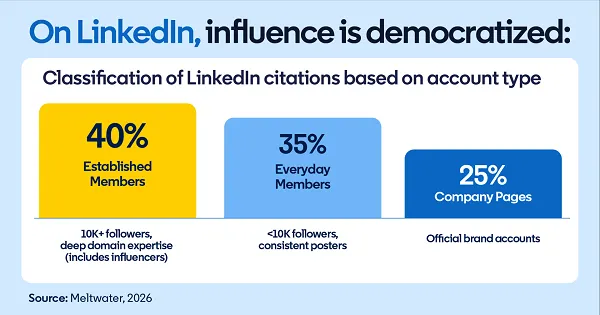
The visual overview shows that accounts with over 10,000 followers and company pages make up 65% of LinkedIn citations in AI chatbot responses. Users with fewer than 10,000 followers account for the remaining 35% of the mentions shown.
“Articles by C-suite and VP-level executives earn higher citation rates per article than non-executive content, which suggests this isn’t about volume alone but about how AI models weigh authority,” Yanik explained. “LinkedIn profile metadata, including job title, company and industry, acts as a direct authority signal that AI models use to assess credibility.”
Based on this, Yanik said brands seeking more AI response citations should activate a range of individuals alongside company page posts to distribute their messaging.

What LinkedIn posting strategy does the report recommend?
The guidance recommends choosing a few recurring themes, encouraging knowledgeable employees to post about them and considering creators whose audiences overlap with a brand’s buyers. These steps describe a way to broaden LinkedIn activity, not a guaranteed method for earning AI citations.
LinkedIn’s recommended strategy combines consistent employee posts with carefully matched creator partnerships.
- Choose themes: Identify three or four topics the brand wants to be associated with.
- Involve employees: Encourage credible employees to post consistently about those themes.
- Assess creators: Identify one or two creators whose audiences overlap with the brand’s buyers and explore a partnership.
To put this into practice, Yanik said brands should identify three or four themes to own, then encourage “credible employees” to post consistently about those themes. He added that brands should also identify one or two creators “whose audience overlaps with your buyers and explore a partnership.”
In practice, this advice amounts to publishing more on LinkedIn, while Yanik’s guidance also proposes an explanation of how AI models may choose among sources.
What are the limits of LinkedIn’s AI citation findings?
The report does not explain how each AI tool selects sources, so its findings should be read as correlations rather than proof of a specific ranking mechanism. LinkedIn’s established domain authority may also help explain why its content appears in chatbot responses.
The cited research does not establish that LinkedIn posting directly causes AI citations.
Yanik does not explain how each AI tool decides which sources to cite, so the report describes a correlation rather than a confirmed causal process. LinkedIn also benefits from its established domain authority. As a result, the advice offers limited detail on how businesses can understand AI citations and may also encourage more activity on LinkedIn.
Over recent months, LinkedIn has increasingly emphasized that AI chatbots often cite LinkedIn posts and articles in their generated responses.
How does LinkedIn fit into AEO and GEO?
Answer Engine Optimization (AEO) and Generative Engine Optimization (GEO) are approaches businesses consider as search behavior changes and referral traffic from search engines declines. LinkedIn may be one channel to explore, but the report does not show that posting there guarantees chatbot visibility.
LinkedIn activity can form part of an AEO or GEO effort, but citations are not assured.
As search behavior evolves, this creates an opportunity for businesses: referral traffic from search engines has steadily declined for many websites, prompting businesses that rely on those referrals to explore alternative traffic sources, including AEO, or Answer Engine Optimization, and GEO, Generative Engine Optimization.
That makes increased attention to LinkedIn one possibility for businesses to consider.
LinkedIn has sought to address this interest by sharing guidance on what AI chatbots seek in web content, and how brands can improve their visibility in AI chatbot results.
The central message of this guidance is that brands should publish regularly on LinkedIn to benefit from the platform’s existing domain authority and increase their visibility. LinkedIn’s advice relies on its established trust and authority; the report does not describe a specific change to align the platform with AI tools. The company presents itself as a source of guidance on AI citations, drawing on the statistics it shares.
These findings reinforce a practical implication: LinkedIn posting and content that resonates with its users may help build brand and individual authority on the platform, but the report does not establish a guaranteed result. LinkedIn’s other guidance, such as structuring articles for AI chatbots, cannot be assumed to work independently of a creator’s established presence.
In summary, posting on LinkedIn may support AEO and GEO efforts and may help brands earn mentions in AI chatbot responses, but content structure alone is not the full story. The report highlights established trust and presence as possible indicators of relevance and expertise. Platforms such as LinkedIn and Reddit expose engagement signals, including likes, upvotes and follower counts, that may help chatbots identify authoritative responses.
The report’s other recommendations provide limited value without an established presence on the platform.
What should brands take away from LinkedIn’s findings?
Brands can use the findings to plan consistent, credible LinkedIn activity, while treating the citation statistics as correlational evidence rather than a verified ranking formula. The most useful distinction is between recommended actions and what the research actually proves.
The report supports testing consistent LinkedIn activity, not assuming that it guarantees AI citations.
- Develop a small set of recurring themes for company and employee content.
- Consider creator partnerships when audiences overlap with the brand’s buyers.
- Build recognizable professional profiles and a sustained presence.
- Do not treat follower counts or posting volume as a confirmed AI ranking formula.
The findings suggest a trade-off: broader participation may build visibility and professional authority, but the available information does not show which activity causes citations or how different AI tools weigh each signal.
What did Meltwater’s research report about LinkedIn followers?
The research cited by LinkedIn says AI chatbots are more likely to refer to posts by LinkedIn users with more than 10,000 followers. The visual overview attributes 65% of the shown citations to accounts above that threshold and company pages.
The reported follower threshold is more than 10,000 LinkedIn followers.
Does posting on LinkedIn guarantee citations in AI chatbots?
No. The report describes correlations and does not explain how individual AI tools select sources or establish that LinkedIn posting causes citations.
LinkedIn posting does not guarantee AI chatbot citations.
What LinkedIn content strategy does the report suggest?
The report suggests choosing three or four themes, encouraging credible employees to post consistently and considering one or two creators whose audiences overlap with buyers.
The suggested strategy combines recurring themes, employee posts and relevant creator partnerships.
What do AEO and GEO mean in this article?
AEO means Answer Engine Optimization, while GEO means Generative Engine Optimization. Both terms refer here to efforts to improve visibility as people use answer engines and generative AI tools.
AEO and GEO describe optimization efforts aimed at answer and generative engines.


 Sophie Langley