Ivy Caldwell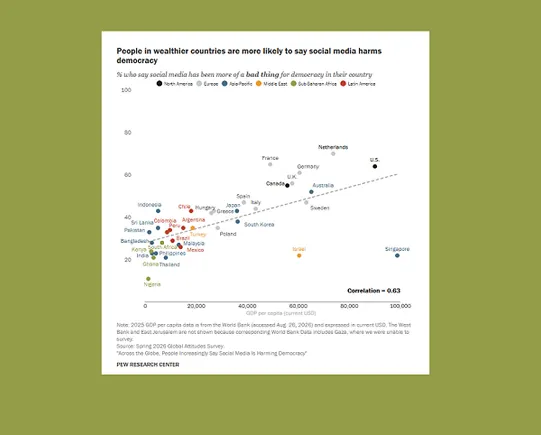

Pew Research has released a comprehensive study that explores global perceptions regarding social media and its effects. The findings indicate a growing belief that social media platforms are detrimental to democracy.
This research, which surveyed 37 nations, revealed a consistent decline in positive sentiment towards social media’s influence across all countries since Pew’s previous survey in 2022.
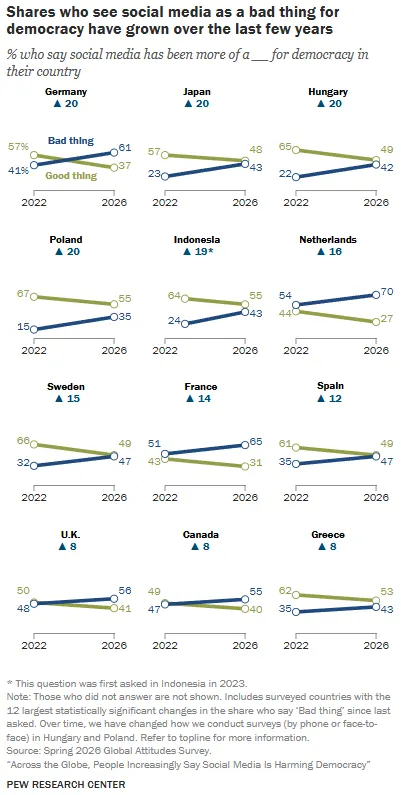
Pew’s findings emphasize that views on social media’s impact are especially negative in the United States, where 64% of adults perceive these platforms as harmful to democracy.
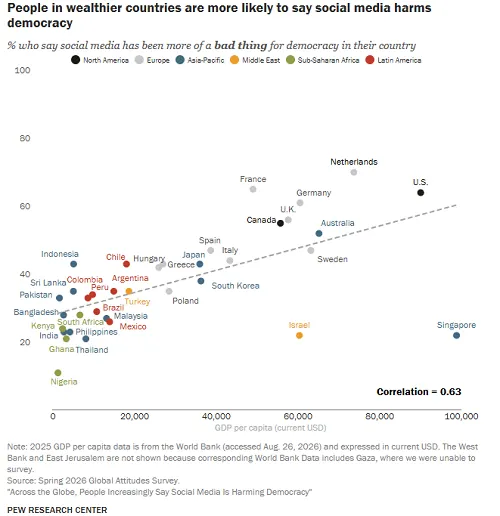
Additionally, the data indicates that individuals in more affluent nations are more likely to view social media as having a negative effect.
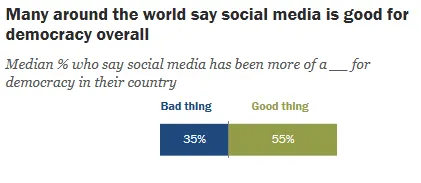
Conversely, 55% of respondents expressed the belief that social media has a generally positive influence on democracy, with younger adults more inclined to see these platforms as beneficial.
This finding is particularly noteworthy when considered alongside another survey conducted by Pew Research, which revealed that 82% of Australian adults favor limiting social media access for children.
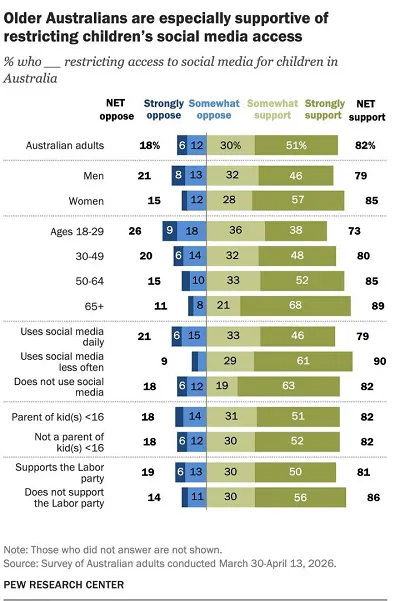
The data illustrates that older demographics are increasingly supportive of social media restrictions for teenagers, reflecting a widespread recognition of the negative consequences associated with social media.
It can be argued that social media has intensified societal divisions, as engagement-driven algorithms often promote contentious and emotionally charged content, leading individuals to modify or deepen their political beliefs.
The insights from Pew’s report likely explain the increasing support for social media restrictions for teenagers, given that a significant portion of the voting public appears to endorse such measures.
Similar surveys conducted in the U.S., U.K., France, Italy, Norway, and Sweden indicate that a majority of adults favor restrictions on social media for adolescents.
In light of the broader agreement regarding social media’s adverse effects, these restrictions could be viewed as a constructive response.


 Troy Sanders
 Maya Kensington