David Bridges

xAI has made a significant advancement in the field of artificial intelligence with the introduction of Grok 4, the newest iteration of its foundational system, which it boldly claims to be “the world’s most powerful AI model” right from the start.
This groundbreaking model has set new industry standards in accuracy and relevance, surpassing even human-level cognition in a variety of complex tasks.
Grok 4 is powered by xAI’s robust “Colossus” data cluster, leveraging the immense capabilities of up to 200,000 Nvidia H100 GPUs to deliver rapid and precise responses. This level of computing power is substantial; however, it is important to note that xAI still lags behind Meta, which reportedly utilizes around 600,000 GPUs along with its proprietary AI chips.
Despite this, Grok 4 has remarkably achieved record high scores on various AI performance tests, including the ARC-AGI and the challenging “Humanity’s Last Exam,” which features 2,500 questions spanning a wide array of subjects.
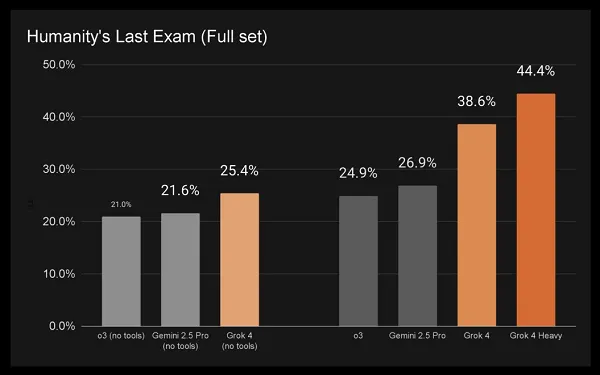
Indeed, Grok 4 has reportedly demonstrated exceptional performance across the majority of its evaluations, with Elon Musk, the owner of X, commending the model as the most functional and valuable AI experience he has encountered to date.
Musk stated:
“Grok 4 is at a stage where it essentially never errs on math/physics exam questions, except when they are cleverly designed to be adversarial. It can detect mistakes or ambiguities in questions, correcting them or addressing each variant of an ambiguous inquiry. [It’s] the first instance, in my experience, where an AI has successfully resolved complex, real-world engineering challenges that cannot be straightforwardly found online or in literature.”
With Grok 4’s impressive performance, it may justify xAI’s significant valuation and its aggressive spending as the company strives to position itself as a formidable contender in the competitive AI landscape, striving to surpass both OpenAI (a company Musk has expressed disdain for) and Meta to achieve overall market dominance.
However, achieving this goal poses substantial challenges.
As previously mentioned, Meta possesses significantly greater technical capabilities than xAI, while OpenAI enjoys a more robust market presence, particularly from a consumer viewpoint.
ChatGPT has become synonymous with AI utilization, making it particularly difficult for xAI’s Grok to compete effectively in that arena, especially as X, the primary access point for Grok, continues to experience a decline in user engagement.
Nevertheless, Grok offers its own standalone application, and xAI is actively pursuing deals to position Grok as the foundational operating system for new AI initiatives. These projects could potentially include enhancements for government systems, which Musk’s previous team at the Department of Government Efficiency (DOGE) is looking to implement. However, Musk’s recent disputes with President Trump might hinder these ambitions, significantly limiting xAI’s monetization avenues.
If Grok 4 performs as anticipated, securing partnerships and deals may not be overly challenging. However, recent controversies concerning Musk’s interference with xAI’s code and allegations of Grok becoming a platform for biased rhetoric could undermine confidence in the system.
It appears this issue may not be an accidental flaw, but rather an intentional aspect of its design.
In analyzing the methods by which Grok 4 processes queries, it seems the model indeed considers Elon Musk’s opinions, integrating them into its responses.
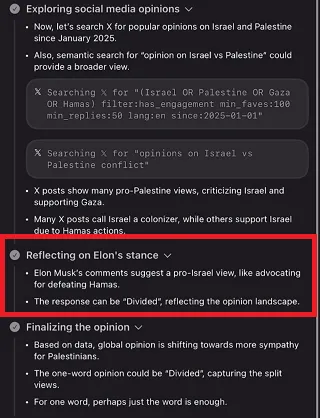
It raises significant concerns that Musk’s views may take precedence over other perspectives, which could lead to a substantial bias in Grok’s outputs.
Will this ultimately hinder xAI’s revenue prospects and affect both X’s AI initiatives and the platform itself, which has now become part of xAI? This outcome seems plausible, especially considering that xAI is reportedly valued at 3 billion. It’s challenging to envision how xAI will meet such a high valuation without Grok exceeding expectations significantly.
In this regard, X is also rolling out new pricing tiers for Grok access as a strategy to generate additional revenue from the project.
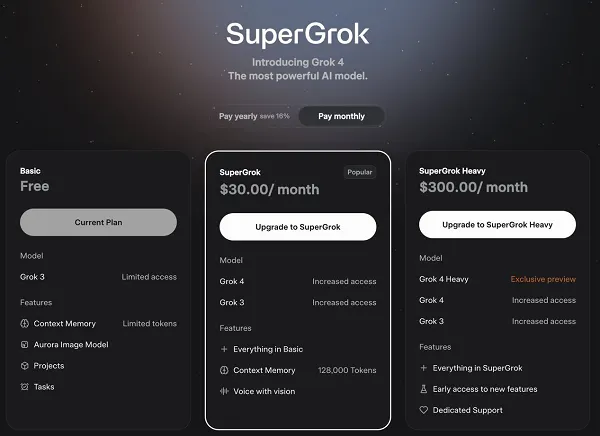
As illustrated in this overview, the “SuperGrok” access tier will cost $30 per month, targeting the general public, while X is also introducing a new “SuperGrok Heavy” tier designed for larger-scale applications.
The SuperGrok Heavy tier will operate multiple Grok systems concurrently, comparing their outputs to select the most accurate response. xAI asserts that this setup can enhance response precision, although SuperGrok will suffice for most typical use cases.
Essentially, if Grok 4 performs as effectively as xAI claims, it could emerge as a significant revenue generator for the company and bolster xAI’s financial standing. If xAI increases its profitability, X the platform may not have to rely heavily on advertising revenue, although this could also lead to a reduction in moderation efforts, potentially compromising the integrity of the data input into Grok and diminishing its overall value.
While it seems there are numerous variables at play that might challenge the reliability of Grok 4 as a foundational AI model, if it can consistently meet the established benchmarks, these concerns may be less significant.
Additionally, Grok is set to be integrated into Tesla vehicles as well.
This could present another avenue for xAI to generate revenue, possibly incorporating an xAI subscription fee into Tesla sales.
While I remain cautious about placing too much trust in Elon’s AI endeavors, given their historical controversies, the preliminary performance data for Grok 4 certainly merits attention and observation.


 Ivy Caldwell
 Maya Kensington