Daniel Mercer

The surge in NAND density makes smaller flash drives increasingly impractical.
In the early 2000s, a flash memory capacity of 1GB was considered significant, and it came with a hefty price tag. In 2002, JMTek’s USBDrive was notable for its 1GB capacity. Fast forward to today, and this capacity is considered minimal by consumer standards. Many of Kingston’s current DataTraveler models begin at 64GB and extend up to an impressive 512GB.
The rapid decline in storage prices has been nothing short of remarkable. From over $8,000 per gigabyte in its formative years, the cost plummeted to just 94 cents per gigabyte by 2013. The fundamental design of a flash drive has remained consistent, requiring a USB connector, controller, circuit board, casing, and one or more memory chips. While it is still feasible to produce a 1GB drive, it simply does not hold much market value anymore.
How Has NAND Technology Increased Data Storage?
luchschenF/Shutterstock
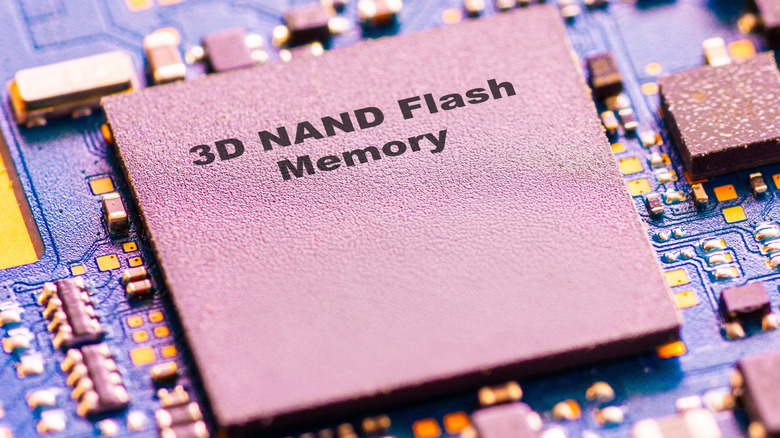
The remarkable advancements took place within the memory chips themselves. For many years, NAND manufacturers have continuously innovated by reducing the size of memory cells, fitting multiple bits into each cell, and ultimately stacking these cells in a vertical arrangement known as 3D NAND. This technological evolution allows for significantly greater data density in flash drives without increasing their size to the point of requiring bulky carrying cases.
A notable milestone occurred in 2005 when Toshiba and SanDisk introduced an 8Gb (gigabit) NAND chip capable of storing 1GB on a single chip. This new chip was only slightly larger than its predecessor, a 4Gb model, yet it doubled the storage capacity. The companies anticipated this chip would be the “production workhorse” for their flash storage products, leading to substantial cost savings.
The pace of innovation accelerated rapidly. In 2004, a 2.1GB Verbatim Store ‘n Go retailed for $250. By 2013, Kingston unveiled a 1TB DataTraveler, while the earlier 512GB model was priced at a staggering $1,750. TLC NAND technology, which stores three bits per memory cell, is now prevalent in budget-friendly consumer storage solutions like USB drives. While both capacity and speed have improved, a larger capacity does not automatically translate into faster performance; factors such as the type of NAND, the controller, and the USB interface also play crucial roles.
Why Producing Small Flash Drives Is Not Economically Viable
Reducing a 64GB flash drive down to 1GB does not eliminate the need for the other hardware components. The low-capacity variant still requires a controller, connector, circuit board, casing, and packaging. It also incurs costs related to assembly, shipping, and retail display. when high-density NAND becomes affordable at scale, lowering storage capacity does not proportionately decrease the overall cost of the finished product.
There is no specific capacity threshold where production costs suddenly become impractical, so there was no abrupt shift in the industry when manufacturers collectively moved away from 1GB drives. Instead, this transition happened gradually. For instance, Microsoft’s Windows installation media tool mandates at least an 8GB blank flash drive, rendering a 1GB drive insufficient for one of the most common uses for a spare USB drive.
Multi-Level Cell (MLC) NAND is also facing production challenges. Analysts project that global MLC NAND capacity will decline by 41.7 percent year over year by 2026 as major manufacturers reduce output and redirect resources toward more advanced processes. This shift could lead to an unusual scenario where older NAND types become more expensive due to limited availability.
Although small flash drives are becoming increasingly rare, they still exist in specialized industrial and embedded applications where factors like compatibility, durability, or fixed hardware configurations are prioritized over sheer capacity. Companies like Delkin offer industrial USB drives starting from 1GB, while Apacer provides options beginning at 256MB.



 Brandon Fletcher