 Clara Hastings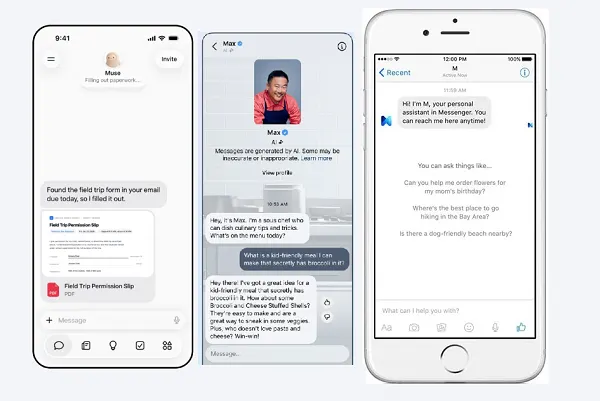

Despite the continuous public skepticism towards Meta’s digital assistant initiatives, CEO Mark Zuckerberg remains committed to these concepts, believing they can enhance the world.
This week, Meta unveiled the Muse app and chatbot, its most sophisticated AI-powered assistant to date. Muse allows users to personalize their bot, interact with it, assign tasks for background execution, and essentially utilize it as an omnipresent personal assistant.
Zuckerberg views this technology as a pivotal advancement towards making personal superintelligence accessible to everyone.
However, this isn’t the first time Meta has introduced a similar concept.
Back in 2015, Meta launched the M personal assistant, which, like Muse, was designed to perform tasks for users through AI technology.

What functions could the M assistant perform?
As described by former Messenger chief Davis Marcus: “It can purchase items, arrange gift deliveries, book restaurants, manage travel plans, set appointments, and much more.”
Essentially, M closely resembled Meta’s current Muse initiative. While AI technology has evolved significantly over the past decade, enhancing Muse’s capabilities, similar functionalities existed over ten years ago.
Nevertheless, user engagement was minimal. Despite Meta’s enthusiasm for bots, interest from users was limited, leading to the eventual discontinuation of the M project in January 2018.
Meta also attempted to introduce celebrity-themed chatbots on Messenger, in several variations, none of which captured significant attention. The company launched Messenger bots in 2016.
Despite extensive promotional efforts, including celebrity endorsements, none of these features garnered much interest, similar to the current campaign surrounding Muse.
Yet, Meta persists with this strategy. Given past experiences, it seems unlikely that Muse will achieve widespread acceptance, which could significantly impact Meta’s ambitious AI investment plans.
What drives Meta’s unwavering focus on a concept that clearly fails to resonate with users?
Perhaps it stems from a vision influenced by science fiction of a ubiquitous computer system that assists with daily tasks. Zuckerberg has developed a system for his home, indicating a personal interest in such technology. However, the primary motivation appears to be a drive for optimization—an effort to maximize productivity and enhance decision-making for a theoretically improved life.
Yet, this perspective does not align with the preferences of many users.
Many individuals prefer to learn through experience and handle tasks like product research and shopping independently. People cherish authentic human interactions, which Zuckerberg seems to perceive as inefficiencies, while most see them as essential life experiences.
In a recent interview with Sources this week. Zuckerberg shared his personal use case for the Muse AI chatbot: “For me, when I’m using my Muse Agent, I want it to help me be a better father and a better husband, and to show up better for my friends.”
This statement highlights a potential disconnect between Zuckerberg’s perspective and that of everyday users. He seems to approach life with a focus on optimization, aiming to accomplish more in less time, thus maximizing his efficiency.
This mindset is not universally shared.
Zuckerberg’s zeal for optimization is advantageous in programming and business. it’s clear that not everyone aligns with this outlook.
This misalignment suggests that Meta’s latest venture to promote digital assistants may likely falter once more. Despite the wealth of data Meta possesses about user behavior, the company seems to interpret this insight merely as data rather than recognizing it as a reflection of the diverse ways in which people desire to engage with the world.


 Tessa Everly
 Maya Kensington