 Tessa Everly


LinkedIn is steadily enhancing its innovative brand kit feature, allowing marketers to define their essential brand colors and fonts. The platform’s system will utilize these specifications in the artificial intelligence-driven creation of future promotional content.
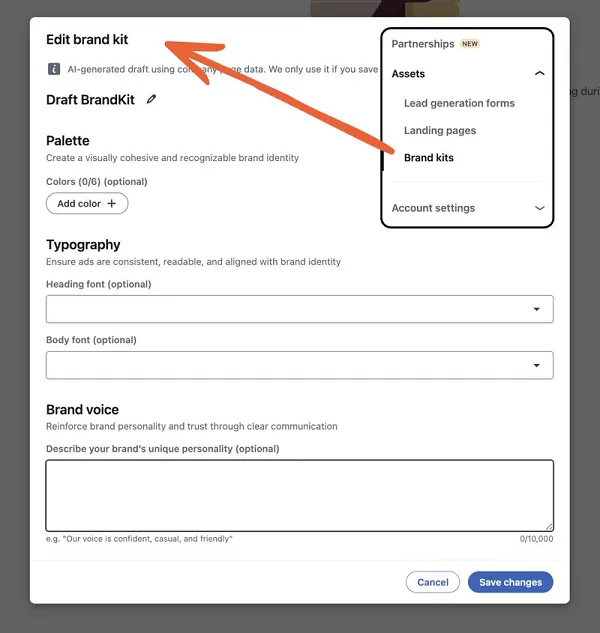
In an example shared by LinkedIn user Anthony Blatner, the brand kit—currently available to a select group of users—allows marketers to establish a defined brand color palette, choose font styles, and articulate a brand voice. LinkedIn’s system then references these elements for future content suggestions.
LinkedIn explains, “Brand kit in Campaign Manager enables you to set your brand’s core assets such as color palette, fonts, and brand voice to ensure your ads remain consistently aligned with your brand. When you first access brand kits, LinkedIn automatically assembles your brand voice using your existing LinkedIn presence, including past content and your Company Page.”
This tool empowers businesses to create a cohesive brand identity on the platform, with LinkedIn constructing a brand persona based on previously published posts from the company’s page.
“Brand kits can save you time and minimize off-brand errors by ensuring that AI-generated ads and assets align with your brand without requiring manual adjustments,” noted LinkedIn.
Providing clearer instructions to LinkedIn’s AI creation tools can enhance the customization of ads and content. This guidance may also aid marketers in refining their content according to established brand standards.
The brand kit could serve as a useful reference during the content creation process, generating more relevant ideas as a foundation for LinkedIn’s evolving AI capabilities.
A potential risk exists if users become overly dependent on such tools, allowing AI systems to handle the majority of their work. While these tools can automate many tasks, unchecked AI can still produce flawed outputs that may damage brand reputation.
This dilemma is one that social platforms are increasingly addressing. On LinkedIn, the platform has recently introduced new regulations to limit AI-generated content in user feeds. Despite this, LinkedIn also provides users with various tools to utilize AI for crafting and enhancing their in-stream updates.
This creates a paradox: LinkedIn cautions users against posting low-quality AI-generated content while simultaneously encouraging them to utilize AI features to produce such content.
This reflects the broader conflict surrounding the rise of AI. Social platforms and AI developers promote increased AI usage, yet higher reliance on AI can lead to user disengagement due to the proliferation of low-quality content, which undermines trust and interest.
The genuine benefit of the latest AI tools lies in their capacity to assist, offering prompts and guidance to enhance work quality. Yet, these tools can also be employed to complete entire tasks. Many users opt for the simpler route, resulting in an overproduction of unchecked and unrefined content that lacks value and may spread misinformation or inaccuracies.
Providing proactive guidance for AI tools appears to be a promising approach to address these issues. Nonetheless, the challenge of overreliance on such tools is likely to grow significantly.

 Sophie Langley