Daniel Mercer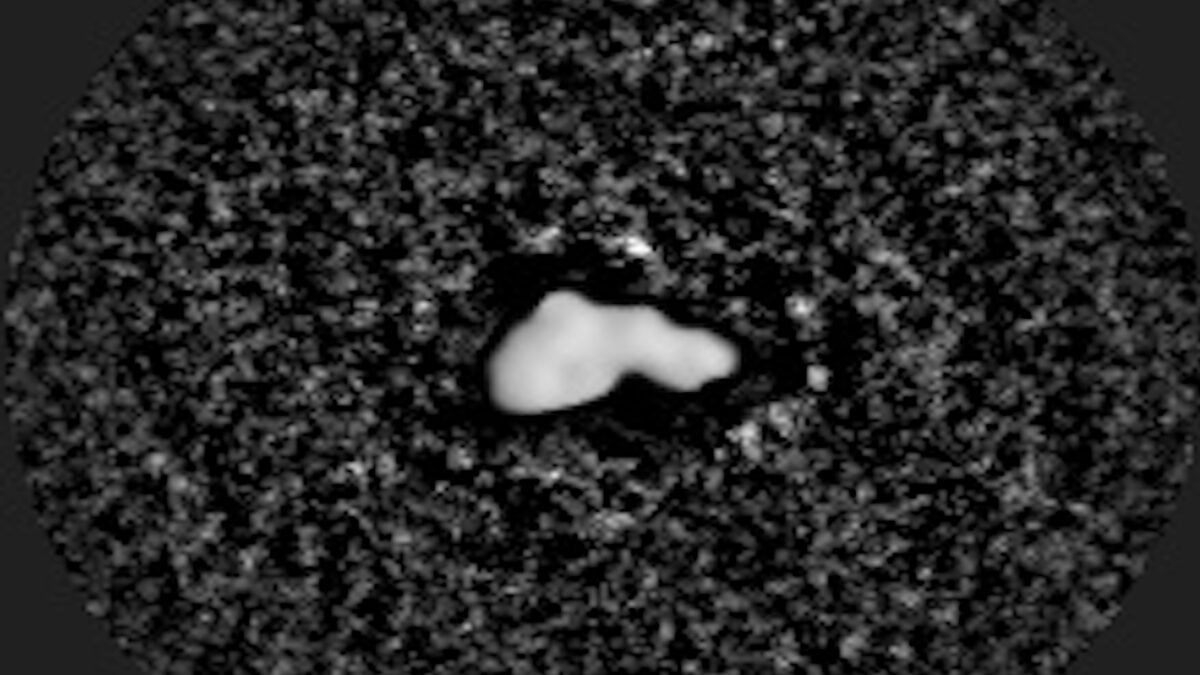

Astronomers have recently conducted an in-depth analysis of one of the largest known asteroids in the main asteroid belt, unveiling a celestial body that features its own moon.
The asteroid, designated (44) Nysa, was first identified in 1857 and orbits the Sun between Mars and Jupiter. Employing high-resolution images from the Large Binocular Telescope in Arizona and the Very Large Telescope in Chile, a dedicated team of scientists constructed a three-dimensional model of Nysa, revealing a structure that is distinctly unique.
Nysa exhibits three lobes, interconnected by a slender neck that maintains the integrity of the asteroid. Recent observations also uncovered a diminutive moon that orbits Nysa from approximately 100 miles (170 kilometers) away.
These groundbreaking discoveries provide insights into the ancient collisions that occurred during the early solar system and how they contributed to the formation of the asteroids we observe today.
Understanding the Structure of Nysa’s Lobes
Since its discovery, Nysa has attracted significant interest due to its remarkable brightness and unusual composition. Astronomers have been studying this asteroid for over a century, with early observations indicating that it may possess an elongated or bilobate shape.
Nysa is classified as an E-type asteroid, a relatively uncommon variety that is abundant in an iron-free mineral known as enstatite. This mineral’s light-reflecting properties give Nysa its bright appearance. E-type asteroids share similar chemical characteristics with the fundamental building blocks of Earth, suggesting they formed closer to the Sun and may provide valuable clues about the solar system’s formation process.
To enhance their understanding of the asteroid, the research team obtained the highest-resolution images of Nysa ever captured and applied advanced image processing techniques. These images revealed several significant surface features, including two prominent valleys that encircle the asteroid and may serve as a neck linking its lobes.
“The images depict an exceptionally unusual object,” said Kate Minker, an astronomer at the Lowell Observatory in Flagstaff, Arizona, and the lead author of the study. “The most probable explanation is that Nysa is a contact trinary, consisting of three interconnected components, or an exceptionally irregular coherent body unlike any we’ve observed before.”
While two-lobed asteroids are relatively common in the universe, the new images may mark the first identification of a three-lobed asteroid.
Discovering Nysa’s Moon
To the asteroid itself, astronomers identified an uncharted moon in orbit around Nysa. This small moon is slightly over half a mile (1 kilometer) in diameter and revolves around its 47-mile-wide (75-kilometer) parent body.
The research team utilized high-contrast imaging techniques to detect the faint light emitted by the small moon, which was previously obscured by Nysa’s brilliant brightness. Future observations of this tiny satellite will assist astronomers in more accurately determining the mass and density of Nysa.
“Our approach is akin to trying to guess the contents of a wrapped Christmas present,” explained Al Conrad, an associate staff scientist at the Large Binocular Telescope Observatory and a co-author of the study. “You might wonder if the box holds a clock radio or a bag of socks; to get a hint, you would pick it up and assess its weight. In a way, you are intuitively measuring density to infer the composition.”
Once the astronomers gather additional data about the asteroid, they will be positioned to confirm whether Nysa is indeed the three-lobed anomaly they hypothesize.
“The new images align with several earlier indicators suggesting that Nysa is truly a distinctive object,” Conrad remarked. “For the first time, we can directly investigate whether these indicators point to a deeply indented body or a genuine multi-lobed structure.”



 Ethan Carter