Ivy Caldwell

LinkedIn recently provided an update on its new “seems like AI slop” reporting feature, which debuted earlier this month, offering users a systematic way to report content that appears to be produced by artificial intelligence tools.
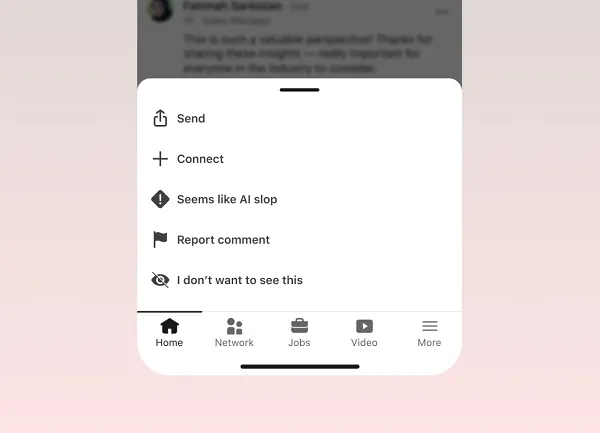
Clearly, there seems to be an abundance of AI-generated content within the platform.
LinkedIn’s Chief Product Officer, Hari Srinivasan, reported that over one million users utilized this feature in its initial two weeks.
Simultaneously, the platform emphasized the intended purpose of this feature and the process that follows when users report “seems like AI Slop.”
LinkedIn clarified that reporting AI slop does not automatically lead to reduced visibility for the reported content.
As articulated by LinkedIn Creator Product Lead, Sam Corrao Clannon,: “We define AI slop internally as content that may appear sophisticated or polished but lacks real substance. It presents no unique experience, perspective, or insight, serving merely as filler that aims to attract attention without genuine effort.”
Corrao Clannon emphasized that this feature does not target all forms of AI utilization in LinkedIn post creation. Users leveraging AI for language refinement are not the focus; rather, the feature aims to address low-quality posts that users prefer to avoid.
He further explained that the option is not intended as a means to report policy violations. Instead, it empowers users to curate their feeds more effectively while providing LinkedIn with valuable insights into what constitutes low-quality, low-effort content.
“This feature allows users to take control of their feeds by indicating that they are not interested in content that resembles generic, superficial, AI-generated material,” Corrao Clannon stated.
Essentially, when a user utilizes the AI slop reporting feature, it primarily affects their personal feed experience without necessarily altering the overall visibility of the post throughout the platform.
Srinivasan noted that individual feedback does not dictate content distribution on LinkedIn. “We analyze multiple signals collectively and have implemented safeguards to prevent any single feedback from unfairly targeting other users,” he stated.
Although reporting content may lead to seeing less from that particular creator, the overall performance of any post remains unaffected unless a significant number of users express similar concerns.
In response to this, LinkedIn is introducing new notifications for users who receive numerous AI slop reports, informing them of potential issues.
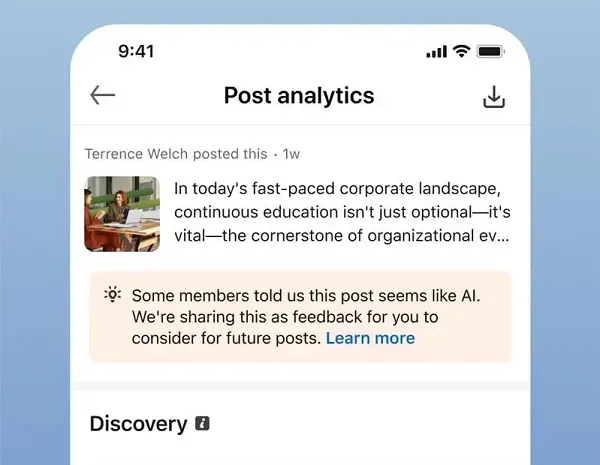
LinkedIn aims to take an informative rather than punitive stance in addressing the overuse of AI content by encouraging users who produce AI slop to reconsider their approach.
This reporting feature is already showing promising results.
Srinivasan highlighted that content categorized as AI slop has experienced a 40% decrease in views compared to just a few weeks prior.
“Despite these advancements, we recognize the ongoing need to ensure LinkedIn remains a platform for authentic voices and genuine perspectives. This goal is consistently at the forefront of our efforts,” Srinivasan remarked.
LinkedIn is also encouraging users to complete its verification process to confirm their authenticity as real users. This verification serves as a criterion to help users filter interactions within the platform.
Through these initiatives, LinkedIn aspires to stay ahead of the growing trend of AI-generated content, aiming to mitigate the effects of low-quality AI posts on user engagement and interest.


 Cameron Steel
 Clara Hastings