David Bridges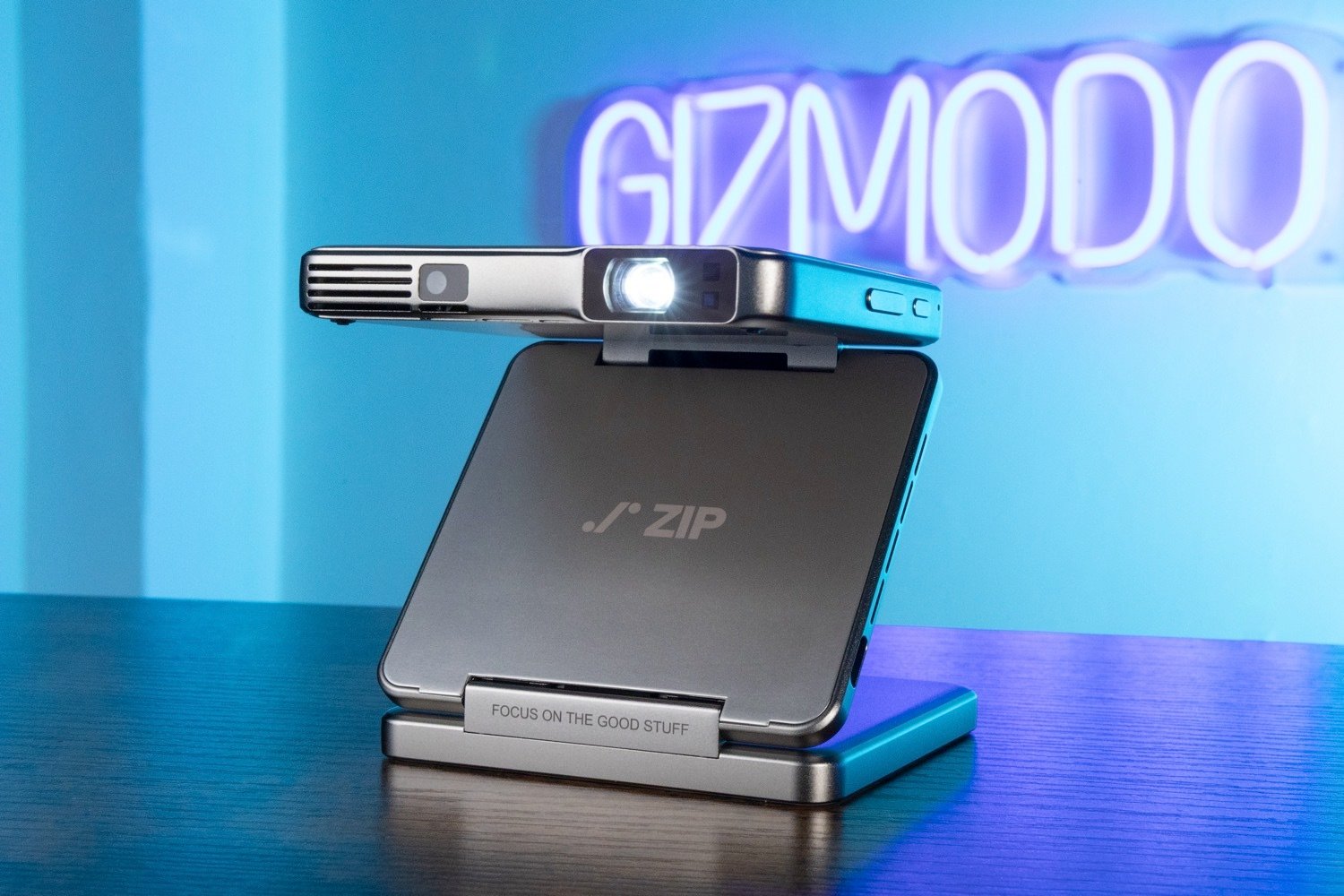

The moment I encountered the Aurzen Zip, I was captivated and thought to myself, “I need to have one of these.” This remarkable device serves as a portable projector and is compact enough to fit in your back pocket, allowing you to transform any nearby wall into an instant second screen. The best part? It operates without the need for wires or WiFi connectivity. Marketed by the company as the “world’s first tri-fold projector,” its unique design is certainly eye-catching. However, despite my initial enthusiasm for its concept, my actual experience using the Aurzen Zip left me feeling somewhat underwhelmed.
The standout characteristic of the Zip is undoubtedly its innovative tri-fold design, which is the primary reason to consider purchasing it. When fully folded, this mini projector is just 3.3 x 3 x 1 inches—about half the size of a standard iPhone—and weighs slightly over 0.6 lbs. Upon unfolding, it resembles a quirky cousin of the iconic Pixar lamp, poised to project your favorite YouTube videos onto any surface. It’s perfect for spontaneous viewing—be it at a campsite or during a flight. While I may not camp frequently nor wish to disturb fellow travelers with game trailers on the plane, the potential to do so is undeniably appealing.
Discover the Aurzen Zip
The Aurzen Zip offers the portability you’ve always desired in a mini-projector, but its dim brightness and high price point make it challenging to fully endorse.
Advantages of the Aurzen Zip
-
Exceptional compact design -
User-friendly operation
Drawbacks to Consider
-
Limited brightness output -
Noticeable fan noise -
Insufficient battery life -
Priced at $400
Setting up the Aurzen Zip is a breeze. After connecting the device to your computer or accessing your phone’s screen mirroring options, simply follow the on-screen instructions. I experienced virtually no latency when mirroring content from my phone, making it easy to enjoy Mets spring training games projected on the wall near my desk, much to the chagrin of my Yankee fan colleagues. A more relatable application was using it to project a few Ms. Rachel videos on the ceiling for my toddler before bedtime. The kids loved it, but unfortunately, the fun ended abruptly when the battery ran out.
However, I did notice some latency when I attempted to use the Zip as a secondary screen for both my iMac and PC. This delay became evident when watching videos, as the audio and visuals appeared slightly out of sync, creating a somewhat distracting viewing experience.
It’s important to note that while YouTube and Twitch are readily available, many popular streaming applications like Max and Netflix do not support screen mirroring from phones and computers. This limitation isn’t unique to the Zip; numerous streaming platforms impose strict DRM restrictions on specific external displays. You would encounter similar issues if you attempted to use Apple AirPlay from your iPhone to a smart TV. Therefore, if this restriction is a dealbreaker for you, you might want to consider a mini-projector with integrated Google TV functionality, such as the Nebula Capsule Air. Although it won’t fit in your backpack, it remains compact enough for travel.
See at Amazon
The Zip emits only 100 lumens, which is quite dim for any projector, regardless of size. As a result, you’ll require near-complete darkness to enjoy a comfortable viewing experience. The picture quality significantly diminishes in well-lit settings, as demonstrated below when comparing images with the studio lights on versus off. Too much ambient light results in a washed-out image that’s hardly visible.


For optimal viewing, positioning the projector two to four feet away from the wall is ideal, yielding a screen size of approximately 30-40 inches. If you extend the distance to five or six feet, you can project an impressive 70 inches. However, the further you move away, the more you compromise screen clarity and brightness, which can detract from your overall viewing experience.
After using the Zip for a couple of weeks, I remain astonished by how loud it is for such a small device. Once powered on, the tiny internal fans begin to operate at full throttle, creating noise that overpowers the already underwhelming 1W built-in speakers. Even at maximum volume, the fan noise is consistently audible, which detracts from the enjoyment of any media played.
Battery life is also a significant drawback; even at 100 lumens, you can expect only about 45 minutes of battery life in Turbo mode and just over an hour in Eco mode. The primary distinction between these two modes is that Eco mode reduces screen brightness further to conserve battery power. While this might be useful during a blackout, for most situations, it feels more like a novelty than a truly practical solution.

Ultimately, the Aurzen Zip’s primary advantage lies in its remarkable portability. It is undoubtedly the most compact projector I have encountered to date. I appreciate its innovative design and user-friendly operation, yet the unsatisfactory battery life, subpar sound quality, and low brightness output make it difficult to justify the steep price tag it carries.
See at Amazon
The Aurzen Zip is set to launch in April for $400, but you can pre-order it now for $250.



 Daniel Mercer
 Ethan Carter