David Bridges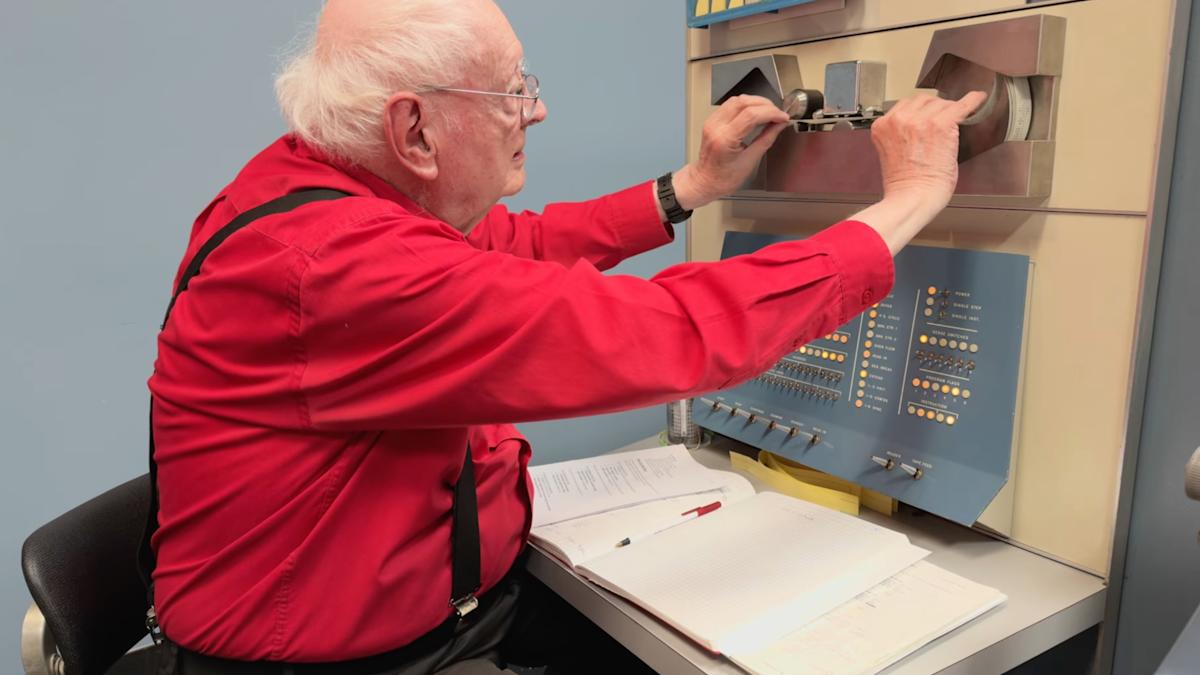
Key Highlights
- Historical Significance: The PDP-1 is known for hosting Spacewar!, one of the first video games.
- Music Playback: The PDP-1 can also play music, demonstrated by the use of Boards of Canada’s “Olson.”
- Innovative Technology: Peter Samson repurposed light bulbs to create audio output through the PDP-1.
- Labor-Intensive Process: Playing music on the PDP-1 involves a complex setup using paper tape.
The Programmed Data Processor-1 (PDP-1) is perhaps most recognizable as the home of Spacewar!, one of the world’s first video games, but as the video above proves, it also works as an enormous and very slow iPod, too.

In the video, Boards of Canada’s “Olson” is playing off of paper tape that’s carefully fed and programmed into the PDP-1 by engineer and Computer History Museum docent Peter Samson. It’s the final product of Joe Lynch’s PDP-1.music project, an attempt to translate the short and atmospheric song into something the PDP-1 can reproduce.
As Lynch writes on GitHub, the “Harmony Compiler” used to translate “Olson” to paper tape was actually created by Samson to play audio through four of the computer’s lightbulbs while he was a student at MIT in the 1960s. He used it to recreate classical music, but it’ll work with ’90s electronic music in a pinch, too.
“While these bulbs were originally intended to provide program status information to the computer operator,” Lynch writes, “Peter repurposed four of these light bulbs into four square wave generators (or four 1-bit DACs, put another way), by turning the bulbs on and off at audio frequencies.” The signal from each bulb is then downmixed into stereo audio channels, transcribed via an emulator and merged into a single file that has to be manually punched into the paper tape that’s fed into the PDP-1.
It’s a laborious process for playing even the simplest of songs, but it’s worth it to hear Boards of Canada’s already nostalgic music from an even older classic computer.


 Brandon Fletcher
 Ethan Carter